Caring for the Dead


In the last blog post I spoke about Zippori which was home to many important rabbinical dynasties.  When these rabbis passed away they were carried about 20 miles to Bet Shearim to a necropolis for burial.  The traditions for death tell us a great deal about cultures.  You’ve learned about the elaborate Egyptian customs, the Etruscan, and some of you have learned about the Chinese tradition of burial in mounds with 1000s of clay figures.  In Bet Shearim one can find Jewish motifs alongside Roman and Christian carvings.  Many inscriptions appear in Greek, Hebrew, Aramaic, and Palmyrene.  Grave robbers thought Jewish tombs would contain treasure and chiseled out holes in each of the sarcophagi to find nothing.  The archaeologists found scattered bones that were buried in a nearby cemetery.  The most famous of the rabbis buried here is Rabbi Judah Ha’Nasi.

Bringing us to the present I’ve included some images from a more modern day concern for honoring the dead seen in my walks in Jerusalem.
IMG_4797
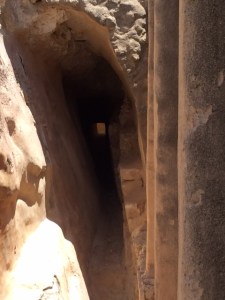
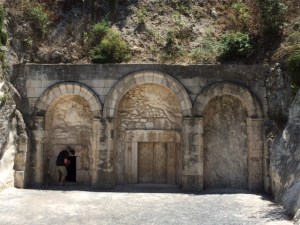
One of the entrances to the necropolis that has many branches.
IMG_4799
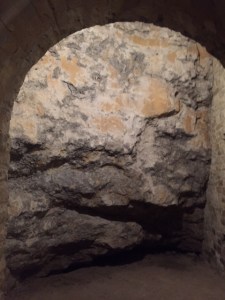
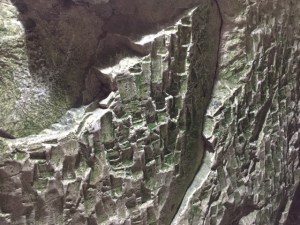
You can see the chisel marks inside the cave that shows how intensive the creation of this necropolis (city of the dead) was. Each of the caves has many branches that go way back into the hillside.
IMG_4795
This is a piece of a stone entrance door that was carved to simulate a wooden door.
IMG_4794
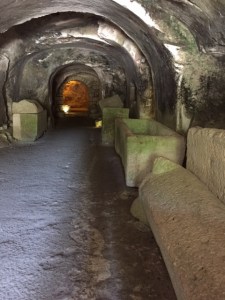
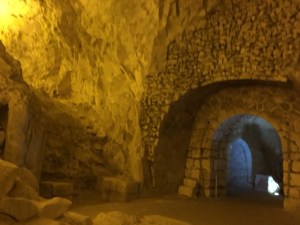
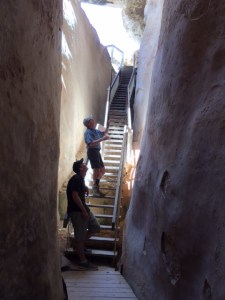
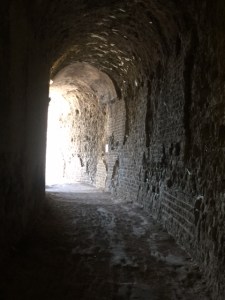
One of the first tunnels, one of the shorter ones. Just to give you an idea, Rabbi Judah Ha’nasi who is buried in one of these tunnels was carried from Zippori over 20 miles to be buried here.
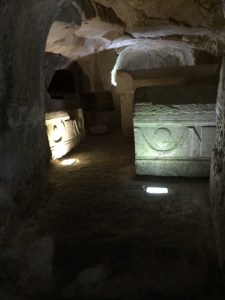
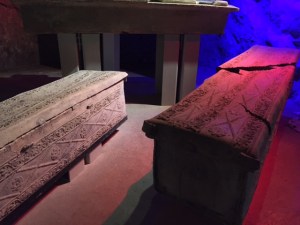
On either side of the cave shafts are sarcophagi and some burial niches. Of course, wealthier and more important people would have been buried in the stone sarcophagi (coffins)
IMG_4800
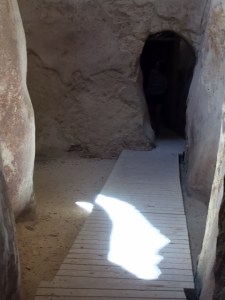
This entrance is to the largest of the caves and as you can see has been partially reconstructed, a good example of this.
IMG_4812
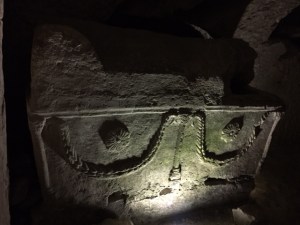
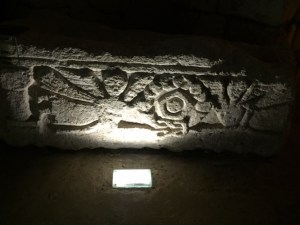
The decorations on the sides of the sarcophagi give a clue as to who might have been buried there (their religious tradition not who the individuals were).
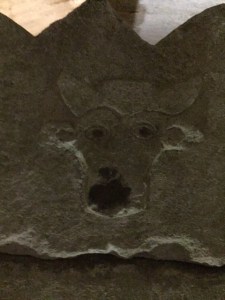
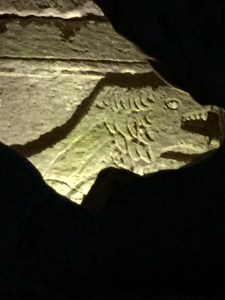
Lions as we have seen in many civilizations are a symbol of strength and royalty.
The symbol of the bull, also a symbol of strength
Decorative end panel
Decorative end panel featuring an eagle, not usually a Jewish symbol so this is more likely a Roman sarcophagus (the bull from previous image is on the cover).
Some of the images are more elaborate and some a bit more simple in their decoration.
Some of the images are more elaborate and some a bit more simple in their decoration. All the sarcophagi were broken into (broken top) by grave robbers who found nothing beside the bodies.
The symbol of Nike (winged victory) if you were a Roman or a winged angel if you were a Christian
The symbol of Nike (winged victory) if you were a Roman or a winged angel if you were a Christian.
More finely carved detail.
A little less finely carved though carved both top and bottom.
Telling a story of the "hunt"
Telling a story of the “hunt”
A final image through the wall of one shaft into another- yet again another lion.
A Hebrew inscription identifying the sarcophagus for a young child (15 months) a granddaughter of the great Rabbi Gamliel.
Continuing deeper into the main cave to a large room dug out.
This gives you a sense of the open space that we found with stacked plastic chairs. Because Rabbi Judah Ha'Nasi is buried here (his actual tomb was not accessible) people sometimes come here to pray or mark life cycle events such as weddings or bar mitzvahs (coming of age ceremonies) in the Jewish tradition.
This gives you a sense of the open space that we found with stacked plastic chairs. Because Rabbi Judah Ha’Nasi is buried here (his actual tomb was not accessible) people sometimes come here to pray or mark life cycle events such as weddings or bar mitzvahs (coming of age ceremonies) in the Jewish tradition.
A beautiful menorah carved into one wall of the open room.
Looking out towards the opening
Looking out towards the opening.
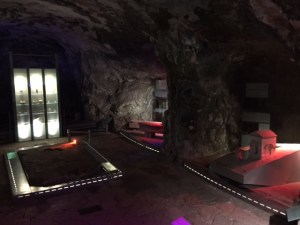
One of the caves turned into a museum of artifacts found inside the caves.
This giant slab of ancient glass was probably already in this location as I can't imagine how they might have moved it.  Produced between the 4th and 6th centuries using 10 tons of raw material (sand mostly) heated to over 1800 degrees fahrenheit for 5-10 days! The poor quality of the end product and that it was left here indicates they were not able to complete the job and who knows what its purpose was.
This giant slab of ancient glass was probably already in this location as I can’t imagine how they might have moved it. Produced between the 4th and 6th centuries using 10 tons of raw material (sand mostly) heated to over 1800 degrees fahrenheit for 5-10 days! The poor quality of the end product and that it was left here indicates they were not able to complete the job and who knows what its purpose was.
Coffins made of leather or lead.
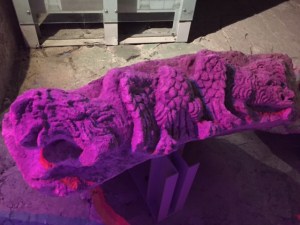
The following three slides are portions of a carved arch.  The pink color is just from the lighting.
The following three slides are portions of a carved arch. The pink color is just from the lighting.

IMG_4846IMG_4844

IMG_4652
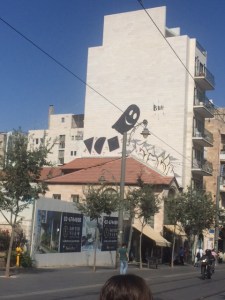
The posters you see on the side of the building in the background announce the death of someone in the community, when and where the funeral will be and “comforting” the family of the deceased.
IMG_4651
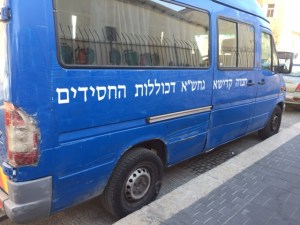
This van tells you that it is a van of the “Hevra Kadisha”, the burial society that takes care of the body preparing it for burial. This is something people do voluntarily and is considered a great mitzvah (righteous deed). It was parked in the same day two days in a row and on the third day it was moved so I assume they had to bury someone. In the Jewish tradition one is buried as close to 24 hours after death but in Jerusalem definitely within 24 hours even if it’s in the middle of the night.
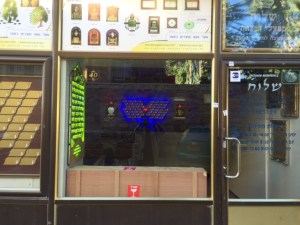
A shop that sells memorial plaques.  Jews honor their dead parents or children each year on the anniversary of their death.  A "business" exists to sell memorial plaques installed in the synagogue as a way to honor the dead and also a reminder to the mourners that this is the anniversary.  They have little lights that are lit.  It also tells the rest of the congregation so they can also acknowledge it.
A shop that sells memorial plaques. Jews honor their dead parents or children each year on the anniversary of their death. A “business” exists to sell memorial plaques installed in the synagogue as a way to honor the dead and also a reminder to the mourners that this is the anniversary. They have little lights that are lit. It also tells the rest of the congregation so they can also acknowledge it.


Always Digging

Zippori (Sephorris) is my most favorite site in northern Israel.  I’ve been here at least 4 or 5 times and every time there is something new to see as this is an active archaeological dig.  Those of you taking ancient art history will see some of the images from Zippori in the Voice Thread entitled “Syncretism”. Just an update on Zippori if you are new to this, it is in the lower Galilee and is another important crossroads to the coast.

It includes Hellenistic, Jewish, Roman, Islamic, Crusader, Arabic and Ottoman evidence of habitation there.  Let’s say it’s a treasure trove for archaeologists.

The cardo main street from 63 BCE
The Cardo main street from 63 BCE
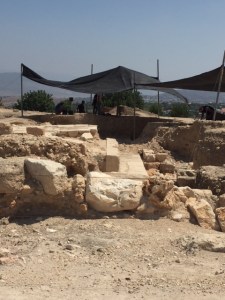
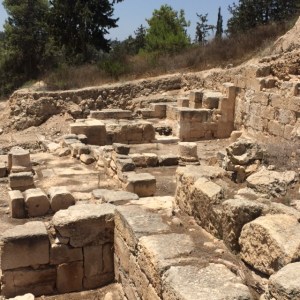
Digging on either side of the cardo (main street) probably preparing for the archaeology students who will come in the fall.
Digging on either side of the Cardo probably preparing for the archaeology students who will come in the fall.

IMG_4724

The grooves that you see in the stones are from carts going down the street.


Reproduction of one of the carts that would have traveled along the cardo.
Reproduction of one of the carts that would have traveled along the Cardo.
Zippori is famous for its mosaics and this is one I have not seen before adjacent to the road intersecting the Cardo.
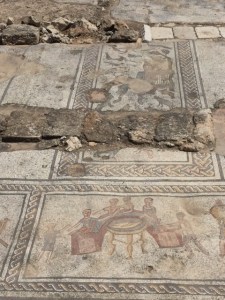
Orpheus Mosaic was unearthed in 1995 and it dates to the end of the 3rd century CE.  It shows scenes from daily life though is a good example of how syncretism works.  If you want to interpret a work to suit your beliefs perhaps you might think this is a scene of baptism and Christian friendship.
Orpheus Mosaic was unearthed in 1995 and it dates to the end of the 3rd century CE. It shows scenes from daily life though is a good example of how syncretism works. If you want to interpret a work to suit your beliefs perhaps you might think this is a scene of baptism.
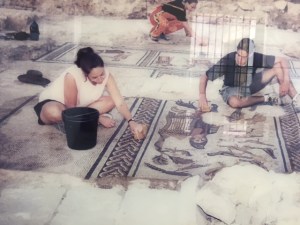
This shows how mosaics were found when excavated.  They can be rolled on to a drum and taken for restoration as many of them have been at Zippori.
This shows how mosaics were found when excavated. They can be rolled on to a drum and taken for restoration as many of them have been at Zippori.
The Nile House contains some of the most detailed mosaics at Zippori.
The floors are wetted to show the vivid colors of the mosaics, made from natural stones and pieces of glass.
Just walking around you find these exquisite little gems of detailed mosaic.
Amazons, something new I learned- they are mythological female beings who cut off one breast so it would not get in the way of their weapons.
Amazons, something new I learned- they are mythological female beings who cut off one breast so it would not get in the way of their weapons.  These figures also remind me of Mithras, the Roman cult from the 2nd century.
The citadel which was established by Crusaders and then fortified by Arab invaders is at the top of the Zippori site.
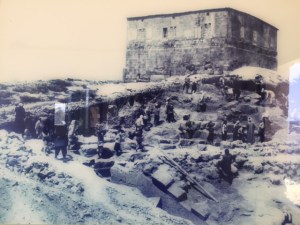
A photo of early excavations at Zippori. The citadel/fortress was erected  in the 12th century.
A photo of early excavations at Zippori. The citadel/fortress was erected in the 12th century.
Inside the citadel you can still see the Byzantine arches that are both structural and decorative.
Looking out from the citadel you can see the "neighborhood" of houses.  Archaeologists can tell a Jewish home from a Christian or Arab home from artifacts found in each one.
Looking out from the citadel you can see the “neighborhood” of houses. Archaeologists can tell a Jewish home from a Christian or Arab home from artifacts found in each one.
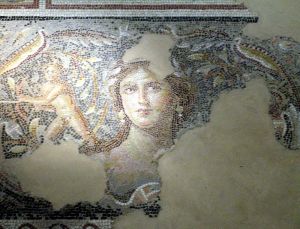
The famous Mona Lisa of the Galilee mosaic is part of a 54 square foot mosaic floor in the Dionysian House, probably the dining room.  It is comprised of 1000s of tiny stones and glass.
The famous Mona Lisa of the Galilee mosaic is part of a 54 square foot mosaic floor in the Dionysian House, probably the dining room. It is comprised of 1000s of tiny stones and glass.
This photo shows the beginning of restoration of the mosaic floor.
Mosaics even for the bathroom: this is an acrostic that says "To Health".  The rabbis who likely lived at Zippori taught "Who is wealthy?  He who has a privy near his table".
Mosaics even for the bathroom: this is an acrostic that says “To Health”. The rabbis who likely lived at Zippori taught “Who is wealthy? He who has a privy near his table”.
The synagogue has been identified by the elevated wall where the ark would be and the raised area called the bema (stage).  Unusual here is that this one faces West instead of East.
The synagogue has been identified by the elevated wall where the ark would be and the raised area called the bema (stage). Unusual here is that this one faces West instead of East.

Water and Light

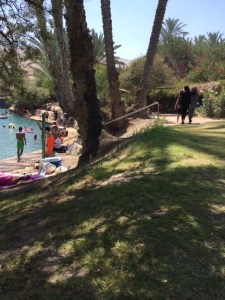
In a part of the world that is so arid seeing this abundance of water seems nothing less than miraculous.  This is Gan Ha’Shlosha or Sachne in Arabic, and yes it’s a national park enjoyed by all the residents of this part of the Galilee- Muslims, Jews, and Christians.  Refreshing in so many ways.  Nearby is an unexpected find that I had read about recently and wanted to check out.  It’s the Arts Hall at Kibbutz Ein Harod, now an abandoned kibbutz with only the museum still functioning. This was one of the first museums built in Israel, in the 1930s.  It was designed by one of the kibbutz members, Samuel Bickels.

It was inaugurated at the height of hostilities during Israel’s war of independence in 1947.  It was the belief of the members of Kibbutz Ein Harod that culture was a necessity, not a luxury and this museum was built even before other necessary facilities for comfort or success.


IMG_4692
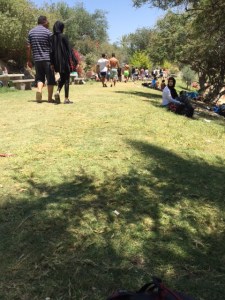
Springs were widened into pools with warm water all year round. You may be able to see the arid hills behind, a stark contrast.
IMG_4691
It’s a pleasure to see so many different kinds of people having a pleasurable afternoon together.
IMG_4694
Burkinis on the upper path, swim trunks and hookas by the water.
IMG_4695
And by way of sad contrast this peaceful line of walkers includes a number who have machine guns strapped across their chests, something one gets used to quickly in this part of the world.
IMG_4715
Front entrance of Arts Hall, Ein Harod. Kibbutz Ein Harod existed from 1921-1952 when it was abandoned and split into two communities. This garden of sculptures looks both like a Japanese dry garden as well as abandoned farm tools from the defunct kibbutz nearby.
IMG_4699
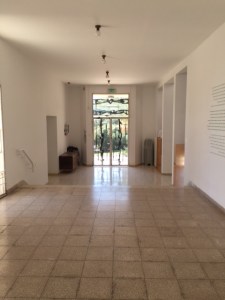
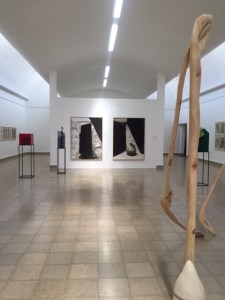
Museum considered one of the earliest examples of modernist museum architecture based exclusively on natural light. This museum was an inspiration to the famous architect Renzo Piano for his Menil Collection in Houston and numerous other architects have followed suit.
The natural light comes through skylights onto the walls.  As far as I could tell all of the art is by Israeli artists, much of which looks quite derivative and dated when looking at the permanent collection of the museum.
The natural light comes through skylights onto the walls. As far as I could tell all of the art is by Israeli artists, much of which looks quite derivative and dated when looking at the permanent collection of the museum.
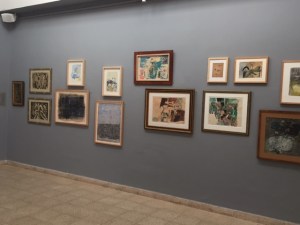
What is refreshing is the more contemporary works and the prints and drawings.  Here you can see how natural light is the only source of lighting in this room.
What is refreshing is the more contemporary works and the prints and drawings. Here you can see how natural light is the only source of lighting in this room.
A special exhibit of prints and drawings by Israeli impressionists.
A new use for steel wool and felt, "The Jezreel  Valley in the Dark" by Gal Weinstein, 2015
A new use for steel wool and felt, “The Jezreel Valley in the Dark” by Gal Weinstein, 2015
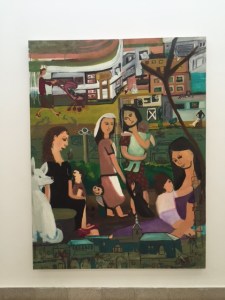
This and the next triptych painting reminded me of where we were earlier in the day, at Sachne.  A community of people enjoying themselves.  This one is titled "Yohanan and me" by Shira Gepstein Moshkovich, 2011
This and the next triptych painting reminded me of where we were earlier in the day, at Sachne. A community of people enjoying themselves. This one is titled “Yohanan and me” by Shira Gepstein Moshkovich, 2011
Jonathan Gold, "Green Bathers", 2015, pigment and glue on canvas
Jonathan Gold, “Green Bathers”, 2015, pigment and glue on canvas
Beautiful light in the contemporary gallery, especially falling on the large photographs as if they were part of the work.
More about water before finishing.  What you are looking at is the view of Nazareth on the top of the hill where water springs bring water down to the valley and to the ancient town of Zippori (more about that in the next post).
More about water before finishing. What you are looking at is the view of Nazareth on the top of the hill where water springs bring water down to the valley and to the ancient town of Zippori (more about that in the next post).
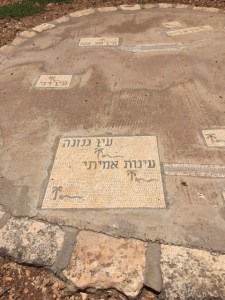
This mosaic map shows the springs that brought water into channels man-made to distribute water in ancient times.
Yes, this is a mosaic map of the channels flowing towards Zippori.
An active archaeological and reconstruction zone (more on this in the next post)
The channel through which that water flowed in ancient times.
The channels were dug through the earth and lined with plaster.  The plaster is now being repaired and preserved.
The channels were dug through the earth and lined with plaster. The plaster is now being repaired and preserved.
These tunnels were built in the 2nd century CE (not including the stairs)

IMG_4766IMG_4770

An Important City You Never Heard of

IMG_4661
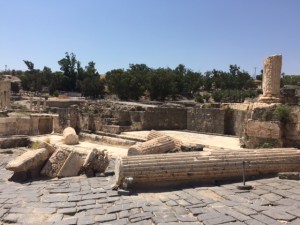
From the stage of the theater you can see down the main Cardo (main street) to the Tel, the hill that contains the other 15 cities in layers.
IMG_4662
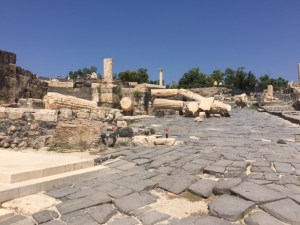
This colonnaded street is 150 meters long. It was built by the Romans and renovated at the beginning of the Byzantine period (4th century CE).
IMG_4672
On either side of the Palladius Street (main street) were rows of shops whose facades were faced with marble. Having a shop on this main thoroughfare probably meant a prosperous business and consequently high rent.
IMG_4667
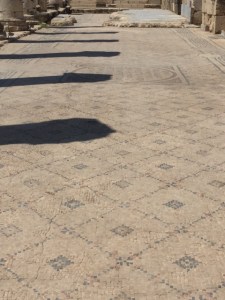
Inside the shops one can see remnants of pretty elaborate mosaic floors somewhat restored to their original glory.
IMG_4663
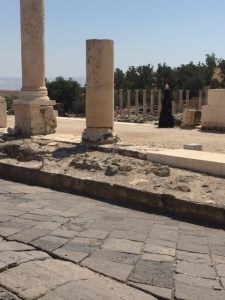
This cut out figure is meant to give a flavor of “life” in ancient Bet Shean. In the foreground of this picture you can see the stones of the Cardo.
IMG_4656
Exterior entrance to the theater.
IMG_4660
This is one of the best preserved Roman theaters with seating for 7000 built in the first century CE.
IMG_4665
The mass of these stones always begs the question of how they could have been transported and erected.
IMG_4657
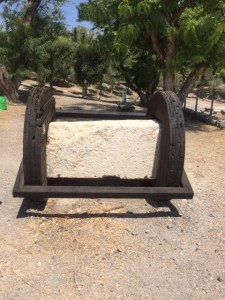
One theory of how they were transported in this recreation of a two wheeled machine for moving blocks of stone.
IMG_4658
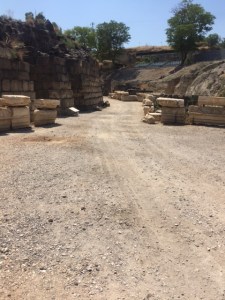
Since much of the city was destroyed in an earthquake there are many pieces that have not been put into place and you can see many of them lining the outside of the theater.
IMG_4659
Details carved into fragments from walls and capitals.
IMG_4670
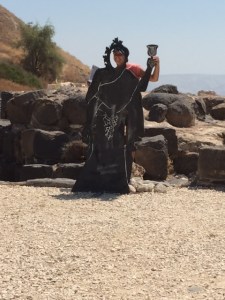
My daughter Yael as Dionysos
IMG_4671
Steps leading up to what was a large Roman temple built in the 2nd century CE. It was destroyed during the Byzantine period though you can see that some of the corinthian columns remained. The facade contained four large columns supporting a 15 meter gabled roof.
IMG_4674
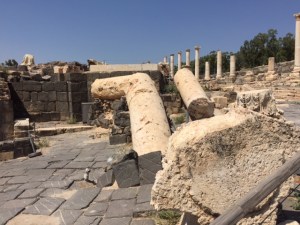
Some if the collapsed columns from the Roman temple that became uncovered in the earthquake of 749 CE.
IMG_4675
A public fountain of the 2nd century was remodeled in the 4th century. Water spilled into a pool situated in front of the structure, on the side facing the street. Decorative elements that have been found on the site but not quite identified may belong here.
IMG_4673
Evidence of the devastation from the earthquake of 749 CE that destroyed the city.
IMG_4676
More devastation and notice the size of the paving stones used for the main streets of the city.
IMG_4664
Mosaic floor that leads to the bathhouse. We were surprised that they allow visitors to walk on these ancient stones. I guess they are not as delicate as you might think.
IMG_4680
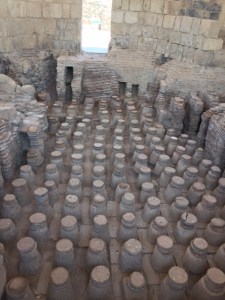
Built in Roman times and renovated in Byzantine times the bathhouse is quite well preserved. The cylinders that you see supported a floor that would have retained heated water pumped in from below. The fires were kept going by slaves outside the building.
IMG_4681
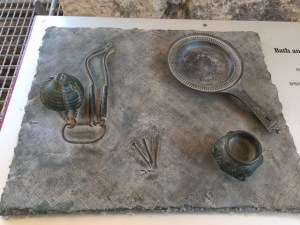
Bronze plaque recreating the tools of the bathhouse (left to right clockwise): oil flask, pair of strigils for scraping the oil from the skin, pouring dishes (patter) used for splashing cold water over the body to open pores after the heat of the bath, toiletry set for personal hygiene: ear scoop and nail cleaner.
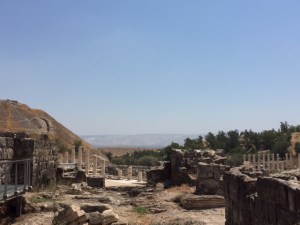
A view down the valley towards Lake Tiberius.
IMG_4678
Final view overlooking Bet Shean. One would never guess from the 106 degree temperature it was and how dry it all seems that there is lots of water in the area. More about that in the next blog post.

Always a Surprise

No matter how many times I come to Jerusalem there is something new to see.  I do a lot of walking, always the best way to see a city and Jerusalem has so many interesting places to walk.  It’s also quite hilly so you really get your exercise here.  It’s such a cross between religious neighborhoods of all “stripes”, the secular Western world (unusual in this part of the world), and a place that celebrates a global presence.

Taking a different route this morning, brought me to the backside of an abandoned Christian orphanage on a prime piece of Jerusalem real estate that is now being turned into modern luxury apartments.

IMG_4642
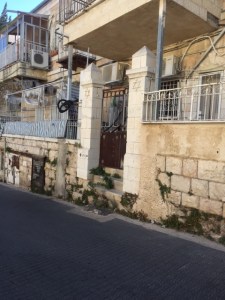
The columns on either side of this entry are distinctly marking a Jewish home and then at the bottom of the left hand column is a symbol directing you to the closest bomb shelter.
IMG_4645
Watching the world go by- boys and girls go to separate schools. The girls are now out for the summer while the boys have a few more weeks.
IMG_4596
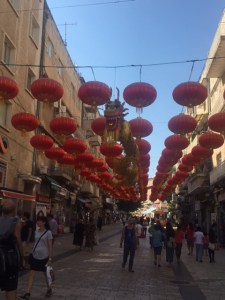
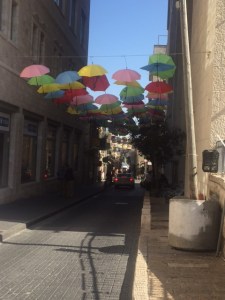
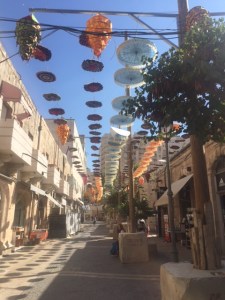
In downtown Jerusalem many of the side streets have these distinct objects for different cultures. Here is the tribute to China and this also gives you a sense of what the streets looks like.
IMG_4595
A tribute to Mexico
IMG_4593
A tribute to Brazil, and the upcoming Olympics. Every day we see new ones cropping up.
IMG_4594
Not sure about the umbrellas but they look great in the wind (very hot here so any wind is a blessing)
IMG_4592
Nepal: many Israelis travel to Nepal after they complete their army service. If you go to Nepal you are sure to meet Israeli travelers.
IMG_4653
Schneller Compound, founded in 1855 by Maronite Christians as an orphanage that until 1903 cared for over 1500 children.
Used as an army barracks by the Turks, then by the British, and finally by the Haganah (Israeli forces) in 1948. It became a public parking lot and now will be over 200 luxury apartments, supposedly preserving the 8 original buildings.


Graphics

We have discussed propaganda in the Ancient Art History class and in Art Appreciation we have looked at graphic design.  In both cases it’s interesting to consider how powerful graphics can be to convey a message.  What is particularly interesting to think about is that in the religious community here in Jerusalem people don’t watch television, movies, play video games, or use computer except for work or study.  So it’s very interesting that children’s backpacks have images from popular culture devoid of their “meaning”.  What captures a child’s attention when they don’t know the story behind it?

The Sumo wrestler on the back of the truck obviously gives you a sense of how “macho” the delivery capabilities are of this trucking company.  Do those following it even know it’s a sumo wrestler very scantily dressed?  People dress modestly so are they offended seeing this or just puzzled?IMG_4597IMG_4590IMG_4591

IMG_4587

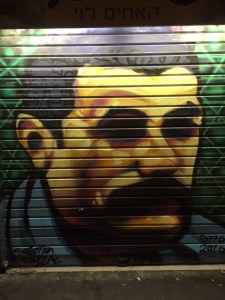
Machane Yehuda is a fabulous though gritty indoor market selling everything and anything. Two artists have taken upon themselves to spray paint portraits of famous Jewish figures on the metal shutters of every stall. It's a great visual late at night. If you want to know more I've attached a link.
Machane Yehuda is a fabulous though gritty indoor market selling everything and anything. Two artists have taken upon themselves to spray paint portraits of famous Jewish figures on the metal shutters of every stall. It’s a great visual late at night. If you want to know more I’ve attached a link.

IMG_4585


The stage is set

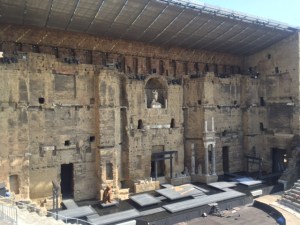
As a last stop in Provence before moving on to Israel we visited the Roman Theatre in Orange. This theatre is a UNESCO World Heritage site built in the first century CE against the hill almost to the top known as Colline-St. Europe.  Its acoustics are still considered some of the best in Europe.  The theatre has a tiered semicircle of seating that held up to 7,000 spectators for comedy as well as tragedy.  Today in addition to opera and stage performances many great musicians have appeared on the stage as well. From the 16th to the 19th centuries the interior was filled with slum housing.  In the 19th century restoration began including a new roof over the stage.

IMG_4553
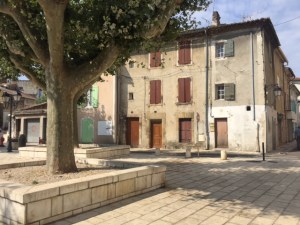
City founded in 35 BCE by veterans of the Roman legion. With a theatre and a triumphal arch it was a small Rome in Gaul. Eventually it was a center of the Protestant faith so at odds with the Church. This is a particularly French neighborhood square.
IMG_4554
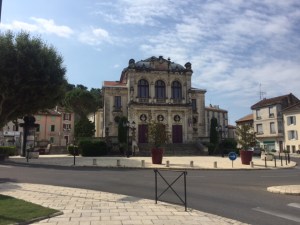
We’ve come to see the famous Roman theatre so it’s amusing to the Beaux Art theatre probably dating from the 19th century.
IMG_4552
Not a day has gone by this week without “running” into some Roman structure. In this case a large arch.
IMG_4545
Greek tragedies, comedies, and improvisations were performed in this theatre until Christianity banned them and the theatre fell into disuse.
IMG_4544
They were preparing for a performance today while we were there, not sure what it was but seems to be an Asian theme with the buddha figure and the wooden archway. Notice how it mirrors the columns engaged on the wall.
IMG_4538
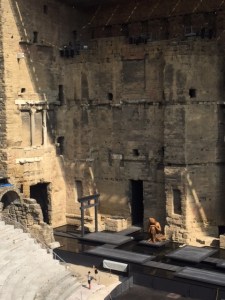
This is one of only three theatre that still have their stage wall. The other two are in Turkey and Syria.
IMG_4539
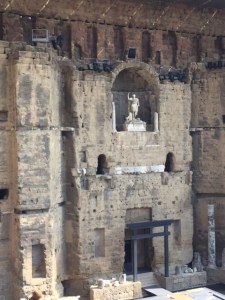
That is the emperor Augustus framed by the arch way up high. He is presiding over all events in the theatre even though he is probably a reproduction of the original.
IMG_4548
This is a good way to see how the seats of the theatre are imbedded into the hill behind it.
IMG_4550
Elements discovered on the site during restoration have been put together in some interesting ways.
IMG_4543
This is farewell to France for now. More from Israel in a few days.

In the Neighborhood

This little area of Provence is so dense with things to do and see that it’s almost overwhelming.  If the rest of southern France is half as full one could spend years exploring.  Of course that means return trips, not the worst thing.  Everywhere one goes there is something else in the “neighborhood” worth seeing and all of this is 1 hour or less from where we are staying near Le Thor (or L’Isle Sur la Sorgue).  So starting with that closest neighborhood the Sorgue is a river that lies between the Alps and the Rhone River with its source the biggest spring in France.

Because the lavender is in full bloom, a trip to the Abbaye de Senanque was an appropriate stop and in the “neighborhood” is the beautiful hill town of Gordes.  We did not stop there but the view from the road was spectacular.  So was the Abbaye. This was the only pocket that we really felt the oppressiveness of too many tourists.  Unfortunately Gordes has been discovered by movie stars and now all the rest.

The water from the Pont du Garde was destined for the city of Uzes, a medieval city mostly not on the tourist radar so a quiet stroll around led to some lovely surprises and lastly, Nimes has another almost totally intact arena that is in restoration.

OLYMPUS DIGITAL CAMERA
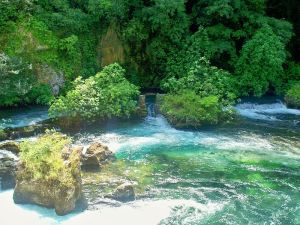
The source of the river which fills this cavity in the cliff that is a sheer 700 feet high.
IMG_4529
The spring surges over these rocks in March every year for about 5 weeks into the river below
800px-Fontaine_de_Vaucluse3
Even when the spring is not at its height the Sorgue which is some of the clearest water I’ve ever seen in a river rushes very fast.
IMG_4525
That is the Sorgue river below (where you see the green) with a fortress above. This area was a trade route for the Phoenicians and of course later the Romans. Roman coins have been found in underwater caves and Jacques Cousteau almost perished in 1946 trying to find the source of the spring.
IMG_4530
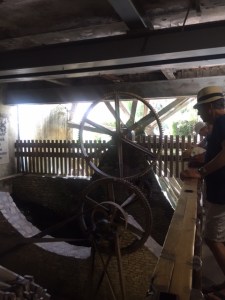
A paper mill on the banks of the river, you can see the original beaters making paper pulp with energy coming from two water wheels.
IMG_4531
Water wheels for turning the paper beaters.
IMG_4533
Finishing off the sheets of paper for sale. Petrarque lived here so there are many letterpresses poems by him for sale.
DOT_France_29_Provence_Gordes_20
It’s always a pleasure to experience something unexpected and so coming upon the view of Gordes from across the valley was wonderful. It is considered one of the most beautiful in France and you can see why. First occupied by the Romans and in more recent history was a center of the Resistance during World War II.
IMG_4534
The Abbey was founded in 1148 by Cistercian monks and grew in popularity until the 13th or 14th century including mills and expanded estates. It is built in the Romanesque style in a cruciform shape with a protruding apse at the end and a cloister inside.
IMG_4535
As you can see the monks now grow lavender extensively.
IMG_4503
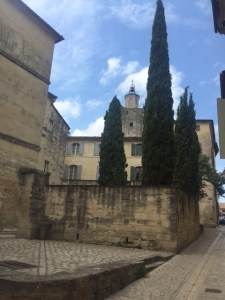
Uzes was established in the 5th century as a major town although the aqueduct Pont du Garde was built to bring water to it in the first century BCE. It was known as an open minded city, hence there was a Jewish community though they were subsequently expelled by the end of the 6th century.
IMG_4504
In the 8th century fortifications were established and many towers possibly as a result of the expansion of Andalusia (Islamic Spain) into the southern regions of France.
IMG_4502
Cloth was a major industry and so Uzes became a Protestant stronghold in the 16th century and as a result of the strife many of the churches were stripped of their relics and artworks. This is a perfect example of our discussion on iconoclasm.
IMG_4506
This little fellow reflects the current sweet feeling one gets in this quiet town (probably not on Saturday market day which we fortunately missed) though it belies the strife that occurred here and elsewhere in this region since the beginning of time.
IMG_4509
Fortunes of this town came and went. A scholarly Jewish community reestablished itself in the 13th century, the French Revolution reduced the power of the wealthy cloth industry, and then became a sleepy hamlet.
IMG_4520
On the other side of the Pont du Garde is Nimes, sometimes called the French Rome because of the important Roman monuments here. It is located along the ancient Roman road connecting Italy to Spain. It’s hard to imagine it from this photo but there was a Neolithic settlement here dated from 4000 BCE.
IMG_4521
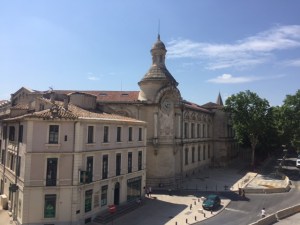
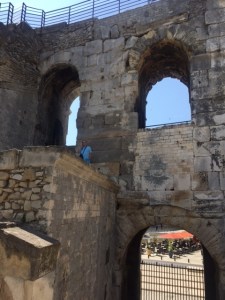
This arena did not impress me as much as the one in Arles maybe because it seems so chopped up as it’s in the process of renovation as is much of downtown Nimes. The arena was first built in 70 CE and then remodeled into a bull ring in the 19th century. I was surprised here too that bull fights still take place. Many events are held here and it has a movable cover. People are surprised to know that arenas even in ancient times had such covers.
IMG_4519
Extensive renovations are in process and since this arena is more stone while Arles is more concrete this will probably take longer. The section that is completed is very nicely preserved.
IMG_4518
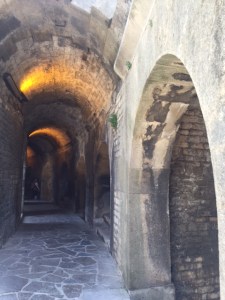
As with other arenas this one has been someone’s private dwelling and then a “slum” community until the 18th century when it was slowly converted back into an arena.

Skills of the ancients

In our classes this summer we have had conversations about the amazement we feel about structures such as Stonehenge or the pyramids or even the Nazca Lines and we sell human skills short by thinking someone from “the olden days” could not possibly have created such things.  In this part of France there are many opportunities to marvel at the skills of our ancestors.

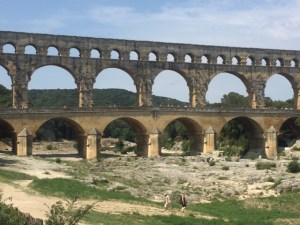
The Pont du Gard is one such structure, standing through wars, earthquakes, and floods since 19 BCE.  The Maison Carre in Nimes, is the world’s best preserved Roman Temple from 16 BCE.

pont du garde
The Pont du Garde crosses the Gardon river and is part of an aqueduct that carried water from a spring near Uzes to Nimes.
IMG_4498
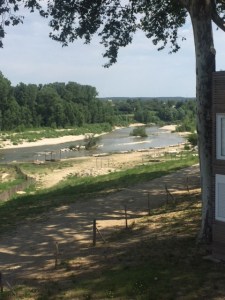
The river is quite low now as it’s summer but in 2002 flooded to the extent that piers had to be added, one of the only modifications to the aqueduct.
IMG_4490
The water channel covered by stone slabs on the top carried 4.4 million gallons of water 31 miles. Unknown how long the aqueduct remained in use but may still have been functioning in the 9th century.
IMG_4486
Limestone blocks some as heavy as 6 tons were erected without mortar.
IMG_4501
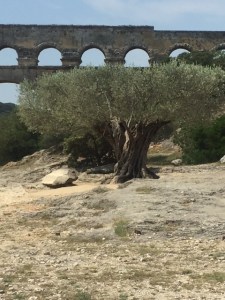
1000 year old olive tree and the aqueduct which was the tallest of all the aqueducts in the Roman Empire.
IMG_4494
Lower section has built onto adding a road in the 18th century as this became a tourist destination and one could drive on this section until 1996.
pdg_08-09-10_45
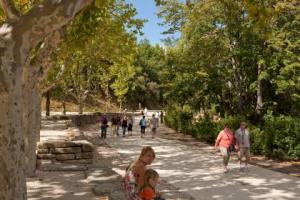
In 2000 in keeping with this as a World Heritage Site and to preserve the environment surrounding it an extensive visitor center with parking, a museum, and well designed paths were installed.
IMG_4510
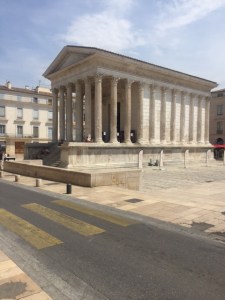
While I’ve seen photos of the Maison Carre, coming upon it right in the center of Nimes in its stark whiteness was startling. Apparently it was cleaned in 2014.
IMG_4517
Built by Marcus Agrippa it is Hellenic with Corinthian columns both freestanding and engaged. Louis XIV’s chief minister wanted it taken apart brick by brick and re-erected at Versailles. Fortunately that did not happen.
IMG_4516
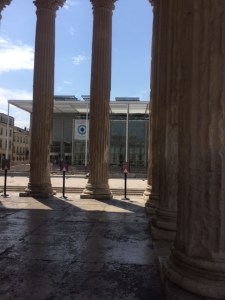
Looking through the temple portico across the square is the Carre d’Art (Contemporary Art Museum) designed by architect Norman Foster. It’s interesting how it mimics a portico and columns.
IMG_4513
You can see why this is considered the best preserved temple. It’s detail is pristine and looks almost new.
IMG_4515
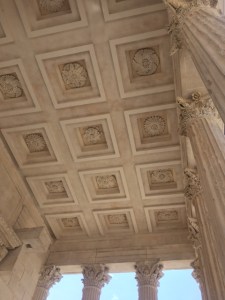
Inside the portico looking up at the ceiling details.

Hill and Dale

The countryside of Provence is quite beautiful and distinctly Mediterranean.  I never realized how overwhelmingly dense in things to do and see.  There is no way not to make this a return region to visit.  There is something to see or do everywhere you turn.  When we think of “old” in California we are amazed to find something a few hundred years old though there are Native American sites.  Here almost everywhere you step there is something ancient and certainly there has been quite a bit of attention focused on this region.

I always think of this type of road with the tall trees on either side as a distinct feature of French landscape. The only thing missing is an elderly man with a beret riding a bicycle with a baguette on the back.
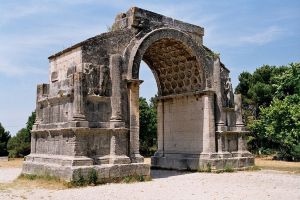
This triumphal arch built in 25 BCE can be found across the road from the hospital in St. Remy where van Gogh spent some time. It marked the northern end of the city of Galum, a fortified city later abandoned in 260 CE. It is the best preserved of this type of arch in France.
Also known as the Julii Mausoleum located in the same place was built earlier in 40 BCE, acknowledging one of the most distinguished family names in the Roman Empire and currently the best preserved in France.
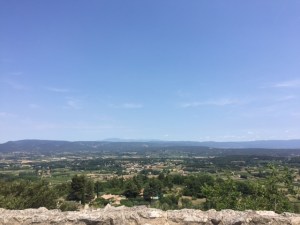
Looking out from Opede Le Vieux over the Luberon region.
Looking out from Oppede Le Vieux over the Luberon region.
Oppede Le Vieux is a village at the top of a hill dating from the 12th century.
This village was hard to get to and a bit dark and dank so by the 19th century it was mostly abandoned for a new village further down in the valley. Only facilities for visitors remain and a few hearty souls.
Through this arch one starts the climb up to the village and the small cathedral at the top.
This restored cathedral contains a number of trompe l'oeil frescoes mostly gone with bits preserved here and there, a Roman column and capital supporting a perch for the priest.
This restored cathedral contains a number of trompe l’oeil frescoes mostly gone with bits preserved here and there, a Roman column and capital supporting a perch for the priest.
At the very top the fortress looks out over the whole valley and appears to be in some stage of restoration.
Crusader fortress had direct connections to the popes in Avignon.
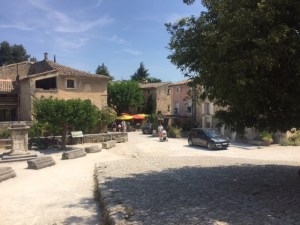
Wending our way back through the village and down to the new village of Oppede.
This 10th century hilltop village would probably be a sleepy backwater except for the fame of "A Year in Provence" which put it and the Luberon region on the map.
This 10th century hilltop village, Menerbes, would probably be a sleepy backwater except for the fame of “A Year in Provence” which put it and the Luberon region on the map.
Another arched alleyway. Menembres was the home of Dora Maar, a surrealist photographer and one of Picasso's lovers.
Another arched alleyway. Menerbres was the home of Dora Maar, a surrealist photographer and one of Picasso’s lovers.
Menerbres was the site of a famous battle between the Catholics and the Huguenots which lasted for five years.
This view from town looks like what you might imagine as the inspiration for "A Year in Provence"
This view from town looks like what you might imagine as the inspiration for “A Year in Provence”