Modernisme

We’ve seen Roman, Medieval, and contemporary Barcelona.  The movement that has had the biggest impact is known as Modernisme.  Combining the historical past with new technologies at the end of the 19th century and the beginning of the 20th century combined to make this a most interesting architectural movement. It is colorful, flamboyant, and honors natural and organic forms.  It began in 1888 at the Universal Exposition and culminated around 1930.  It parallels the artistic movements of Art Nouveau and Arts and Crafts throughout Europe and the US.  In the 19th century the city expanded to the north creating Eixample, a new neighborhood that allowed architects to experiment, hence came Modernisme.  One of the best examples of this style is the Palau Musica de Catalunya.  The architect Domenech i Montaner designed every single piece inside and outside of this amazing musical venue that is a UNESCO site and has a variety of 300 musical performances annually.  It took only three years to fully complete which is unheard of but Montaner supervised every single thing and iron was used for the structure itself which made erecting the building more efficient.

The exterior corner of the Palau Musica de Catalunya. The building was completed in 1908 in the "old" part of Barcelona.
The exterior corner of the Palau Musica de Catalunya. The building was completed in 1908 in the “old” part of Barcelona. And of course, there is St. George slaying the dragon at the very top.
It's hard to get a true perspective on the exterior as it's crowded in among other buildings and until recently had a church right up against it's Western side that blocked the light. It was renovated in 2008 after the church was demolished.
It’s hard to get a true perspective on the exterior as it’s crowded in among other buildings and until recently had a church right up against it’s Western side that blocked the light. It was renovated in 2008 after the church was demolished.
You can see how this building is a combination of old and new (Modernisme).
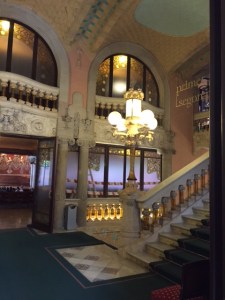
The grand entry. One can imagine the elite of Barcelona parading up and down the stairs.
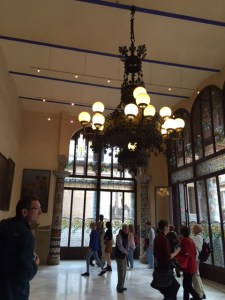
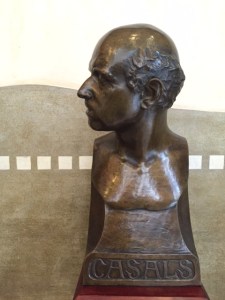
The upper foyer houses busts of many famous performers (all local) and the next slide is one of the only ones I recognized.
Pablo Casals
Pablo Casals
Close up of the mosaic columns in the front balcony of the hall.
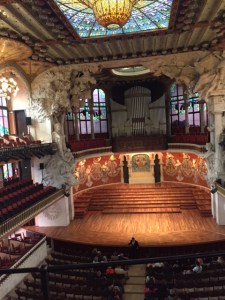
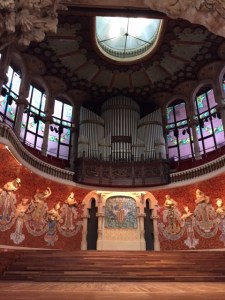
From the upper balcony looking down. The hall seats about 2000 and is the only concert hall in Europe lit by natural light.
The hall seats 2000 people. All performances are on the stage and opera is performed in concert form, no scenery changes.
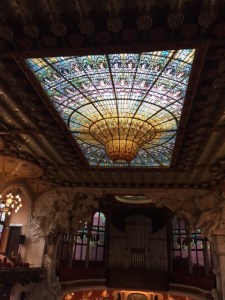
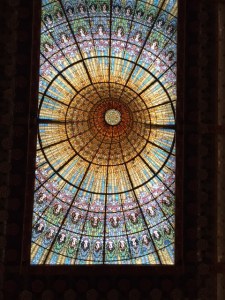
Ceiling from below
Ceiling from below
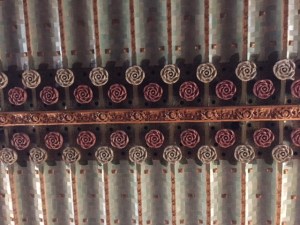
Ceiling detail all around the central window.
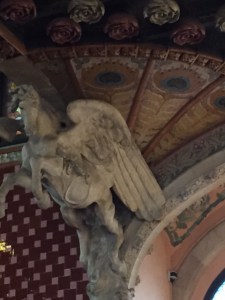
The corners of the hall are covered in mosaic with very large sculptures projecting into the space.
Floor to ceiling windows add additional light into the hall.
The organ was played for us. The acoustics are quite remarkable.
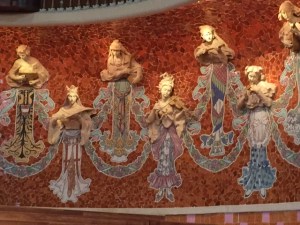
On both sides of the stage are figures with protruding heads and instruments in relief and mosaic bodies. There are nine female figures on each side.
Each figure is unique and depicts a different era or type of music.
To the left front of the stage is the original inspirational leader of Catalan music (Clave) who is responsible for creating this showcase. He represents the local music heritage.
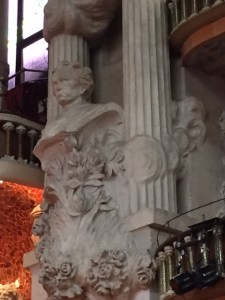
On the right hand side is Beethoven, representing the international musical heritage which is also performed in this hall.
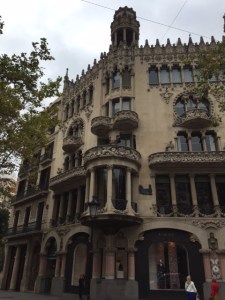
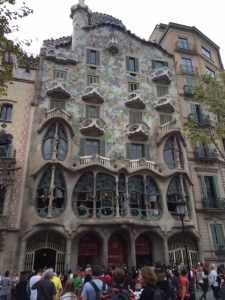
In the newer part of town (Eixample) is another example of Modernisme.  It is a row of three building that occupy one block.  They are by three different architects and the block is called "Illa de la Discordia" because of the range of styles.
In the newer part of town (Eixample) is another example of Modernisme. It is a row of three building that occupy one block. They are by three different architects and the block is called “Illa de la Discordia” because of the range of styles.
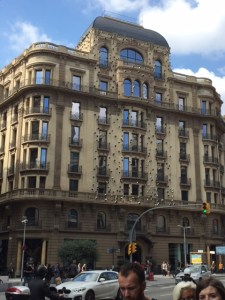
First is by the same architect as the Palau Musica, Montaner designed in 1902.  You can see how the old and new mix together in this building.
First is by the same architect as the Palau Musica, Montaner designed in 1902. You can see how the old and new mix together in this building.
Next is Casa Amattler, designed by Puig i Cadfalch in 1898.  It has a stepped gable roof blending Moorish and Gothic windows with Modernisme.
Next is Casa Amattler, designed by Puig i Cadfalch in 1898. It has a stepped gable roof blending Moorish and Gothic windows with Modernisme.
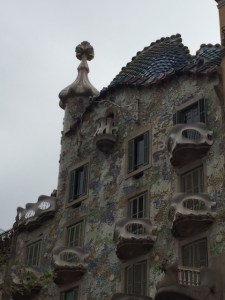
The third building is Casa Batllo by Antoni Gaudi has the most unusual facade with its undulating natural forms.  It is a renovation of a previously existing building and the renovation was done in 1906.
The third building is Casa Batllo by Antoni Gaudi has the most unusual facade with its undulating natural forms. It is a renovation of a previously existing building and the renovation was done in 1906.
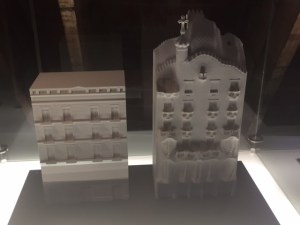
Here is a model showing the before and after renovation of the facade.
Notice the dragon form on the roof (remember St. George and the Dragon)...
Notice the dragon form on the roof (remember St. George and the Dragon)…

It takes a lot of imagination

In Catalonia the Jewish quarter of a town or city is known as the Call (from the Hebrew word kahal, meaning community).  In 1391 the Jewish population of Barcelona was eliminated either from a pogrom (massacre), fled if they could afford to, or were forcibly converted to Christianity.  The Jewish quarter is right in the center of Barcelona and we had a fantastic guide for this part of the visit as there is so much we would not have seen otherwise.  One needs an imagination to conjure a flourising community that disappeared over 600 years ago.

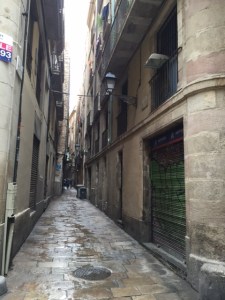
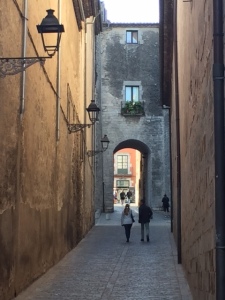
We are inside the area that would have been the Jewish quarter. The streets are the narrowest in the city, only wide enough for a cart and horse to fit. When a community is confined they make the most of the space they have.
We are inside the area that would have been the Jewish quarter. The streets are the narrowest in the city, only wide enough for a cart and horse to fit. When a community is confined they make the most of the space they have. This is the entrance that would have had a gate (open during the day closed at night). This post requires an imagination (and a guide helps too).
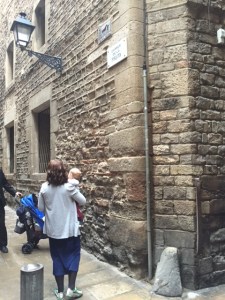
Standing by the oldest building in Barcelona that was home to a very important scholar and rabbi named Rashba who was a student of Ramban (are you confused)?! Notice at the corner the bump for getting off and on your horse.
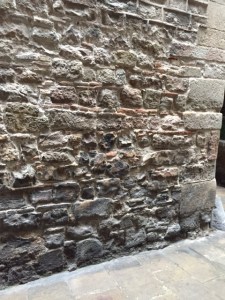
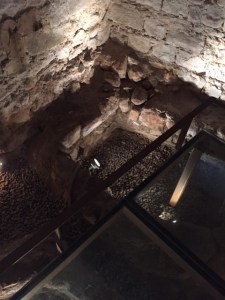
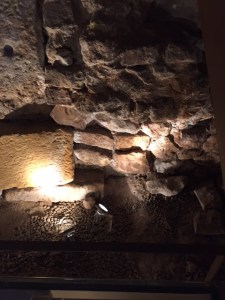
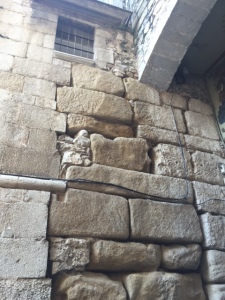
The oldest stone of this wall is from Roman times.
Stone above is from Middle Ages. Again if you have limited space you build up.
Across the alley from the oldest building you can see the crossroads of two main thoroughfares in the quarter. Look up and you'll see a niche. In the Middle Ages people were illiterate so instead of a street sign there would be a marker or statue to tell the location.
Across the alley from the oldest building you can see the crossroads of two main thoroughfares in the quarter. Look up and you’ll see a niche. In the Middle Ages people were illiterate so instead of a street sign there would be a marker or statue to tell the location.
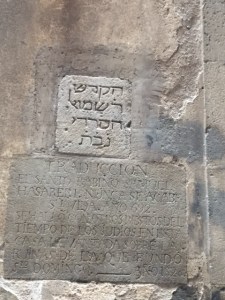
A marker stone to identify one of the home, in this case Samuel from Sardinia. Since Barcelona was a commercial center Jewish merchants from throughout Europe passed through. They had a distinct advantage, a common language with other Jews so they sought them out whenever possible.
The groove marks the spot where there would have been a mezuzah (kind of amulet attached to the doorpost of every Jewish home). Of course during the time of the Inquisition this identification would have been quite dangerous.
There is a joke about Jewish people who have the synagogue they attend and the one they would never go to. Historians believe this is the location of one of many synagogues in the Jewish quarter at its height.
There is one synagogue discovered in the quarter, called the Sinagoga Major it was probably built as early as the 4th century CE. It was uncovered in 1987.
There is one synagogue discovered in the quarter, probably built as early as the 4th century CE. It was uncovered in 1987. The verification process was quite interesting since records were kept only about taxes and synagogues were not required to pay taxes. However, the tax collector’s route was recorded and indicated he passed it by. The building also is oriented east west instead of north south as the rest of the quarter is. Synagogues face Jerusalem, which is to the east.
Floor of the synagogue dating to Roman times also has dye vats used by a family that occupied the space after it was no longer a synagogue.
Another portion of the Roman floor sunken many feet below street level now.
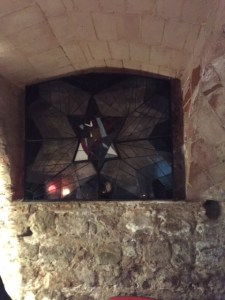
A stained glass window delineating the women's section of the synagogue. There is a solid wall behind the window as another building was erected there after the synagogue was abandoned. Perhaps one day it will be excavated.
A stained glass window delineating the women’s section of the synagogue. There is a solid wall behind the window as another building was erected there after the synagogue was abandoned. Perhaps one day it will be excavated.
Just outside the Call there is a square that is now the city general assembly. If you look to the back you will see one wall that is angled, that was the site of another synagogue and this remaining wall faces East towards Jerusalem.
Just outside the Call there is a square that now has two important municipal government buildings. If you look to the back of this building you will see one wall that is angled, that was the site of another synagogue and this remaining wall faces East towards Jerusalem. You can see how it is oriented differently from the rest.
Leaving the Jewish quarter we once again make our way along the Roman road.
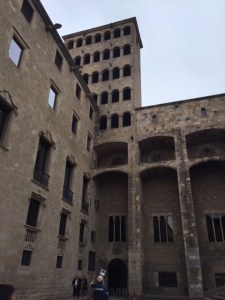
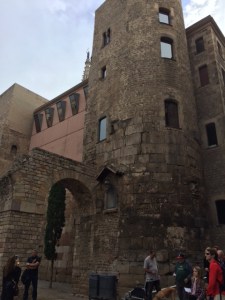
You can see remnants of a Roman aqueduct and a Medieval tower.
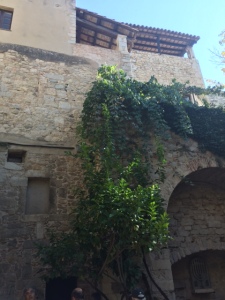
Once again the multiple building levels, Roman stone on the bottom, Medieval stone in the middle, and 20th century additions (pink) on either side.
Multiple building levels are quite apparent here, Roman stone on the bottom, Medieval stone in the middle, and 20th century additions (pink) on either side.
Compare this main cathedral of the city of Barcelona (begun 1298 under Jaume II). It was not finished until the early 20th century. Notice how ornate it is compared to the one in Girona- Barcelona was much richer.
Compare this main cathedral of the city of Barcelona (begun 1298). It was not finished until the early 20th century. Notice how ornate it is compared to the one in Girona.  Barcelona was much richer and could afford a grander cathedral.
Entry doors of Barcelona Cathedral, ca. 1889.
George and the Dragon- dragons are a common theme in Barcelona. You'll see more of them when we look at Gaudi's work. One might thing George and the Dragon are the mascots of the city.
George and the Dragon- dragons are a common theme in Barcelona. You’ll see more of them when we look at Gaudi’s work. One might think George and the Dragon are the mascots of the city.
Around the corner (notice the Catalan independence flag) we get a big surprise. For those of you who are in the ancient art history classes the timing is perfect as we are talking about syncretism in class (adopting other people's imagery, etc).
Around the corner (notice the Catalan independence flag) we get a big surprise. For those of you who are in the ancient art history classes the timing is perfect as we are talking about syncretism in class (adopting other people’s imagery, etc).
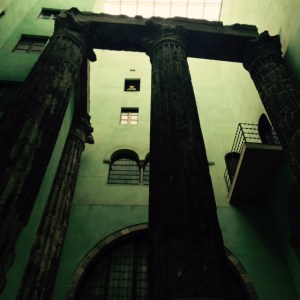
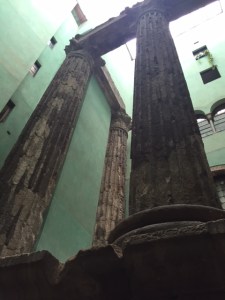
At the end of that alley we entered a room and found the Temple of Augustus from Roman times, or at least what's left of it. It is very close to the cathedral- remember the discussion about one group asserting power of the other by building on top of their sacred space?
At the end of that alley we entered a room and found the Temple of Augustus from Roman times, or at least what’s left of it. It is very close to the cathedral.  Remember the discussion about one group asserting power of the other by building on top of their sacred space?
Not only did they build over the temple but it ended up being buried inside some apartments. Early etchings from the 19th century show people in their apartments with free floating column portions in the living room.
The Jews were under the protection of Jaume I, as they were useful to him for business, medical attention, etc. and of course, he charged them the highest taxes which they were almost happy to pay to buy the king's protection. This is the king's palace and the courtyard here was the site of a famous disputation between Nachmanides (Ramban from Girona) and a Christian cleric. Ramban realized if he "won" the debate it could go very badly for the Jewish community so he argued well enough so that the Jews assumed they had won and the Christians assumed they had won. Most believed the Ramban had won and as punishment he was banished from Spain. He settled in Palestine, never to return.
The Jews were under the protection of Jaume I, as they were useful to him for commerce, medical attention, etc. and of course, he charged them the highest taxes which they were almost happy to pay to buy the king’s protection. This is the king’s palace and the courtyard here was the site of a famous disputation between Nachmanides (Ramban from Girona) and a Christian cleric over Christianity’s main beliefs. Ramban realized if he “won” the debate it could go very badly for the Jewish community so he argued well enough so that the Jews assumed they had won and the Christians assumed they had won. Regardless, as punishment Ramban was banished from Spain. He settled in Palestine, never to return.
Tower in the king's palace so he could see the sea and who he might be able to tax for landing a ship on his shore.
Tower in the king’s palace so he could see the sea and who he might be able to tax for landing a ship on his shore.
See the door up high that doesn't have any access to it? That is a door in the cathedral wall that had a bridge to the king's palace so he could pass without having to come in contact with any of his subjects.
See the door up high that doesn’t have any access to it? That is a door in the cathedral wall that had a bridge to the king’s palace so he could pass without having to come in contact with any of his subjects.
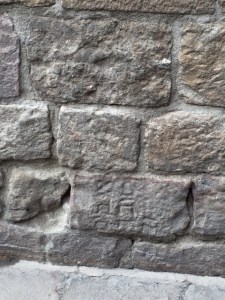
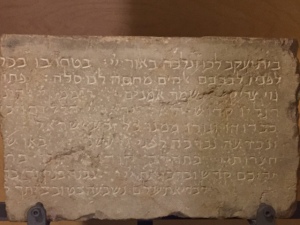
At the base of one of the walls there is a stone with engraved Hebrew letters (turned on its side).  This is a Jewish gravestone.
At the base of one of the walls there is a stone with engraved Hebrew letters (turned on its side). This is a Jewish gravestone.
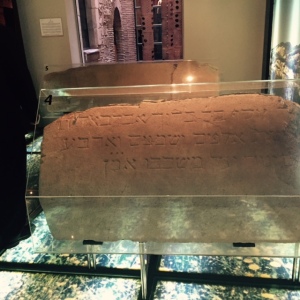
Another portion of a Jewish gravestone.  Remember, the Jewish community of Barcelona vanished at the end of the 14th century.  Many of these buildings were built 200 years later.  These were repurposed stones that happened to be already the right shape and it's likely the builders did not even know what they were.
Another portion of a Jewish gravestone. Remember, the Jewish community of Barcelona vanished at the end of the 14th century. Many of these buildings were built at least 100 years later. These were repurposed stones that happened to be already the right shape and it’s likely the builders did not even know what they were.
Here is one more higher up on the wall.  The ironic thing about this one is it's just down the street from the Inquisition torture chambers.
Here is one more higher up on the wall. The ironic thing about this one is it’s just down the street from the Inquisition torture chambers. The writing is three rows below the wire going horizontally from the lamp in the center.
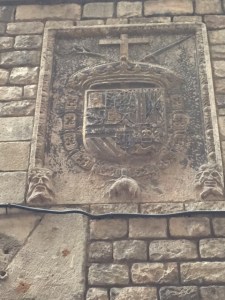
The insignia for the Inquisition.  Notice the pig at the bottom.  Spaniards are quite obsessed with pork and this is and was an issue for observant Jews who do not eat pork.  This became a life or death issue in those days.
The insignia for the Inquisition. Notice the pig at the bottom. Spaniards are quite obsessed with pork and this was and is an issue for observant Jews who do not eat pork. This became a life or death issue in those days.
The facade on this 18th century building is quite lovely but check out the street sign- Banys Noy Street (New Bath Street).  This brought us to the end of our tour and walked on this street full of tourist shops some of which sold Jewish souvenirs along with chic clothing, shoes, and edible treats because they know who comes to this neighborhood.  We arrived at one store and our guide took us inside.
The facade on this 18th century building is quite lovely but check out the street sign- Banys Noy Street (New Bath Street). This brought us to the end of our tour and we walked on this street full of tourist shops some of which sold Jewish souvenirs along with chic clothing, shoes, and edible treats because they know who comes to this neighborhood. We arrived at one store and our guide took us inside.
This is what we found at the back of the store- it's the Mikveh (ritual bath). When the store wanted to expand they broke through an existing wall and found this.  They needed to bring in the antiquities authorities who excavated the entire area and determined this was where the Jewish community in the 14th century had their Mikveh.  If you remember, the Black Plague killed 60% of the population but very few of them were Jews.  So the Jews were blamed for the plague.  It was simple hygiene that saved the Jews and here is where they practiced it.  It's now part of a knick knack store and the original Jewish community is gone.  But our guide for this tour is Jewish and everyone on our tour (6 adults and my grandson) are Jewish, and Barcelona has a small but vibrant Jewish community again.
This is what we found at the back of the store- it’s the Mikveh (ritual bath). When the store wanted to expand they broke through an existing wall and found this. They needed to bring in the antiquities authorities who excavated the entire area and determined this was where the Jewish community in the 14th century had their Mikveh. If you remember, the Black Plague killed 60% of the population but very few of them were Jews. So the Jews were blamed for the plague. It was simple hygiene that saved the Jews from the plague but not from the Inquisition. Here is where they practiced their ritual hygiene. It’s now part of a knick knack store and the original Jewish community is gone. But our guide for this tour is Jewish and everyone on our tour (6 adults and my grandson) are Jewish, and Barcelona has a small but vibrant Jewish community again.

Dali Needed an Editor

After Girona we traveled to Figueres, a city associated with Salvador Dali, and not much else.  The Theatre-Museu Dali (Theatre Museum Dali) is the town’s biggest and probably only attraction.  Dali was born in Figueres in 1904 and lived there until 1922 when he moved to Madrid for art school from which he was expelled four times but not before meeting Federico Garcia Lorca and Luis Bunuel who would have major influences on him and turning him in the direction of surrealism.

In 1929 he met the love of his life, Gala, from whom he was inseparable until her death in 1982.  She was his muse and appears either obviously or in disguise in many of his works.  They moved to Paris during the Spanish Civil War and to the US during World War II.  In the US Dali became famous and eventually moved back to Spain and died in the Dali Theatre Museum in 1989.

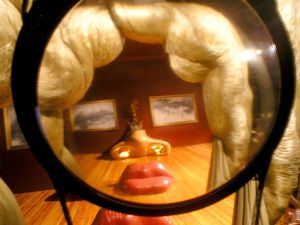
The Teatre-Museu Dali is a neoclassical building constructed in 1848 and an Italian style theatre.  It was converted to the Dali Museum in 1974.  The entire structure of the museum and the contents was designed by Dali himself and you can imagine he had a pretty good time doing it.  However, being an ego maniac he did almost no editing so there are some great works to be seen and quite a bit that should not be seen (in my opinion).  Because Dali’s work is impossible to explain I’m going to share what we saw with little or no explanation.

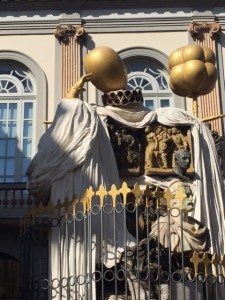
Exterior of the Teatre-Museu Dali

IMG_3591

The church right next door to the museum where Dali was baptized.
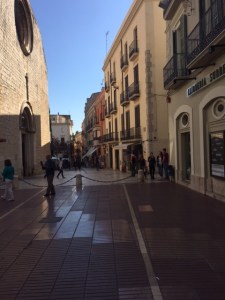
Downtown Figueres
Downtown Figueres
Entrance to the Teatre-Museu Dali
IMG_3548
Dali Monument
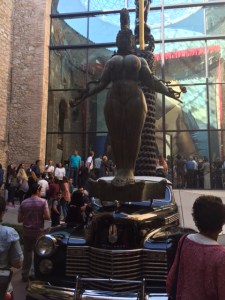
Entry hall of the museum

IMG_3553IMG_3559

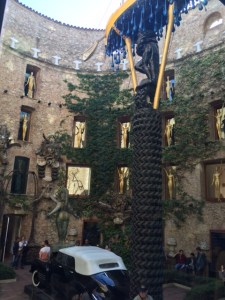
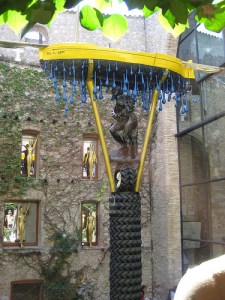
The Cadillac is from the 1940s and never driven.  There is an umbrella at the top of the boat behind the car that slowly opens and it rains inside the car.
The Cadillac is from the 1940s and never driven. There is an umbrella at the top of the boat behind the car that slowly opens and it rains inside the car.
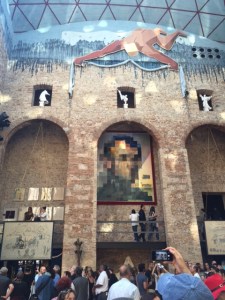
Next room is a large glass dome topped hall with a painting that at first looks like a nude painting from the back of Gala but when one takes a photo with a smartphone the pixels form the face of Abraham Lincoln.  Dali was definitely before his time.
Next room is a large glass dome topped hall with a painting that at first looks like a nude painting from the back of Gala but when one takes a photo with a smartphone the pixels form the face of Abraham Lincoln. Dali was definitely before his time.
7c3a8c_c9e2b94ee9114c0c98671be7aaeda3b1
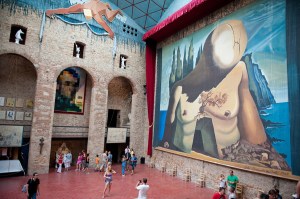
The large painting tapestry was painted in 1947 so must have been completed in the US. It reminds me of some of the imagery Dali produced for Walt Disney that helped secure his fame and fortune of course.
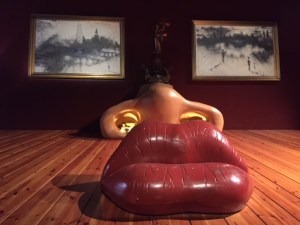
Mae West Room
Mae West Room
To get the full affect one must climb on to the camel and look through a special glass.
IMG_3573
The Camel
A fresco near the private rooms
The couch
The couch
The bed (and the clocks)
Watch out for the dropping baby
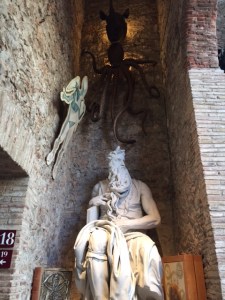
Michelangelo's Moses (in plaster)
Michelangelo’s Moses (in plaster)
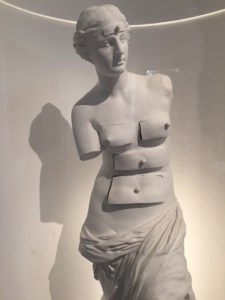
Venus With Drawers, 1936
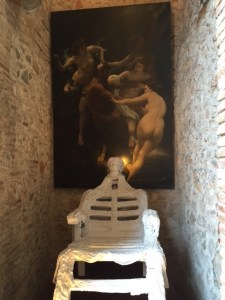
I think this was an original Bouguereau.
Another of these can be seen at the Museum of Modern Art in New York.  That's a real loaf of bread and the ink set is of a famous work by Francois Millet "The Angelus".  It appears many times in Dali's work
Another of these can be seen at the Museum of Modern Art in New York. That’s a real loaf of bread and the ink set is of a famous work by Francois Millet “The Angelus”. It appears many times in Dali’s work
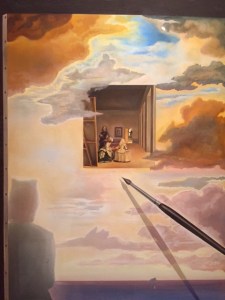
A bust of the Baroque painter Velasquez in a room with Dali's take off on "Las Meninas"
A bust of the Baroque painter Velasquez in a room with Dali’s take off on “Las Meninas”. A tiny reproduction of the painting is across the artist’s forehead.
IMG_3586
One version of the Infanta from “Las Meninas”
A second version of the infanta from "Las Meninas"
A second version of the infanta from “Las Meninas”
Dali's full blown reinterpretation of "Las Meninas"
Dali’s full blown reinterpretation of “Las Meninas”
From upstairs you can see the boat very clearly.  The blue drops are condoms.
From upstairs you can see the boat very clearly. The column is made from truck tires and the blue drops are condoms.

Girona

Girona is a city about an hour and a half outside of Barcelona.  The city was founded by the Romans and one can also see Romanesque, Gothic, Baroque structures in a contained historic district.  It has one of the best preserved Jewish quarters in Europe.

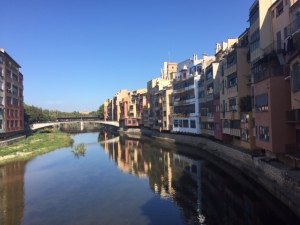
The city of Girona is between four rivers though two of them were widened to prevent flooding.  It's reminiscent of Florence with it's bridges.
The city of Girona is between four rivers though two of them were widened to prevent flooding. It’s reminiscent of Florence with it’s bridges.
There were originally four rivers but to control flooding two of them were widened so that it drained the other two.  The bridge you see looks old but was actually built in the 1970s.
There were originally four rivers but to control flooding two of them were widened so that it drained the other two. The bridge you see looks old but was actually built in the 1970s.
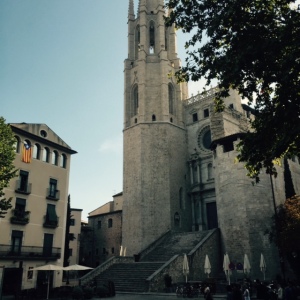
St. Feliu Church at the entrance to the historic district shows the reconstruction that was necessary because Girona was the crossroads of conflict because of it's geographical proximity to France, the Mediterranean coast, and other parts of Spain.  Conflict came from France, Visigoths, Moors, and other Spanish rulers.
St. Feliu Church at the entrance to the historic district shows the reconstruction that was necessary because Girona was the crossroads of conflict because of it’s geographical proximity to France, the Mediterranean coast, and other parts of Spain. Conflict came from France, Visigoths, Moors, and other Spanish rulers.
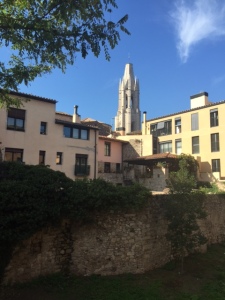
You can see the tower of St. Feliu over modern apartment buildings and a reconstructed wall below.
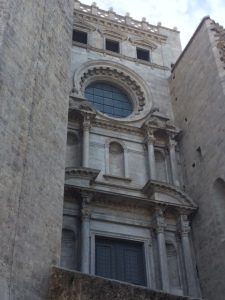
Facade of St. Feliu which shows elements of Baroque style but quite simplified compared to other churches of the time.
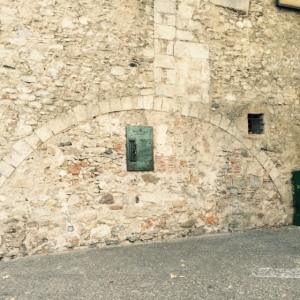
Remnants of a Roman wall seen in the stones of a more contemporary wall, with contemporary being something like 17th century.
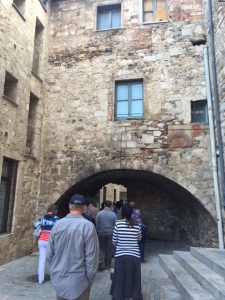
Going through a Roman arch into the heart of the historic center.
Stone on the side walls show the remnants of the Roman origins.  These are called ashlars and are similar to those found at the Western Wall in Jerusalem.
Stone on the side walls show the remnants of the Roman origins. These are called ashlars and are similar to those found at the Western Wall in Jerusalem.
It may be hard to imagine but this is the main Roman road built to link the parts of the empire.  It's amazing to think that roads built by the ancient Romans are still  used by us today.
It may be hard to imagine but this is the main Roman road built to link the parts of the empire. It’s amazing to think that roads built by the ancient Romans are still used by us today.
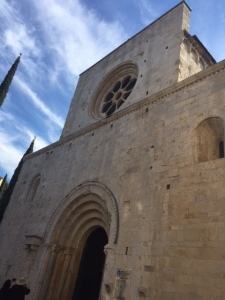
A Romanesque church that is now a film museum.  You can see that this type of structure is not as tall or as ornate as the later Gothic structures.
A Romanesque church that is now a film museum. You can see that this type of structure is not as tall or as ornate as the later Gothic structures.
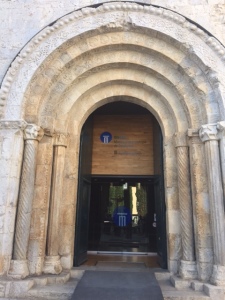
Entrance to the Romanesque church (film museum).  You can see why it is called Romanesque as it uses classical elements of arch and column but is not very embellished.
Entrance to the Romanesque church (film museum). You can see why it is called Romanesque as it uses classical elements of arch and column but is not very embellished.
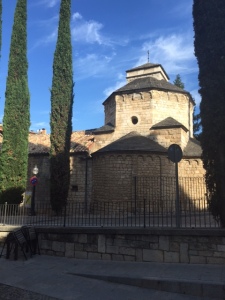
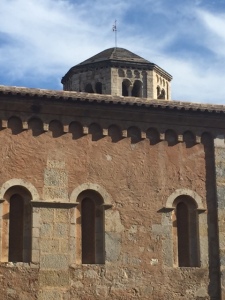
Octagonal buildings are also a hallmark of Romanesque architecture.  This one marked the town cemetery and notice it's right in the center of town (more on this later).
Octagonal buildings are also a hallmark of Romanesque architecture. This one marked the town cemetery and notice it’s right in the center of town (more on this later).
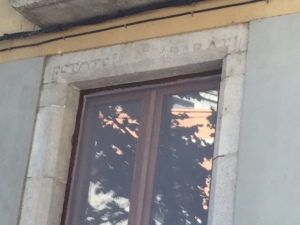
Since must of the historic center has been reconstructed with materials from various eras notice the lintel of this window "repurposed" from the hospital that says in Latin "Be ready" since going to the hospital in the 12th century usually meant you went right across the street to the cemetery when you left.
Since must of the historic center has been reconstructed with materials from various eras notice the lintel of this window “repurposed” from the hospital that says in Latin “Be ready” since going to the hospital in the 12th century usually meant you went right across the street to the cemetery when you left.
Another octagonal structure identifies a Romanesque building.
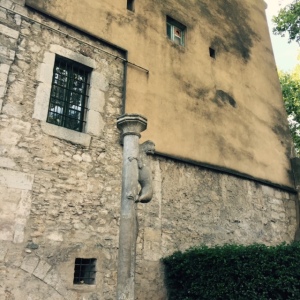
The lioness is the symbol for the city of Girona.  If you get up to the lioness and kiss her bum you will for sure return to Girona.
The lioness is the symbol for the city of Girona. If you get up to the lioness and kiss her bum you will for sure return to Girona.
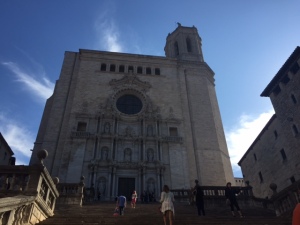
The cathedral has the distinction of having the largest vault of any in Europe.  To be honest if the guide hadn't told us that I would not have noticed.
The cathedral has the distinction of having the largest vault of any in Europe. To be honest if the guide hadn’t told us that I would not have noticed.
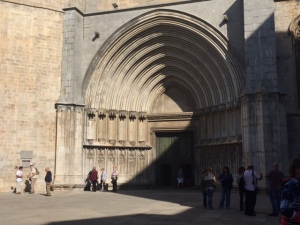
Compared to other Gothic structures this one is very unadorned.  One thing to consider is that a city like Girona was not as well off financially as other cities so could not spend as much on construction of their cathedral.
Compared to other Gothic structures this one is very unadorned. One thing to consider is that a city like Girona was not as well off financially as other cities so could not spend as much on construction of their cathedral.
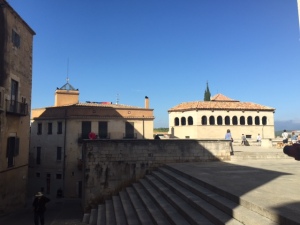
Plaza in front of the cathedral.  Below is the Jewish quarter.
Plaza in front of the cathedral. Below is the Jewish quarter.
Entering the Jewish quarter.  Girona was home of one of the most important rabbis in Jewish history- Nachmanides also known as Ramban (not to be confused with Rambam/Maimonides).  He was responsible for starting the Kabbalistic tradition.
Entering the Jewish quarter. Girona was home of one of the most important rabbis in Jewish history- Nachmanides also known as Ramban (not to be confused with Rambam/Maimonides). He was responsible for starting the Kabbalistic tradition.
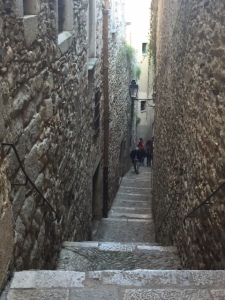
One street of the Jewish quarter which was separated from the rest of the city.  This narrow alley and the one in the next photo were only reopened in the 1970s.  They were walled off before then.
One street of the Jewish quarter which was separated from the rest of the city. This narrow alley and the one in the next photo were only reopened in the 1970s. They were walled off before then.
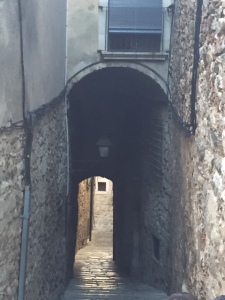
This is the second alley.  The community was protected by the king because the Jewish community provided financial assistance to the king.  The church on the other hand was not so happy with the Jewish community and the Inquisition destroyed the community in the late 15th century.
This is the second alley. The community was protected by the king because the Jewish community provided financial assistance to the king. The church on the other hand was not so happy with the Jewish community and the Inquisition destroyed the community in the late 15th century.
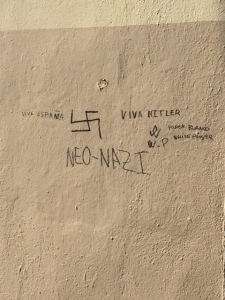
This graffiti on the back wall of the Jewish museum.  Just to remind us that the more things change the more they stay the same.
This graffiti on the back wall of the Jewish museum. Just to remind us that the more things change the more they stay the same.
One of the synagogues and a few houses of the Jewish quarter have been converted to a very nice museum documenting the Jewish community of Girona.


gir4
The museum is on multiple levels with many artifacts and information documenting the height of Jewish society in this region of Spain.
IMG_3537
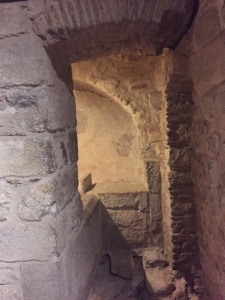
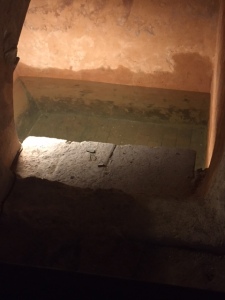
The Mikveh (ritual bath) discovered recently in the basement of the synagogue.
IMG_3539
Some water seeping into the mikveh confirmed what it was. So getting back to the cemetery from earlier, in 1391 the Black Plague killed 60% of the population of Spain. Most of the deaths were among Christians. The Jews were relatively unscathed. Why- simple, hygiene. Jews go to the ritual bath on a regular basis and wash their hands before and after eating. Jews also bury their dead outside of the city. The cemetery building at the beginning of this post was Christian and in the center of town. Of course, since the Jews were not affected by the Plague they must have caused it and so there was a pogrom against them. Many Jews died, those who had the means left Spain and others converted to Christianity though they continued to be Jews in secret.
IMG_3520
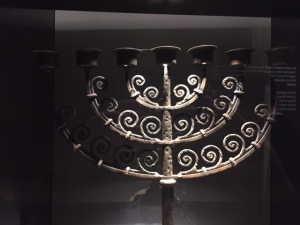
A seven branched menorah from the 13th century similar to the one you see on the Arch of Titus in Rome if you are in the ancient art history class.
IMG_3525
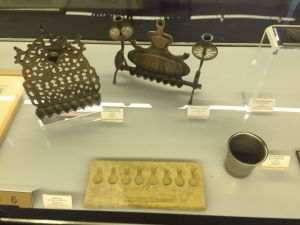
Oil menorahs of many types all from about the 16th to 18th centuries.
IMG_3523
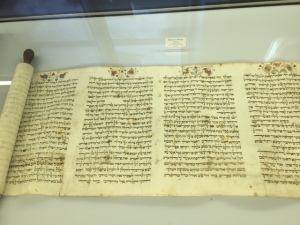
A scroll for Purim (a holiday commemorating the Jews of Persia being liberated). Interestingly the two columns right in the middle are about the evil Haman telling the king about the foreigners in their midst. This scroll called a megillah is from the 18th century.
IMG_3521
A Ketubah (marriage contract)
IMG_3530
A cornerstone from the synagogue (13th century) that helps to prove that the building was actually used by the community for a worship space.
IMG_3528
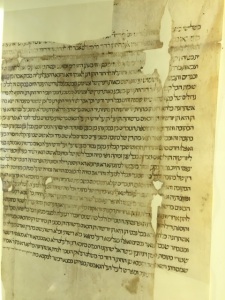
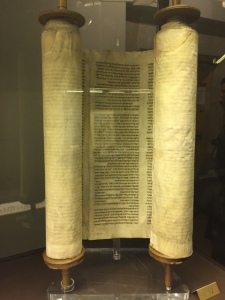
A torah scroll (this one borrowed from a Jewish community elsewhere in Spain. Remember the nano bible the size of a grain of sugar. That contains everything on this gigantic scroll.
Tombstones from the Girona Jewish cemetery.  More on what happens to gravestones in a future blog posting.
Tombstones from the Girona Jewish cemetery. More on what happens to gravestones in a future blog posting.


Look Up

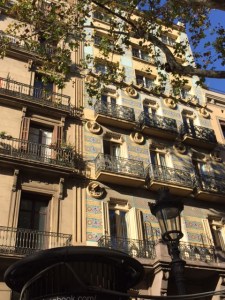
Barcelona is a city where you would miss quite a bit if you just looked straight ahead or at your feet. The city is known for its historic as well as modernistic architecture and there are surprises around every corner.

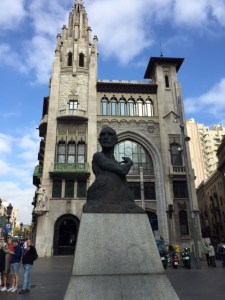
I don't know who the sculpture is supposed to be (reminds me of Cervantes) or what the building is but the combination of the modern and the old gives you and idea of how intermixed the styles are.
I don’t know who the sculpture is supposed to be (reminds me of Cervantes) or what the building is but the combination of the modern and the old gives you and idea of how intermixed the styles are.
The upper floors of the Musical Center of Catalunya,
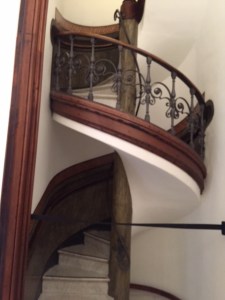
Not permitted to take photos in the Picasso Museum but could not resist this spiral staircase.
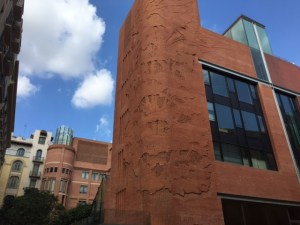
This side wall of the modernized portion of the Music Hall almost appears to be etched into the brick.
Just a brief idea of what the column capitals look like on the music all building.
Believe it or not this is a hotel and those elements protruding are supposed to be eyes and they are permanent.
The eyes (detail)
The eyes (detail)
Contrast between new and old near the Olympic (1992) facilities.
"Gambrinus", by Javier Mariscal greets visitors coming to the waterfront
“Gambrinus”, by Javier Mariscal greets visitors coming to the waterfront
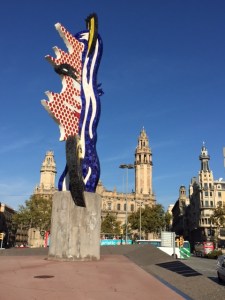
Roy Lichtenstein, "The Head of Barcelona", 1991
Roy Lichtenstein, “The Head of Barcelona”, 1991
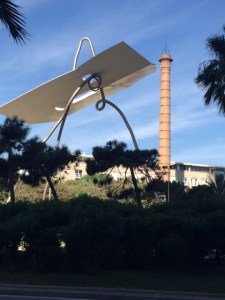
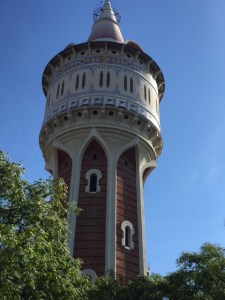
Tower by the sea
Tower by the sea
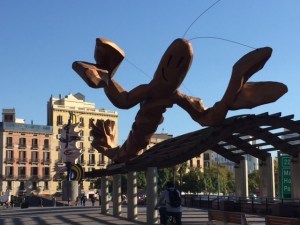
Frank Gehry Goldfish designed and erected for the 1992 Olympics
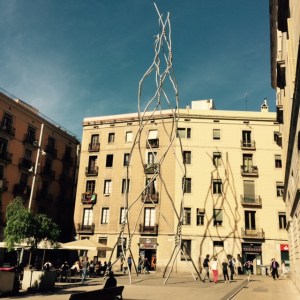
A wire sculpture in a small plaza, could not find out who the artist is.
A more traditional tile facade along Las Ramblas
Another interesting facade on Las Ramblas, notice the dragon protruding from the end.
The Agbar Tower can be seen from many places in the city.  It is not a sculpture, rather an office building and the exterior is meant to call water to mind, rippling and moving.  We keep missing it at night when it is all lit up and is supposed to look like a kaleidoscope. It is not in the historical center of the city rather in a technology hub.
The Agbar Tower can be seen from many places in the city, a gateway to the technology section of the city. It is not a sculpture, rather an office building and the exterior is meant to call water to mind, rippling and moving. We keep missing it at night when it is all lit up and is supposed to look like a kaleidoscope.  We passed it on our way out of town to Girona.

It’s Been Awhile

It’s been awhile since we’ve been in a new place where we have never been and it always strikes me how different a place looks than you imagined when you looked at pictures.  It’s kind of a funny thing since you will likely imagine Barcelona after reading this blog that is very different from what it will actually look like when you come here, which I hope you all will (if you haven’t been here already).  Before coming many people told us Barcelona was their favorite city and my biggest concern was the “this is the best restaurant” or “that was the best movie/book I ever saw/read” and it’s always a disappointment.  So far no disappointments here.  Barcelona gets many visitors/tourists/travels (whatever you want to call it) and I have confirmed that I will try never to come to Europe in the middle of the summer. I think one of the things that makes Barcelona so easy going is of course how nice everyone is but also how well they have managed the infrastructure of the downtown to accommodate visitors.  There are information stations everywhere, the signage is better than any city I’ve ever seen so you almost never get lost and it’s great for walking, something we love to do.  Here are a few preliminary views.
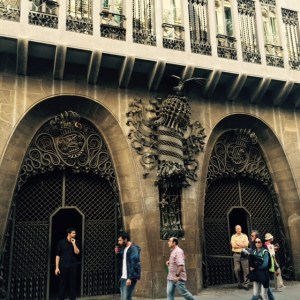
The entry doors to Palau Guell, the palace of the patron of Gaudi, the most well known Moderniste architect.  The palace was built in the late 1800s.
The entry doors to Palau Guell, the palace of the patron of Gaudi, the most well known Moderniste architect. The palace was built in the late 1800s.
FullSizeRender copy
Many cities have they bike sharing arrangements but I’ve never seen it as well used as in Barcelona. The rack across the street from us was completely empty yesterday during the day but the bikes were back at night.
FullSizeRender copy 3
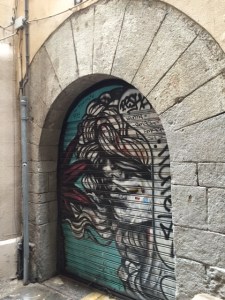
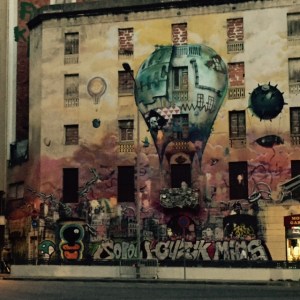
A wall near our apartment- is it graffiti or is it art? If you are in the Renaissance to Modern class this is a question we’ll be looking at towards the end of our class so remember this one.
Downtown Barcelona looks like other Spanish cities and some in Central and South America.
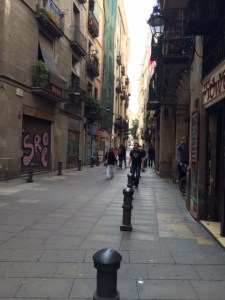
Narrow alleys get you away from the hustle and bustle of the touristy La Rambla
This street is in the Born neighborhood
Near the Picasso Museum (more about that later)
The Art Nouveau style that you see everywhere.
So many parks and unexpected plazas as you come out of one alley and go into another.
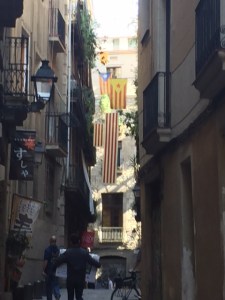
Catalan flags can be seen from many balconies especially after the referendum for independence passed about three weeks ago. Barcelona does have an air of being prosperous. I can see why they want to go their own way.
Date palms remind you that this is a Mediterranean country.
San Antoni market takes up a full block and is in the midst of a massive renovation. It's a much bigger market than the Boqueria (more on that later) in a less tourist traveled area. Look forward to a return trip to Barcelona to see it reopened as it looks beautiful.
San Antoni market takes up a full block and is in the midst of a massive renovation. It’s a much bigger market than the Boqueria (more on that later) in a less tourist traveled area. Look forward to a return trip to Barcelona to see it reopened as it looks beautiful.
The remains of an ancient Roman arch with sections of the wall preserved inside the small arch you see. There is glass to look through to see the remains.

Human Development

Some museums can always be depended upon to have at least one exhibit that is outstanding every visit.  The Israel Museum in Jerusalem is just that kind of museum.  It’s always unexpected how interesting an exhibit can be.  I didn’t have too much enthusiasm for this show before we got there  but it was fabulous.  I think you’ll agree. Especially, in a part of the world where people have such a hard time getting along it’s amazing to see how much we as humans have in common and how long we have been human.  The show was called “A Brief History of Humankind” and brought together works from the museum’s collection of archaeological treasures to their cutting edge contemporary art collection.

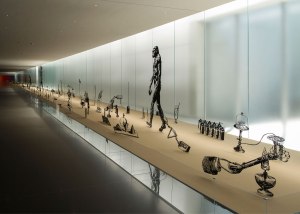
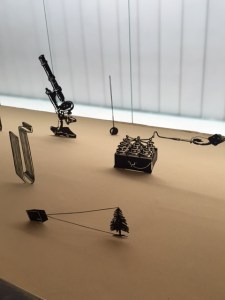
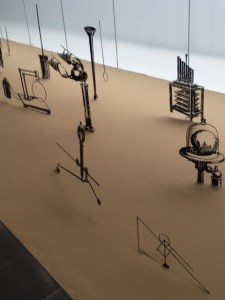
"Evolution and Theory", Zadok ben-David, 1998, hand cut aluminum at the entrance to the exhibit
“Evolution and Theory”, Zadok ben-David, 1998, hand cut aluminum at the entrance to the exhibit
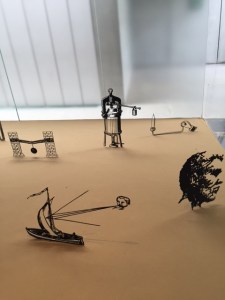
Detail, "Evolution and Theory"
Detail, “Evolution and Theory”
Detail, "Evolution and Theory"
Detail, “Evolution and Theory”
Detail, "Evolution and Theory"
Detail, “Evolution and Theory”
Detail, "Evolution and Theory"
Detail, “Evolution and Theory”
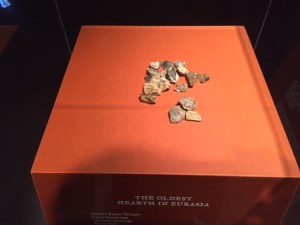
In the Beginning: Burnt flint from the oldest hearth in Eurasia, early stone age
In the Beginning Fire: Burnt flint from the oldest hearth in Eurasia, early stone age
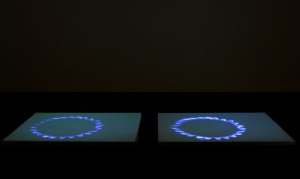
"Blue Gas Eyes" Miroslav Balka, 2014, video, salt, steel
“Blue Gas Eyes” Miroslav Balka, 2014, video, salt, steel
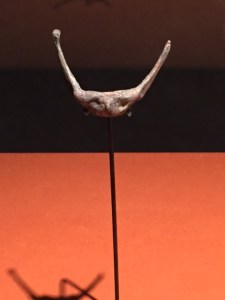
Cognitive Revolution: Hyoid Bone, Middle Paleolithic Period.  The hyoid bone is a horseshoe shaped bone in the middle of the neck which anchors the tongue muscles as well as some of the neck.  In 1989, the journal "Nature" reported the discovery of this particular hyoid bone at Mt. Carmel belonging to a Neanderthal human proving that Neanderthals could speak.
Cognitive Revolution: Hyoid Bone, Middle Paleolithic Period. The hyoid bone is a horseshoe shaped bone in the middle of the neck which anchors the tongue muscles as well as some of the neck. In 1989, the journal “Nature” reported the discovery of this particular hyoid bone at Mt. Carmel belonging to a Neanderthal human proving that Neanderthals could speak.
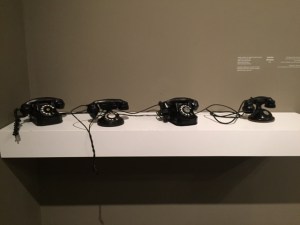
Janet Cardiff and George Bures Miller, Installation: telephones and audio recordings
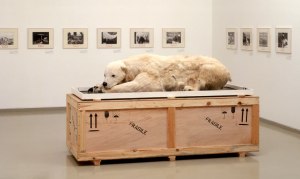
Survival and Extinction: "Ursus Maritimus", Mark Dion, 1995, fiberglass, goat skin, glass eyes, art crate
Survival and Extinction: “Ursus Maritimus”, Mark Dion, 1995, fiberglass, goat skin, glass eyes, art crate
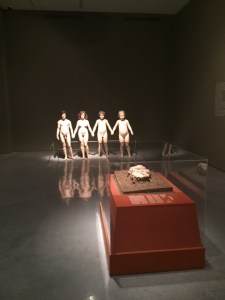
The Family: Charles Ray, "Family Romance", 1992-95, mixed media and Plastered skulls in the foreground 9000 BCE all found together in a family burial.
The Family: Charles Ray, “Family Romance”, 1992-95, mixed media and Plastered skulls in the foreground 9000 BCE all found together in a family burial.
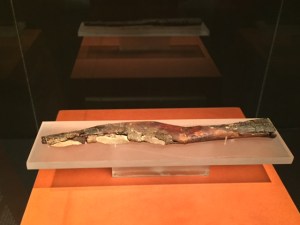
Agricultural Revolution: the oldest complete sickle in the world, 9000 BCE, horn, flint, and resin
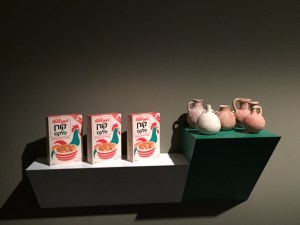
Haim Steinbach, "stay with friends 2", 1986, wooden shelves, Kellogg's boxes, and bronze age pottery
Haim Steinbach, “stay with friends 2”, 1986, wooden shelves, Kellogg’s boxes, and bronze age pottery
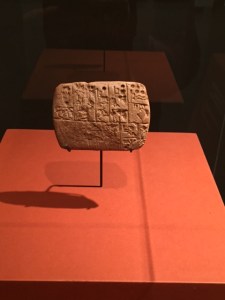
Law: Administrative account inscribed with cuneiform, ca. 3000 BCE
City and House: Model of a House, pottery, early bronze age, 3000-1600 BCE
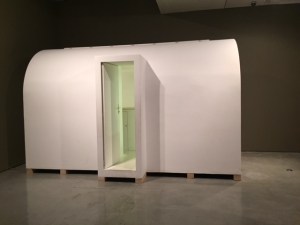
Absalon, "Cell No. 1", 1964, wood, white waterproof paint
Absalon, “Cell No. 1”, 1964, wood, white waterproof paint
Silver Hoard, late 11th century BCE
"Middlemen", aernout mik, 2001, single channel video
“Middlemen”, aernout mik, 2001, single channel video
"Benedictine Arias Montanus, engraving, Maps of the Holy Land, 1572
“Benedictine Arias Montanus, engraving, Maps of the Holy Land, 1572
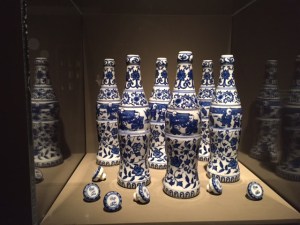
"Kekou-Kele (Six Pack)", 2002, Zhang Hongtu, porcelain
“Kekou-Kele (Six Pack)”, 2002, Zhang Hongtu, porcelain
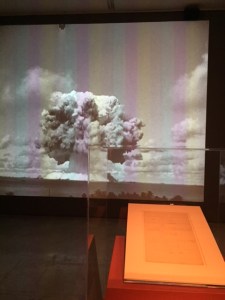
Industrial Revolution: Bruce Conner, 1976, "Crossroads", video and the original Theory of Relativity manuscript  by Albert Einstein.
Industrial Revolution: Bruce Conner, 1976, “Crossroads”, video and the original Theory of Relativity manuscript by Albert Einstein.
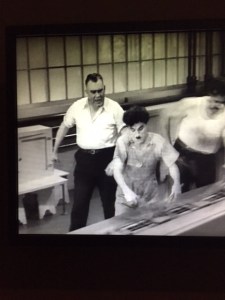
"Modern Times" Charlie Chaplin, 1936
“Modern Times” Charlie Chaplin, 1936
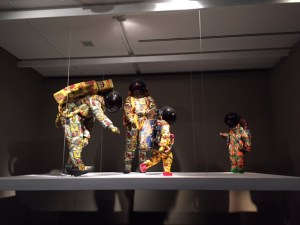
The Future:  "Vacation", Yinka Shonibare, 2000, installation
The Future: “Vacation”, Yinka Shonibare, 2000, installation
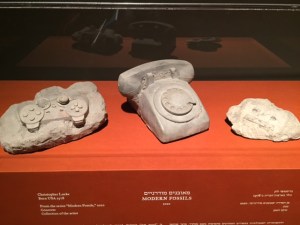
"Modern Fossils", 2010, Christopher Locke, concrete
“Modern Fossils”, 2010, Christopher Locke, concrete
In another part of the Israel Museum is the Shrine of the Book that holds the Dead Sea Scrolls.  This building is hydraulic, able to sink into the ground if attacked.  A temporary exhibit of the smallest bible ever produced was very interesting.
In another part of the Israel Museum is the Shrine of the Book that holds the Dead Sea Scrolls. This building is hydraulic, able to sink into the ground if attacked. A temporary exhibit of the smallest bible ever produced was very interesting.
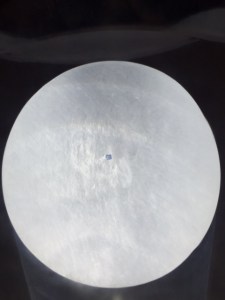
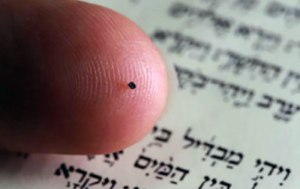
That speck you see (about the size of a grain of sugar) is the new Nano Bible, containing 1,200,000 letters etched, created by the Technion.  It's an example of a beautiful use for Nano technology.  I am attaching a short link about this amazing achievement.
That speck you see (about the size of a grain of sugar) is the new Nano Bible, containing 1,200,000 letters etched, created by the Technion. It’s an example of a beautiful use for Nano technology. I am attaching a short link about this amazing achievement.
Text is etched in Hebrew

Sights and Sounds

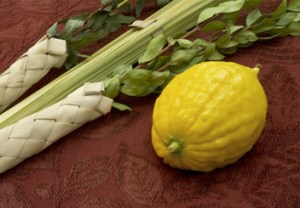
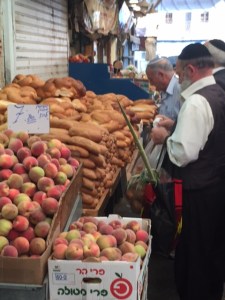
The other ritual objects traditional for Sukkot are the Lulav and Etrog.  Each day during the week of Sukkot one holds the two together (see photo below) and shakes it in 6 directions, the 4 cardinal directions, up towards the heavens and down towards the earth. On the very last day one gets extra willow branches and beats them on the ground to simulate the sound of rain falling.  From now on through the winter a prayer for rain is added to every service.  It is supposed to rain on Wednesday.   Today is the last day of this holiday and we spent some time buying tasty treats in one of my favorite places, Machane Yehuda.  It really feels like harvest time there.

The lulav is made up of a palm branch (representing the spine), myrtle branches (representing the eyes), and willow branches (representing the mouth). The etrog is a citron that represents the heart.
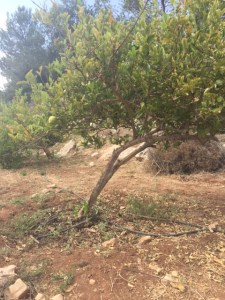
The etrog tree only grows in Israel and is quite thorny.
The etrog tree only grows in Israel and is quite thorny. You can see one on the tree at the lower left otherwise it’s been picked clean.
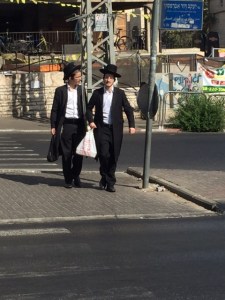
Walking home you can see these two men have a tall plastic bag between them, that holds the lulav.
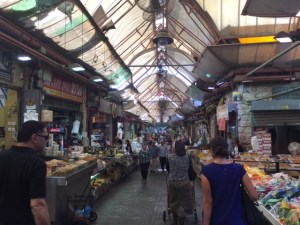
Entrance to the Machane Yehudah market.
Main corridor of the market with many lanes crisscrossing it.
Here you can see the lulav sticking out of the shopping bag. We have seen people carrying them everywhere.
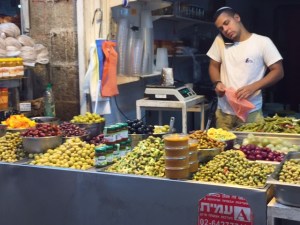
Every type of olive you could imagine.
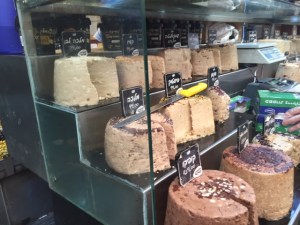
Halvah, an acquired taste. Made from various nut butters and other added ingredients. Popular throughout the Middle East.
My favorite tea and spice seller.
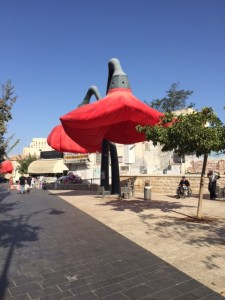
Outside the market a little Urban Art installation. Could not find the name of the artist but these red parachute figures blow up and then deflate.
Outside the market an unexpected Urban Art installation. Could not find the name of the artist but these red parachute figures blow up and then deflate.

More than you ever wanted to know about a sukkah

As I mentioned in my last post, the sukkah is the temporary hut for the holiday of Sukkot.  We visited a park halfway between Jerusalem and Tel Aviv called Neot Kedumim, the Biblical Landscape Reserve.  It is an attempt to recreate the landscape of biblical times.  It was started in the 1920s and in 1999 won the Israel Prize.  It is particularly popular this time of year for its special sukkah exhibit.

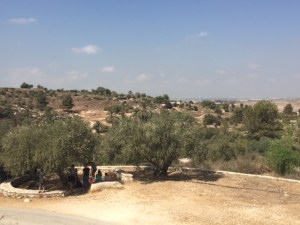
This gives you an idea of what the landscape looked like in biblical times.  It hasn't changed a whole lot since them.  It has been quite hot here but is starting to cool down a little.
This gives you an idea of what the landscape looked like in biblical times. It hasn’t changed a whole lot since them. It has been quite hot here but is starting to cool down a little.
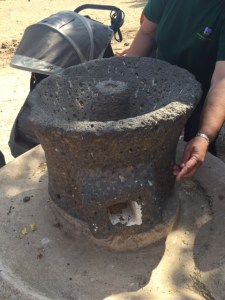
An ancient grain mill that would have been turned by animals to grind the wheat into flour.  The guide estimated this one from about 100 BCE.
An ancient grain mill that would have been turned by animals to grind the wheat into flour. The guide estimated this one from about 100 BCE.
Some kids really got into grinding the wheat and hopefully none of their appendages.
Olive trees have existed in this region for 1000s of years and are an important source of shade, food, and of course oil.  This is obviously a more modern version where the olives are put into those special baskets and then pressed to release the oil.
Olive trees have existed in this region for 1000s of years and are an important source of shade, food, and of course oil. This is obviously a more modern version where the olives are put into those special baskets and then pressed to release the oil.
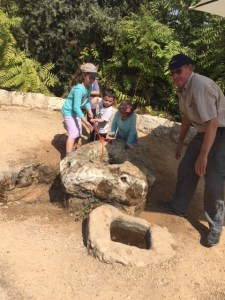
For this ancient one the kids tried to be the animals who would have turned the stone.  Not too successful but they had a valiant try.
For this ancient one the kids tried to be the animals who would have turned the stone. Not too successful but they had a valiant try.
We know how important water is in our part of the world but in this part of the world it's even more precious.  This is an example of an ancient well.
We know how important water is in our part of the world but in this part of the world it’s even more precious. This is an example of an ancient well.
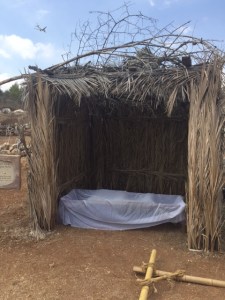
The sukkah exhibit showed which types of sukkot are "kosher" (okay to use) and which ones are not okay.  As I mentioned in my last post during the week of Sukkot one is supposed to sit in the sukkah for all meals.  Here is a family enjoying a picnic in one of the "kosher" sukkahs.
The sukkah exhibit showed which types of sukkot are “kosher” (okay to use) and which ones are not okay. As I mentioned in my last post during the week of Sukkot one is supposed to sit in the sukkah for all meals. Here is a family enjoying a picnic in one of the “kosher” sukkahs.
People also sleep in their sukkah.
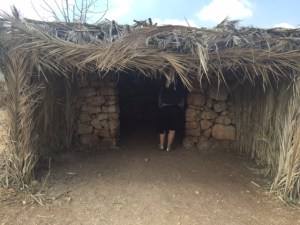
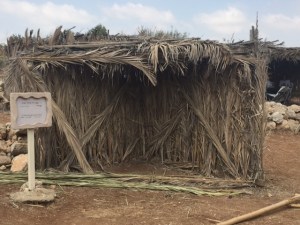
The front part of this sukkah is kosher but the back part (too permanent) is not.
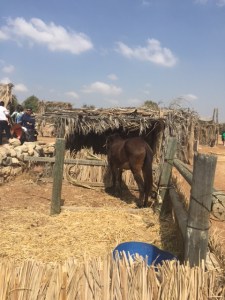
A sukkah with a donkey as one of it's walls is not considered kosher.  The donkey stood with his head through the hole the entire time we were there.
A sukkah with a donkey as one of it’s walls is not considered kosher. The donkey stood with his head through the hole the entire time we were there.
But a sukkah on top of a camel is okay as long as the camel doesn't travel anywhere during the proscribed festival days.
But a sukkah on top of a camel is okay as long as the camel doesn’t travel anywhere during the proscribed festival days.
One might think a sukkah on a cart is not okay because it is too portable but it counts as okay though the walls seemed too open to me.
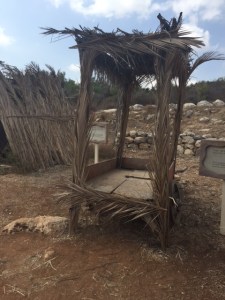
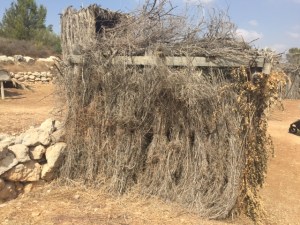
This one has no roof, or at least you can't tell the walls from the roof and the sukkah must have at least three walls.
This one has no roof, or at least you can’t tell the walls from the roof and the sukkah must have at least three walls.
This one only has two walls.
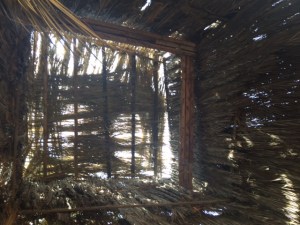
This one is too tall
Looking up through the roof of the too tall sukkah.
This one was my favorite.  I liked all the textures and it felt really cozy inside.
This one was my favorite. I liked all the textures and it felt really cozy inside.
Outside of my favorite one.

Sukkot in Jerusalem

We are in Jerusalem at an especially meaningful time of the year.  The Jewish High Holy Days have passed and the holiday of Sukkot is coming to an end tomorrow (has lasted 8 days) and the culmination will be a holiday called Simchat Torah, that ends the cycle of reading the torah.  Sukkot has always been one of my favorite holidays since childhood.  The holiday celebrates harvest time and people build a temporary structure called a sukkah which simulates the huts the Jewish people lived in when they wandered in the desert after leaving Egypt in biblical times.  Families eat all their meals in the sukkah and often sleep in them as well.  Sukkot is also one of three pilgrimage holidays in the Jewish calendar:  Sukkot, Passover, and Shavuot.  Pilgrimage was made to Jerusalem to the ancient temple.

These are some of the sukkot (huts) on the balconies and on the street.  If people don't have a balcony their sukkah is in front and everyone has a designated spot.  Our kids have a prime spot because the man who owns the apartment had a designated spot that they inherited with the apartment.
These are some of the sukkot (huts) on the balconies and on the street. If people don’t have a balcony their sukkah is in front and everyone has a designated spot. Our kids have a prime spot because the man who owns the apartment had a designated spot that they inherited with the apartment.
Close up of one of the apartment buildings.  One must be able to see the sky through branches on the top so one can't be built under an overhang.  Some are decorated elaborately inside.  The one we had dinner in last night had chandeliers.
Close up of one of the apartment buildings. One must be able to see the sky through branches on the top so one can’t be built under an overhang. Some are decorated elaborately inside. The one we had dinner in last night had chandeliers.
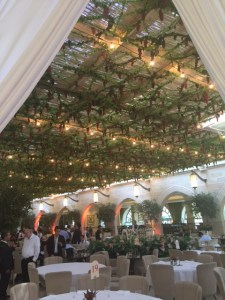
If restaurants want business during the week of Sukkot they must have a sukkah for people to be served in as all meals must be eaten in the sukkah.  This one is at the Waldorf Astoria Hotel and it's inside but they have a glass roof so it "counts."
If restaurants want business during the week of Sukkot they must have a sukkah for people to be served in as all meals must be eaten in the sukkah. This one is at the Waldorf Astoria Hotel and it’s inside but they have a glass roof so it “counts.”
This period of time from New Years (Rosh Hashana) to Simchat Torah (beginning tomorrow) is a long vacation period in Israel for adults and children so the old city is particularly crowded.
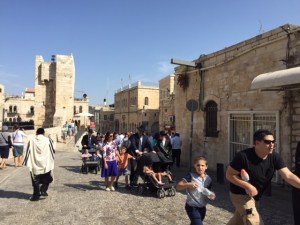
Alley in the old city of Jerusalem.
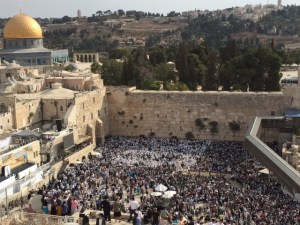
Since this is a pilgrimage holiday a special blessing is recited at the Western Wall called the Birkat Ko'hanim (priestly blessing) and we were there for it.  We were in an apartment that overlooks the Western Wall and you can also see the Temple Mount behind it.  The Western Wall is the holiest site for Jews.
Since this is a pilgrimage holiday a special blessing is recited at the Western Wall called the Birkat Ko’hanim (priestly blessing) and we were there for it. We were in an apartment that overlooks the Western Wall and you can also see the Temple Mount behind it. The Western Wall is the holiest site for Jews.
In this close up you might be able to make out the line of people covered in prayer shawls closest to the wall.  They are facing the people assembled and offering the special blessing.
In this close up you might be able to make out the line of people covered in prayer shawls closest to the wall. They are facing the people assembled and offering the special blessing.