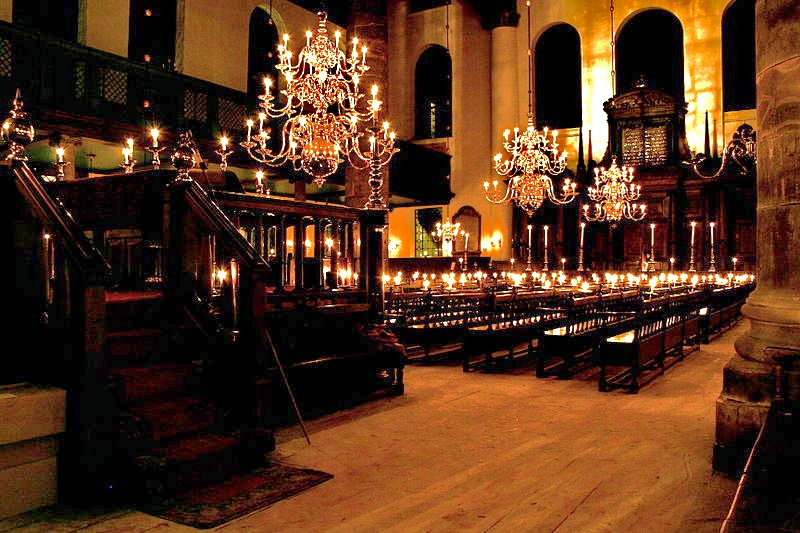
Before departing for our adventure in Belgium we attended Yom Kippur services at the synagogue in Amsterdam from the 17th century. In the interest of full disclosure, I did not take the photograph of the synagogue interior as it’s disrespectful to photograph during a religious service. The photograph comes from the internet. The synagogue is used for cultural events as well as religious services. We also took some nice walks and have overall had a lovely and relaxed time in Holland.
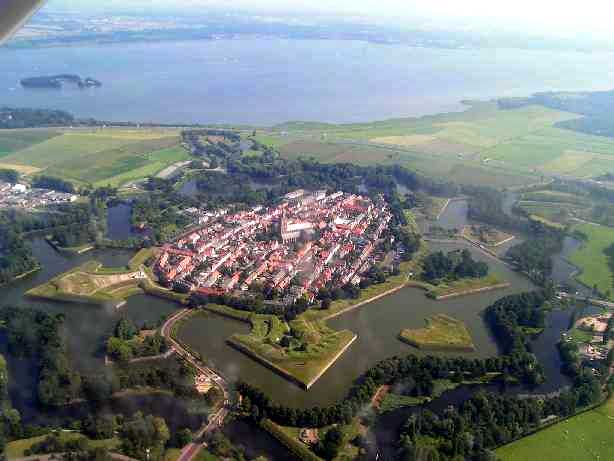
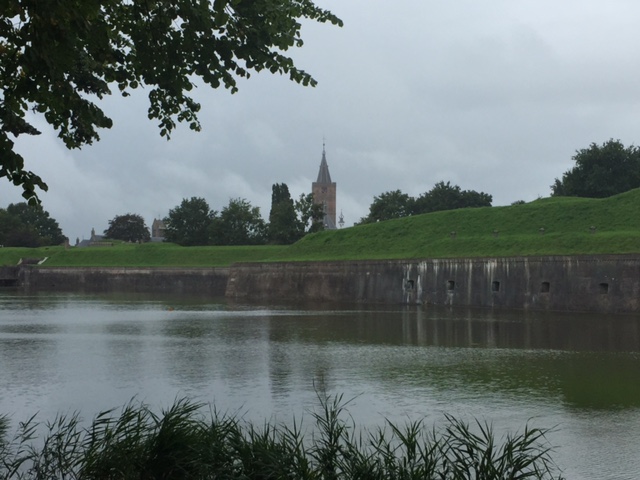
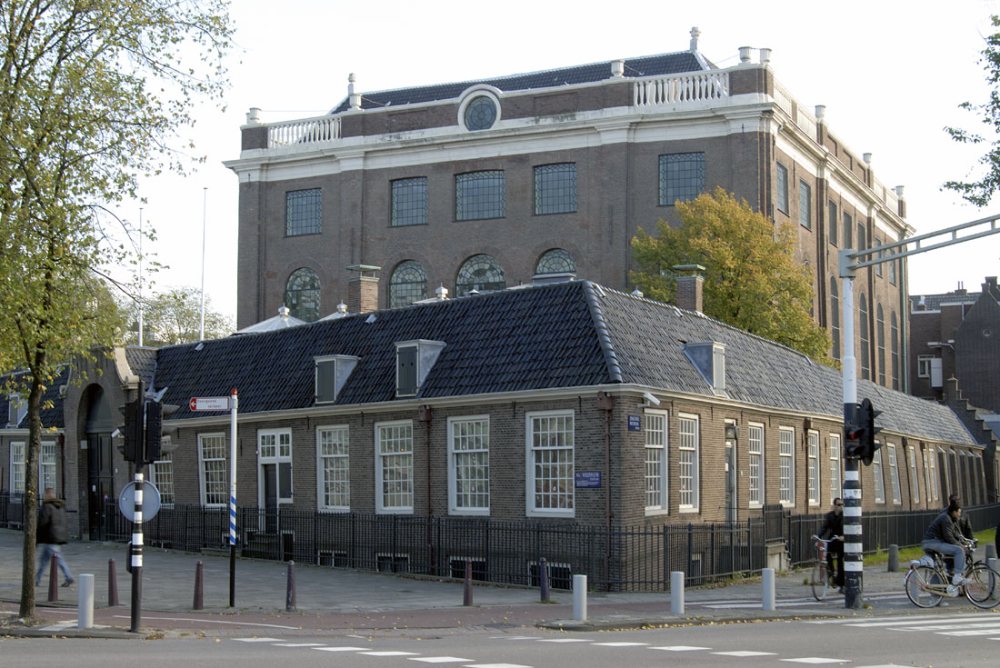
An aerial view of Naarden to give you the complete view.Just before leaving for our trip to Belgium we rode our bikes (a short preparatory ride) around the walls of Naarden a walled city in a star pattern with complete walls and moat from 1300. The church may even predate that.The Esnoga (Portuguese synagogue) built in the 17th century by Spanish and Portuguese Jews who fled Spain in the Inquisition. It has no electricity and is lit completely with candles. It was magical to be there for the evening service for Yom Kippur.Inside the lower buildings you see is a large cobblestoned courtyard. Once it got dark and you could see the glow of candlelight inside and children running around playing games outside, it was easy to imagine being there in the early 1700s.The large and imposing building that is the synagogue is in a very central location in Amsterdam. Somehow it survived World War II unscathed. Not sure why.
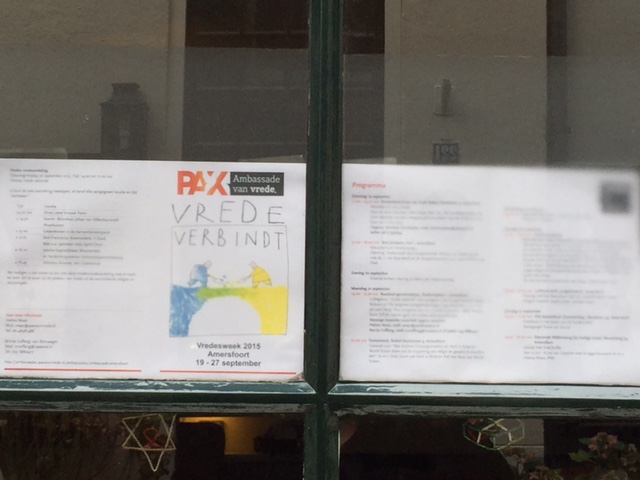
In typical Dutch fashion this household has named itself an embassy of peace. Let’s hope for that in the coming year.A pond near Bussum to start off our new year. One can see how much water is in the life of this country. They are always trying to get rid of it and we are craving it. Let’s hope we get some this year. Apparently these ponds were dug to take earth to Amsterdam for landfill. They now are slow moving bodies of water with lush vegetation all around.Sheep in the woods keep the grass mowed and wonder around at will. We biked to a lovely cafe to get out of the rain.
On the opposite end of the spectrum from the Dutch Baroque, is Piet Mondrian, the father of de Stijl a non-objective artistic style. He was born in Amersfort, about a 30 minutes train ride from Bussum. It was a lovely quiet town to stroll around and we enjoyed the visit to Mondrian’s birthplace. Mondrian moved to Paris where he was greatly influenced by Picasso, Duchamp, and Leger among others. He immigrated to the US in 1938 when he feared that things would go quite badly for artists in Europe under Nazi rule. While it doesn’t exactly fit with the subject here I’m including a photo of Rembrandt’s house that I neglected to send in the last post.
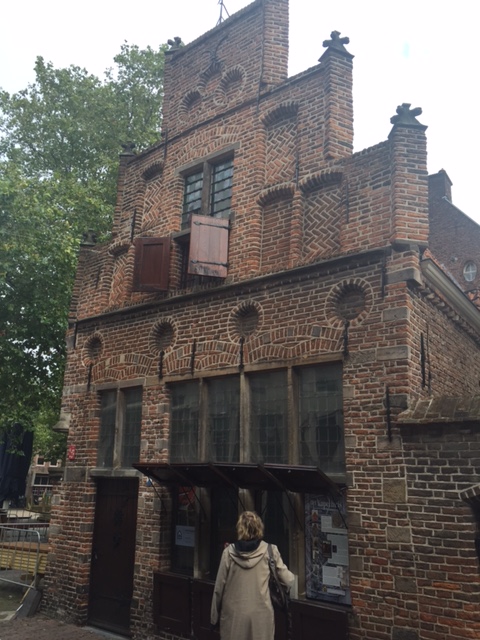
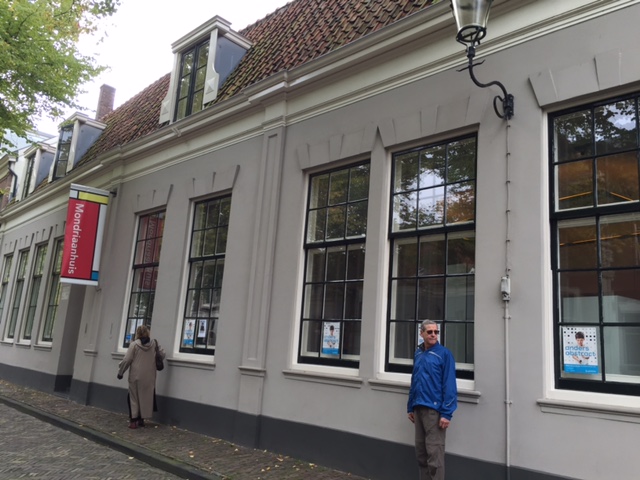
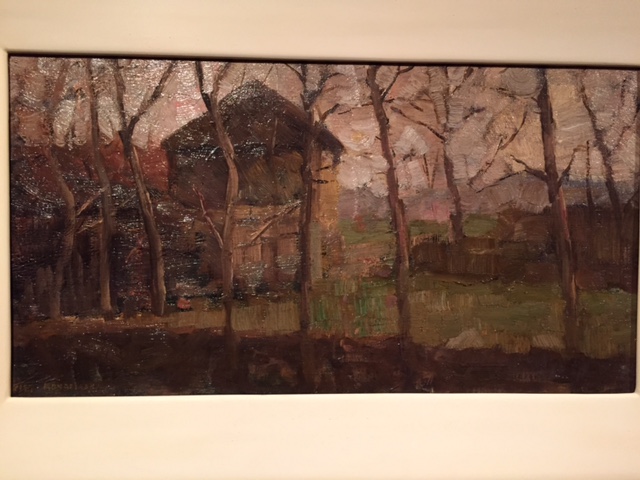
Rembrandt’s house in the center of Amsterdam. The building shows the extensive costume collection that Rembrandt used on his models and the museum next door specializes in drawings and prints.The center of Amersfort, the birthplace of Mondrian. Canals and narrow tall houses as usual.The church in Amersfort is from the Romanesque period and is well known because it is located in the exact center of Holland.The cost to the Netherlands during World War II was in loss of life rather than loss of property with the exception of Rotterdam which was leveled by bombs. This building was built in 1445.These old windows are magnificent examples of old glass that is a bit mottled.Piet Mondrian’s home, a very interesting place to learn about this artist’s life. Most of his art is in museums around the world. This building looks like a school because it was. His father was a schoolmaster and the family lived in the school.There was a small show of early drawings and paintings. You can see that Mondrian started in a very traditional manner but you can see how his early work morphed into his later constructivist works.An early Mondrian landscape painting, very much in the Impressionist mode. The museum had a video that showed early works actually morphing into later works.Mondrian’s Paris studio recreated in the museum. It was complete with the man himself (video projected on the wall). Pamela and Mondrian got into a deep conversation.
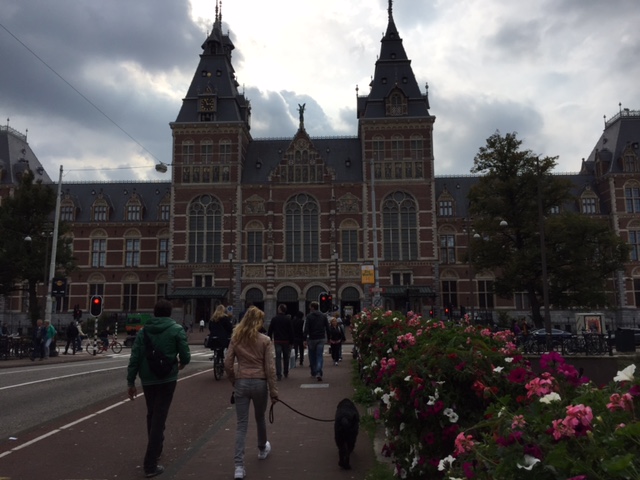
The last time I was in Amsterdam, the Rijksmuseum was closed for a long renovation. It is now reopened and it was a thrill to visit. Some of my favorite paintings live there and getting to see art “in the flesh” is always a thrill no matter how many times you do. The Rijksmusem has a collection of one million objects but they don’t try to display everything all the time. I enjoy museums like that where one is not overwhelmed. We spent most of our time in the Dutch Baroque galleries (1600-1700). For the most part I’m including photographs I took myself so forgive the lopsided funny frames.
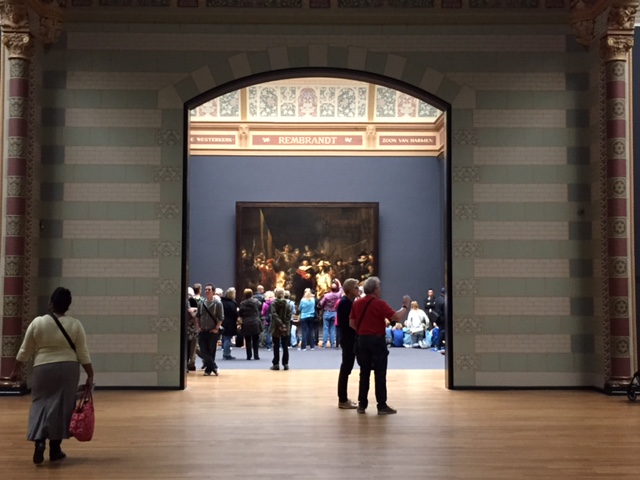
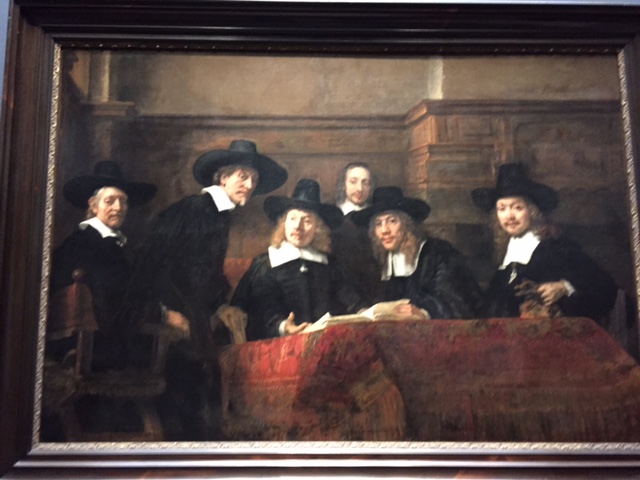
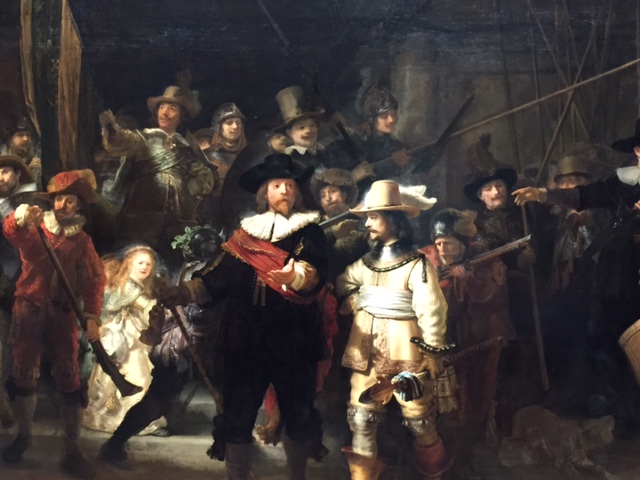
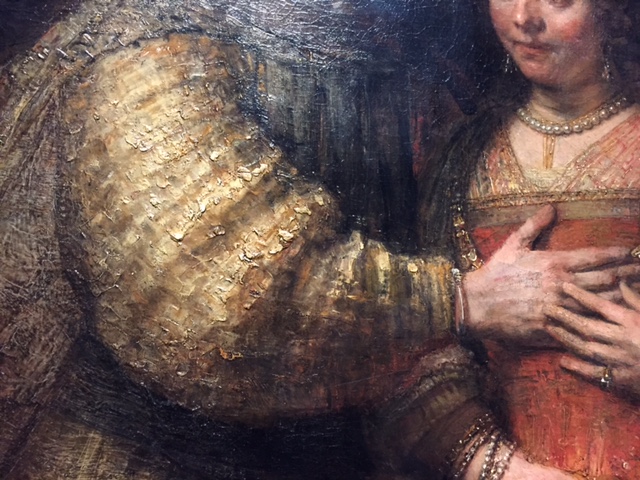
The Rikjsmuseum was built in the late 19th century to house the national collection of the Netherlands. Among the treasures are artists of the Baroque including Rembrandt, Vermeer, Ruisdael, and Steen. There are also galleries of every period of Dutch art from the Middle Ages to the 21st Century. Some galleries are devoted to Asian art particularly from Dutch colonies of the 17th and 18th centuries.Certainly the most famous painting in the museum is Rembrandt’s “Militia Company of Captain Frans Banning Cocq”, also called the Night Watch. As you can see it’s a popular destination in the museum. It was never sold and became part of the Dutch National Collection and is considered priceless. In Art 1A we are discussing the value of art so this is an interesting one to consider. Yesterday the Rijksmuseum paid $180 million for two Rembrandt paintings to keep them from going to private collections. Half the money came from the Dutch government and the other half from the museum. Can you imagine that happening in the US?Rembrandt’s “Sampling Officials” is an example of portrait painting from the 17th century where each individual paid to have their portrait included. Of course, each one had to hold an important spot in the painting to be satisfied so the challenge was how to make they all look good but make it an interesting painting compositionally. You can see a master at work here.This painting was called the “Night Watch” because it was so dark from years of dirt that some of the figures completely disappeared. One thing I never noticed before is how the foreshortened hand of the Captain that is coming out towards us casts a shadow on the yellow jacket of the figure next to him. Also notice the foreshortened spear. The blue tassle close to the point has very thick paint that really gives the feeling of ropes.Rembrandt’s “Jewish Bride” has undergone extensive restoration as has the museum and is luminous. As we’ve discussed in several different classes, hands are the hardest thing to draw or paint and check out the hands here. You don’t get much better than this.The challenge of looking at reproductions is it’s so hard to see the paint surface and Rembrandt’s impasto (thick paint) makes the fabric come alive.
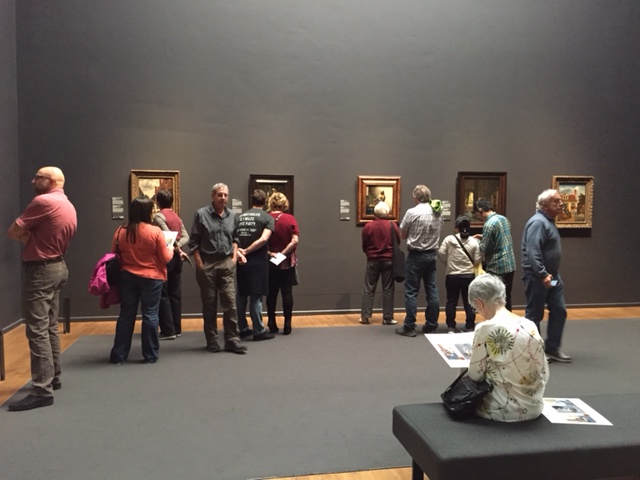
This alcove gallery features three Vermeers, pretty remarkable considering he only painted about 30 in total. Right in the center is “The Milkmaid”.
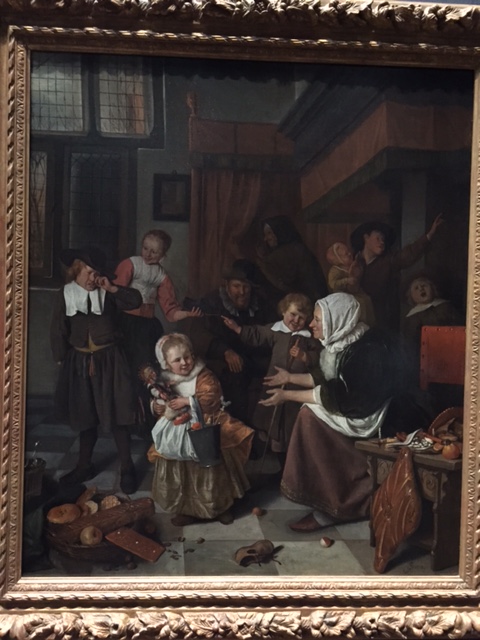
If you are Mendocino College Art 202 you have already seen this image of “St. Nikolaus” by Jan Steen. If you are in CR’s 1B you will be learning about this artist in a couple of weeks. I learned that I was wrong about it’s interpretations (allegorical). The little girl in the foreground is not being chastised for taking the doll, she’s been given the doll for being such a generous child and it’s the little boy who is dissatisfied with the treat she gave him.
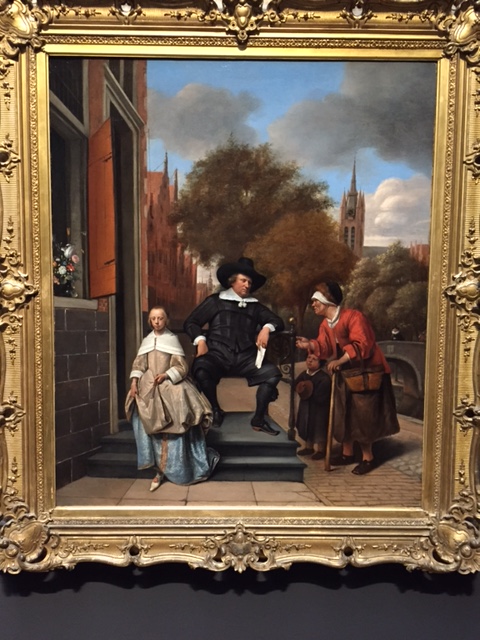
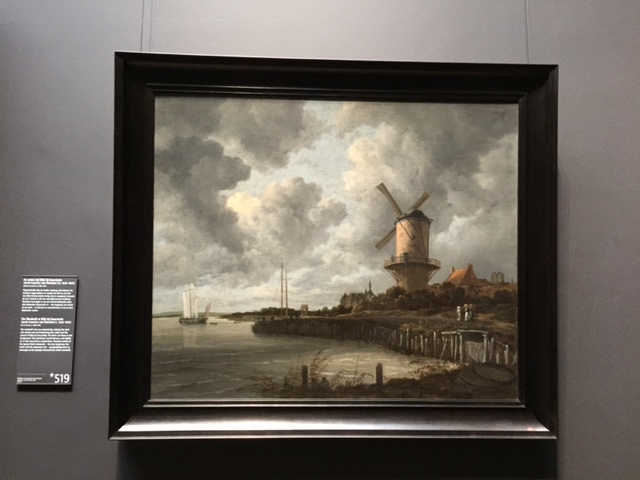
This portrait of a wealthy man and his daughter also by Jan Steen is a little odd because it shows a beggar woman and child. Why would someone want them in their portrait? Is it an allegory about generosity or stinginess? If the latter, it’s hard to imagine the sitter would want to pay for the portrait.Genre painting is a hallmark of Dutch painting of the 17th century. Genre painting depicts daily life and sometimes is an allegory of moral or religious content. In this case, always one of my favorites is a painting by Pieter de Hooch of a mother picking out lice nits from her daughter’s head, something most mothers have experienced along the way.My last post was of a real Dutch landscape though it did not have the windmill or water. If you look at any of the photo images of this country they have the same light and perspective of paintings like this one by Jakob Ruisdael. I’ll have more to share in the next few days.
The Netherlands is quite a civilized place, very quiet (even the dogs), and in addition to efficient trains and trams as in other parts of Europe bike culture is very strong. Not only for individuals to get from place to place but for transporting the children, pets, and goods. There are designated bike lanes, crossing lights especially for the bikes, and rentals at every train station. Of course, in the big cities the canals are a major source of transport as well.
Obviously the driver of this barge has a lot of experience with making turns in a canal, dragging a load behind him. Looks like he’s better than most of the RV drivers who come to Mendocino.
We picked up our bicycles that will be our primary mode of transportation this week. They say the Dutch are born on the bicycle and everyone has one. Of course, the Americans are the only ones protecting their heads with helmets.
Bicycle buddiesCrossing the heath
Holland is the most densely populated country in Europe because it is so small. People live in very crowded towns that allow for farmland and open space in between. We rented our bikes in one town and rode 3 miles back to Bussum through the open land you see. Notice how much this looks like Dutch landscape, especially the expanse of sky.
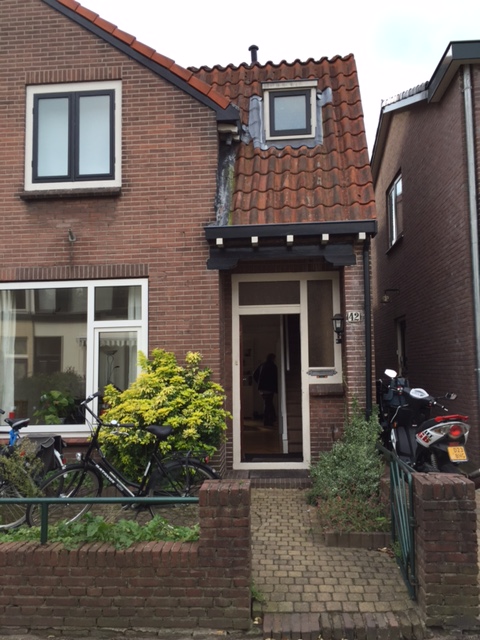
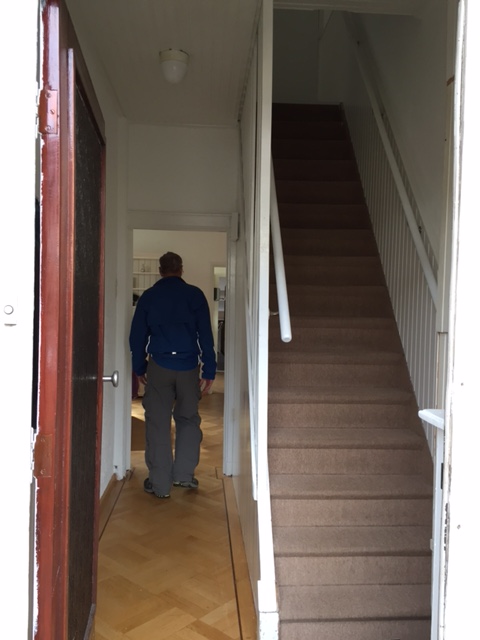
Bussum HouseStairs not for the faint hearted
This is the house of our friends Buz and Pamela Graham in a town close to Amsterdam. The town was established in the 18th century for wealthy people who wanted to escape the city. There are some large houses but in this neighborhood lived the people who “served” the wealthy like the butcher, the baker, and the candlestick maker. The houses are basically duplexes very close together, narrow, and tall to save space. In a tall narrow house the stairs are very steep. One does not go up and down quickly.
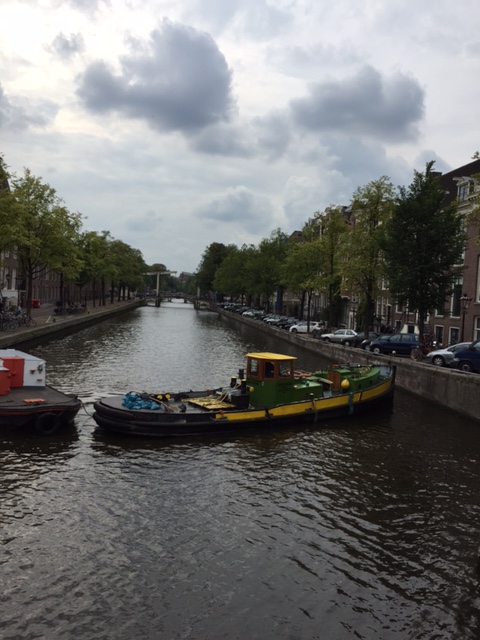
Typical CanalHouseboats
In Amsterdam one crisscrosses the canals and at this time of year many of the bridges have beautiful flower baskets. All have houseboats with some that are quite elaborate and some look like watery slums. We heard a tour guide saying that at the end of World War II houseboats were a temporary housing solution that stuck. Can’t verify that one. Needless to say they look very permanently temporary.
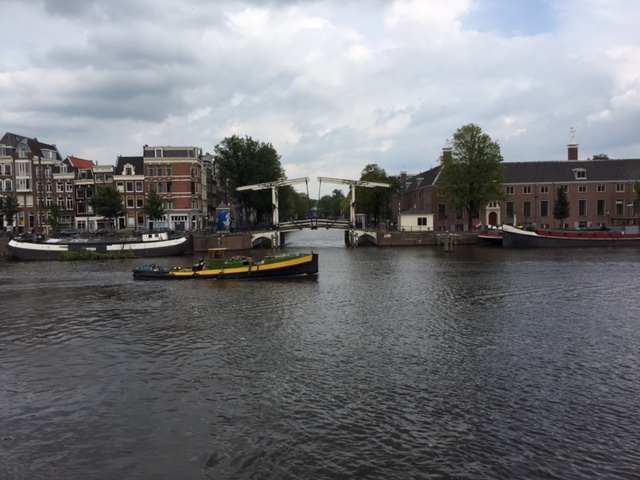
Have seen some very small cars since parking is quite a challenge in this city though bike parking can be had fairly easily. Many canals have these kinds of draw bridges. Van Gogh made one famous in a painting he completed in Arles. This one is on the main canal on the Amstel River.
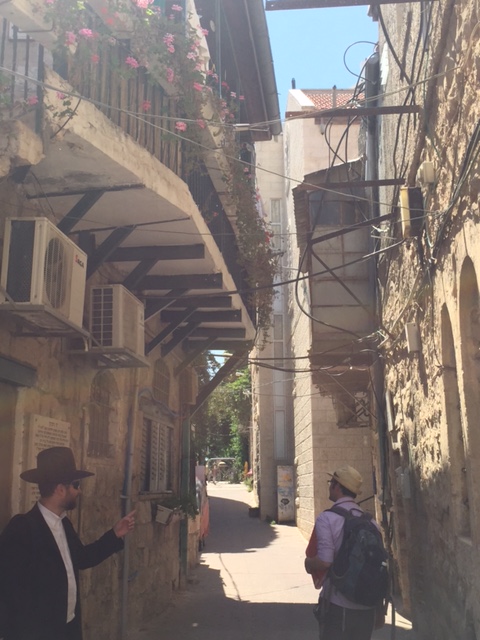
There isn’t a whole lot that I haven’t seen in Jerusalem, though I’m always surprised to see something new. I’ve always been curious about the Nachlaot neighborhood and took a tour there with a guide who used to live there. Yossi was a charming young British man who has lived in Israel for 9 years, most of that time in Jerusalem, and for about 5 years in Nachlaot. Nachlaot is a neighborhood of narrow alleys right smack in the middle of Jerusalem and you might not even notice it is there unless someone takes you. (Note just noticed this was never published/sent even though I’ve been home for a couple of weeks). Sorry about that.
A bit of background, in the mid to late 1800s the Ottoman Turks began to make life difficult for Jews in Jerusalem and they began to seek other places to live while remaining close to their roots and holy places. Hence the Nachlaot came to be.
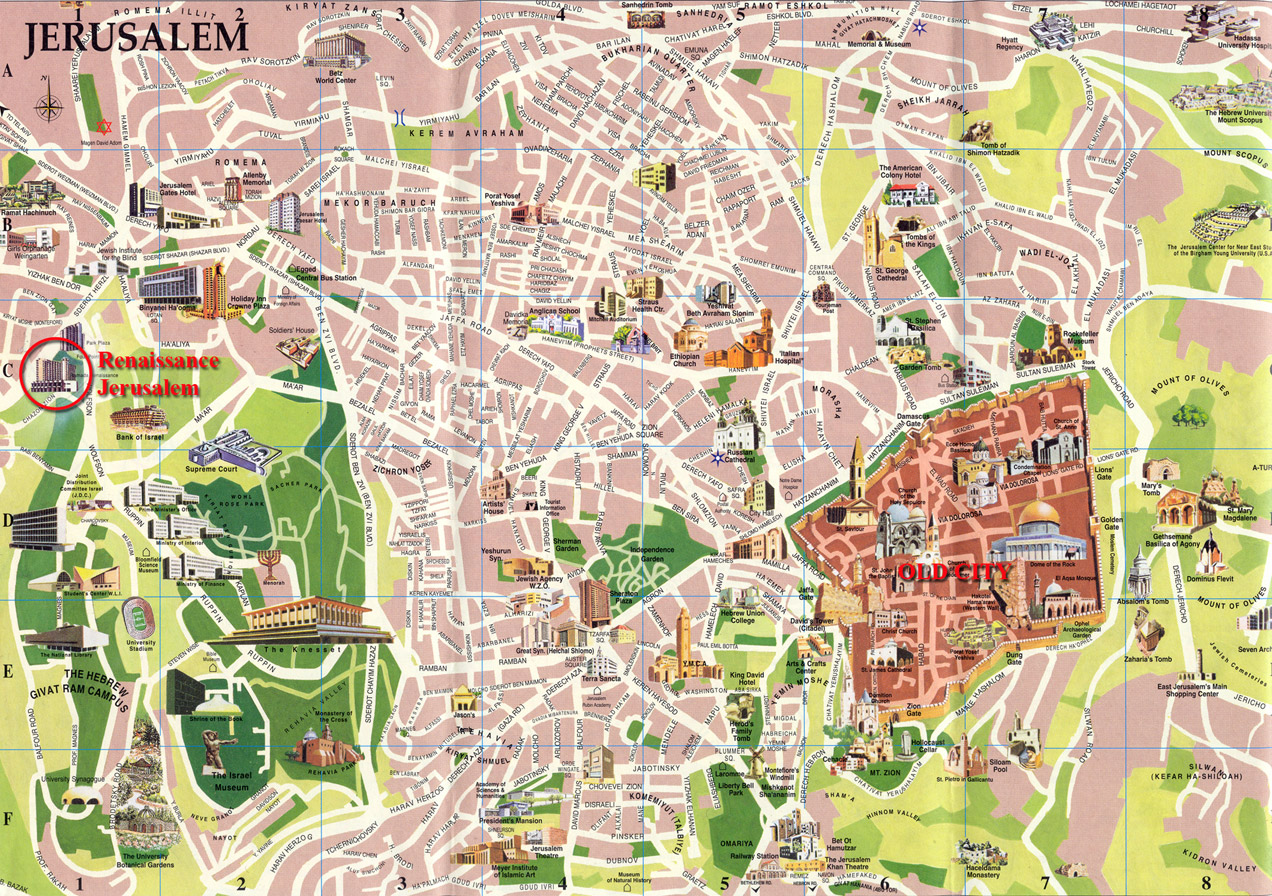
This is a typical tourist map for Jerusalem today. The red area of the old city is where EVERYONE lived in the 1800s. The rest of what you see on this map was built after that time. The population of Jerusalem at the end of the 19th century was 20,000. In 2003 total population was close to 700,000.
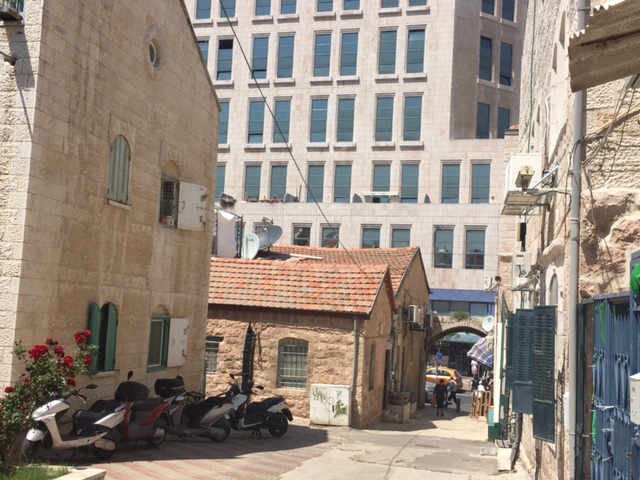
This is a perfect view to show how these neighborhoods, which meander from one to the other are right in the center of the city. When Jews no longer felt comfortable in the Old City they moved outside the walls, though you can see this is a compound with an arched entrance at the far end. If you look on the map you’ll see a large green area to the west. These neighborhoods are the meandering alleys on the map between that green area and Ben Yedudah Street. Outside the walls of the old city people felt vulnerable to wild beasts, bandits, and many many many rats. Hence, the British introduction of cats which have multiplied beyond belief throughout the city of Jerusalem.
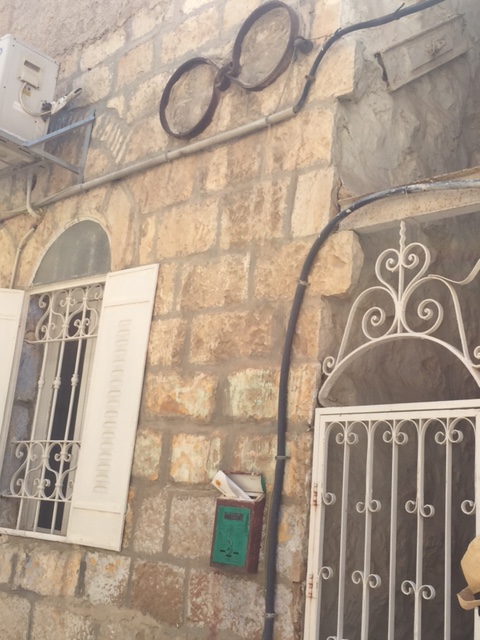
An ingenious way to prevent buildings from collapsing in earthquakes- the eyeglass style bolts holding the building together somehow. This is exactly the kind of thing I would never notice without a guide.
The alley where Rabbi Aryeh Lev lived. This rabbi was a humble man who was truly righteous. The story goes that a former pupil would see him walking and run away every time he saw the rabbi coming. When Rabbi Lev finally cornered him one day, the pupil said, “I didn’t want you to know that I am no longer religious and have become an atheist.” Rabbi Lev reassured him that he did not think any less of him for that, we are all human beings, holy to G-d.
The Gemach: one of my favorite things in the religious Jewish community is the Gemach- it’s like a free store. Anyone can come in and get/leave what they want/don’t need anymore. No money is exchanged. Gemachs exist for goods you might need (extra chairs for a party, boxes for moving, and even a snake catcher in my daughter’s neighborhood).
Sephardic synagogue financed by Moses Monefiore a British financier who very generously established Nachlaot outside the old city walls. At its height these neighborhoods boasted 400 synagogues in one square mile (the most in the world for such a small area).
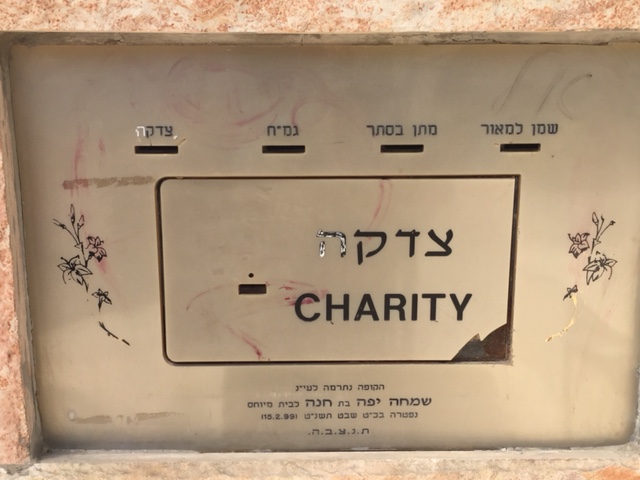
The charity slot on the outside of the synagogue. The slots along the top (left to right) say charity, gemach, anonymous donations, oil for lights (paying the PGE bill…)
If you ever saw the film “Ushpizim” this is where it was filmed. Worth seeing. This is the neighborhood of the people from Munkatch (sp?) Hungary, an important Jewish community that managed to make it to Israel unlike many of their fellow Hungarian Jews and resettle together in one of the Nahlaot.
Perfect example of something you would walk right by- the white structure in the front with the corrugated top is a bread bakery. Orthodox Jews don’t cook on the Sabbath and prepare everything ahead of time. When the bread was done on Fridays people brought their Sabbath food to leave inside the bakery to keep it warm over the Sabbath time. In exchange the baker got a sample of each person’s food.
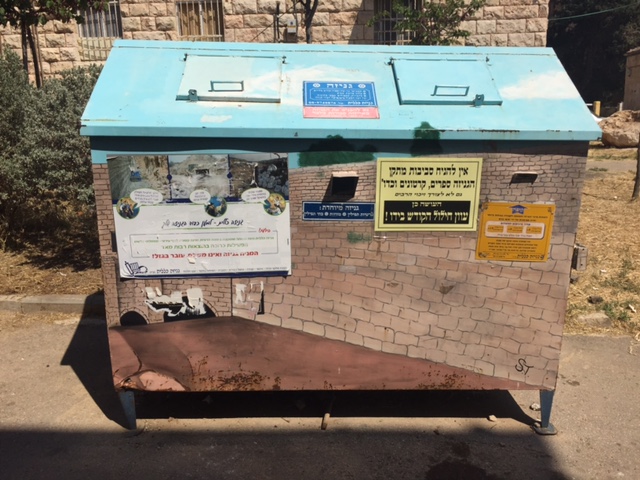
This looks like a decorated dumpster but it’s really a geniza- a place where you leave old books that you no longer want and any papers that have the name of G-d on them for proper disposal/burial.
Stained glass window seen through the grate of a synagogue window.
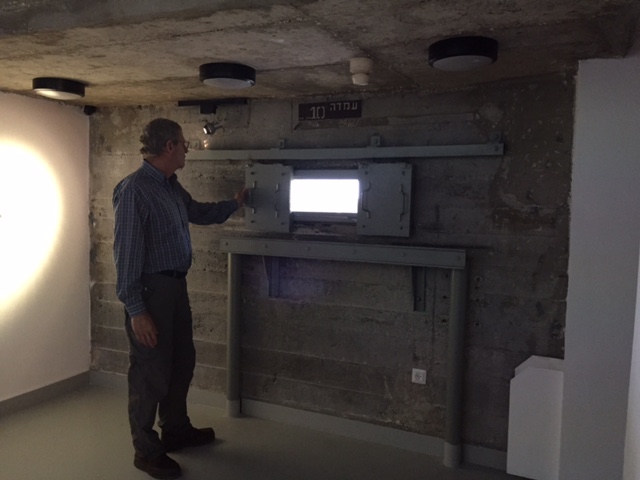
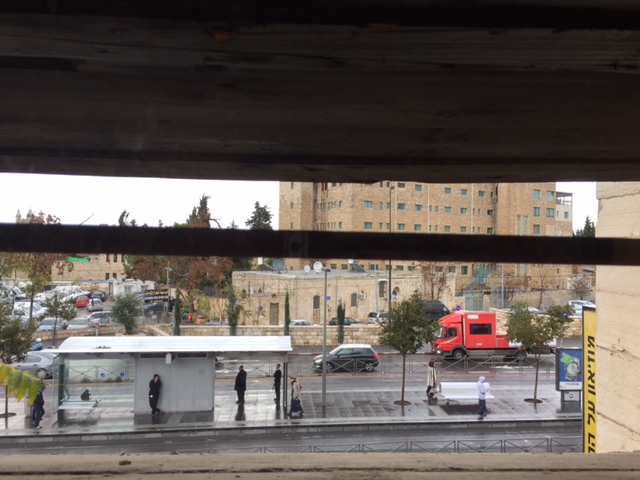
Most unusual synagogue is in the neighborhood bomb shelter. Our guide attended here when he lived in the neighborhood and described an eclectic mix of participants. These neighborhoods have been home to Jewish people from all over the world and from many different backgrounds all coexisting peacefully and in a cooperative manner. How unusual.
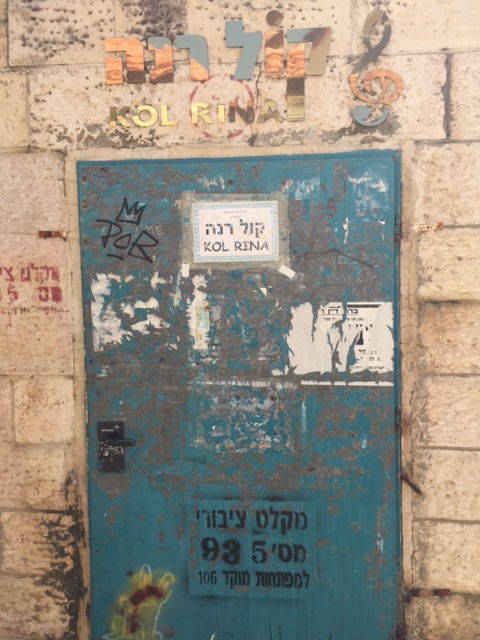
Most unusual of all, Kol Rina is likely to be one of the smallest synagogues in the world.
Always nice to meet a local- this man’s family came from Yemen 7 generations ago and has lived in Nachlaot his whole life. As is often the case he talked about how things “ain’t what they used to be”. This was a low income group of communities all living together peacefully and the area has now gentrified. What else is new?
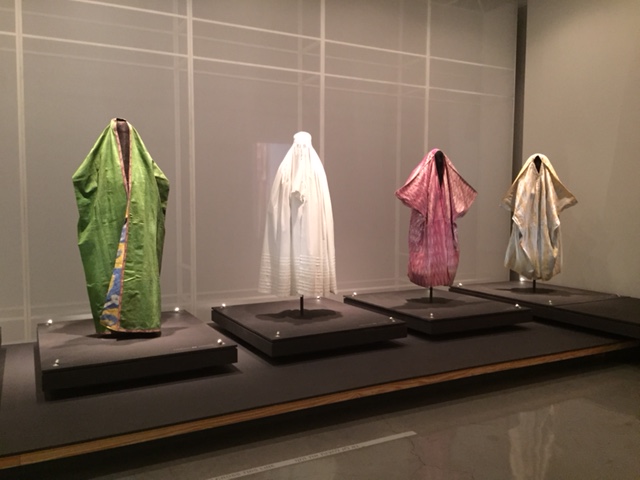
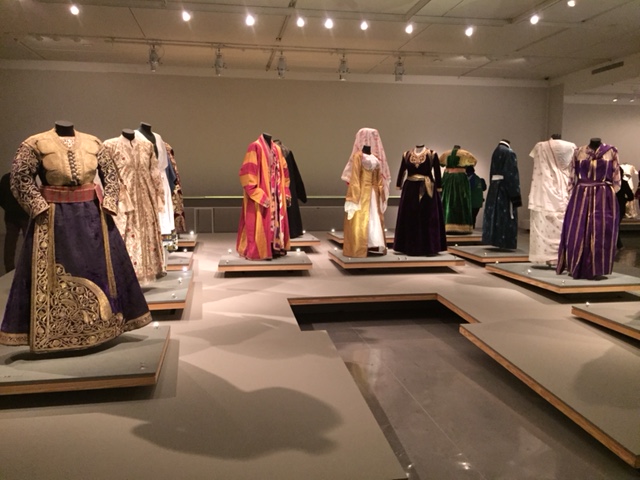
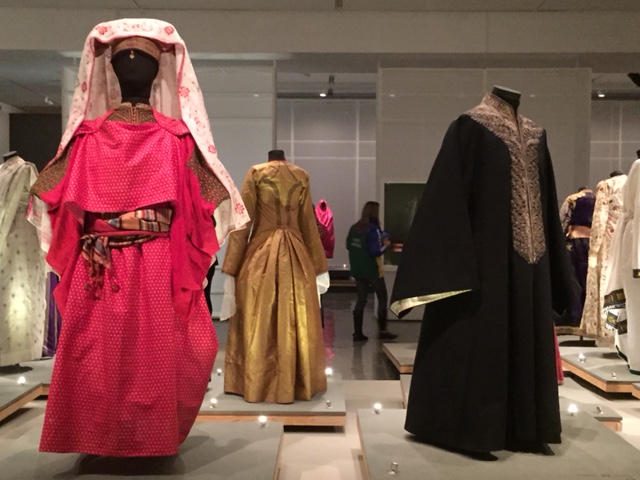
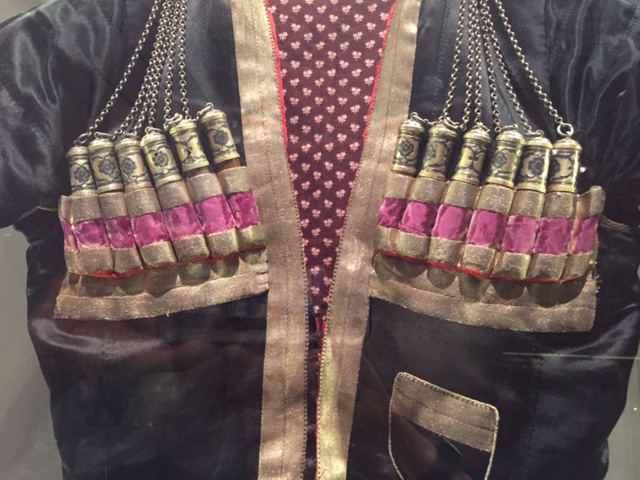
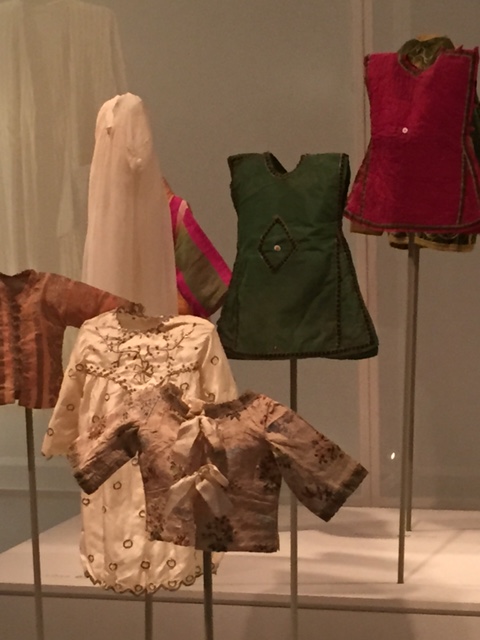
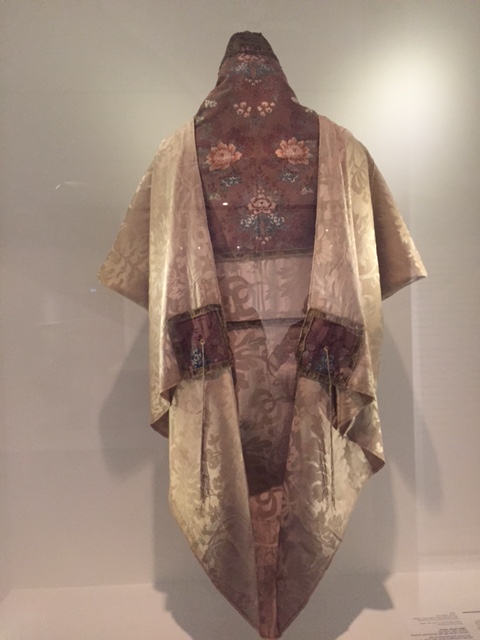
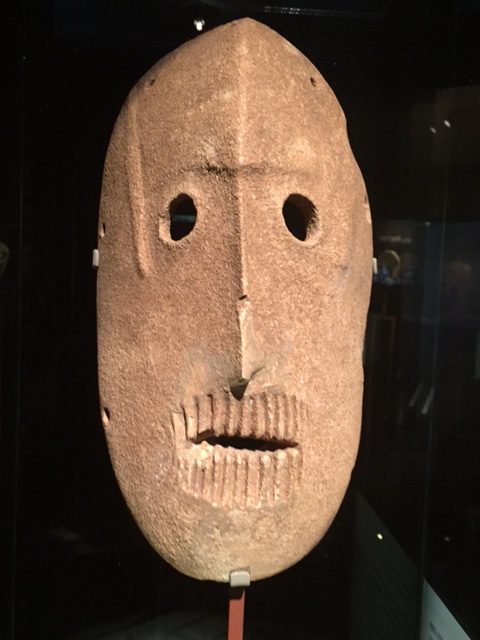
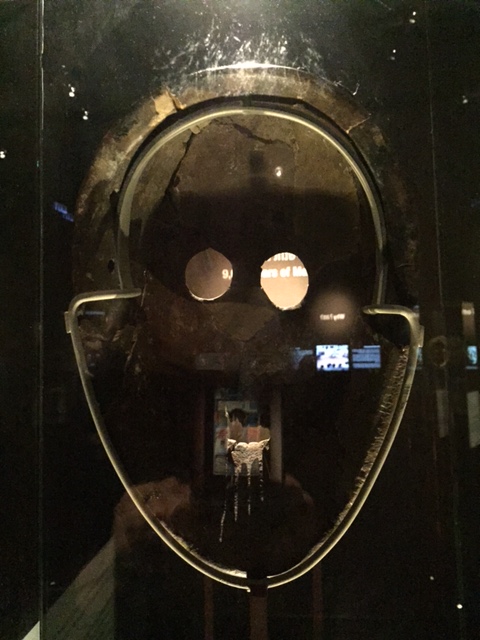
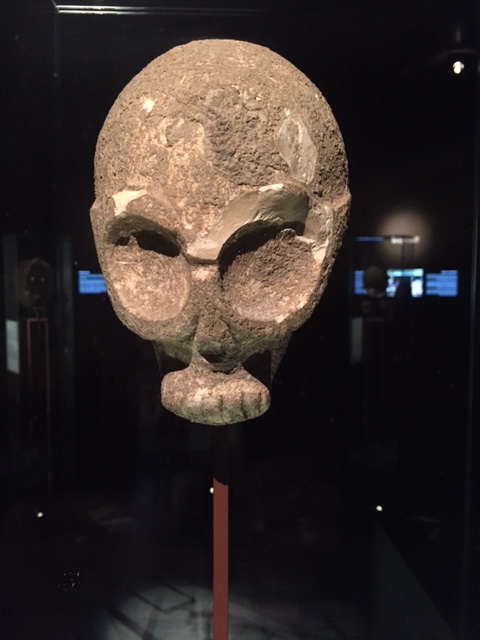
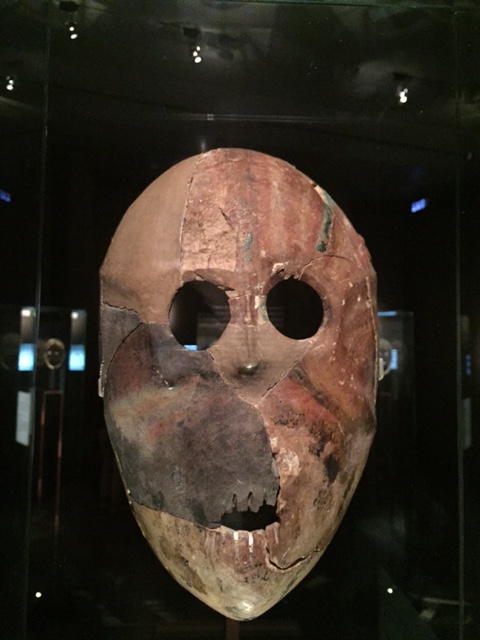
In my estimation a museum is successful if it has a defined mission, presenting interesting and thought provoking special exhibitions, and has a good permanent collection following this mission with a variety of works, more than a “one each” of the latest and greatest. Jerusalem has two such museums though very different in focus. The Israel Museum is a very well respected museum and has a very large collection that spans the ancient art of Israel and the Jewish diaspora, as well as a fine collection of art of the 20th and 21st centuries. There is always something new and inspiring to see. In addition to a James Turrell exhibit (an artist who is a master of using actual light, illusion, and color), the two exhibits we explored were “The Dress Codes: Revealing the Jewish Wardrobe” and “Face to Face: the Oldest Masks in the World.”
The masks are incredibly well preserved and are about 9000 years old. They have been dated based on other materials found in the area where they were excavated.
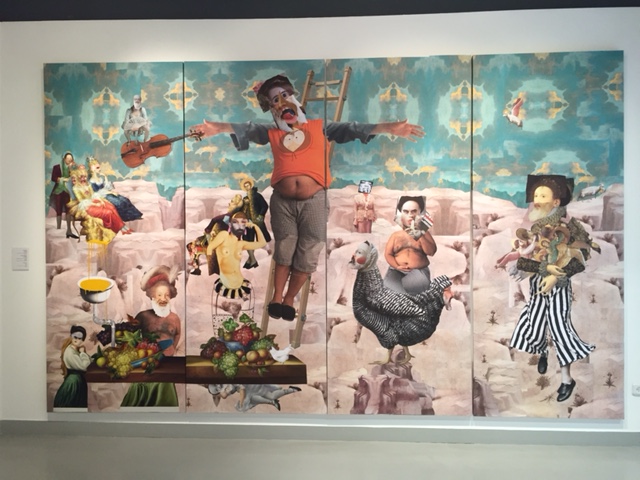
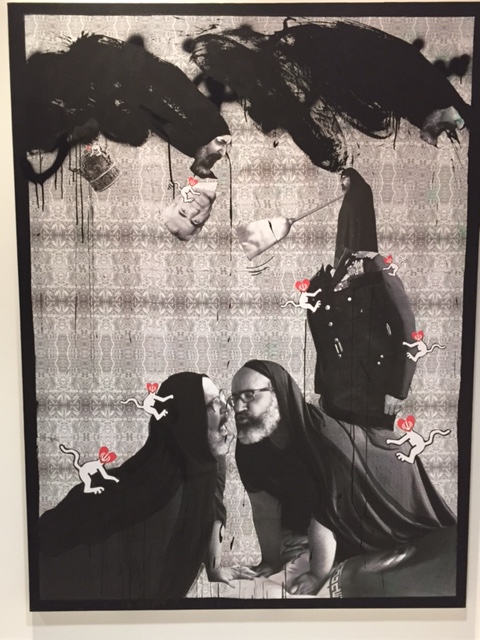
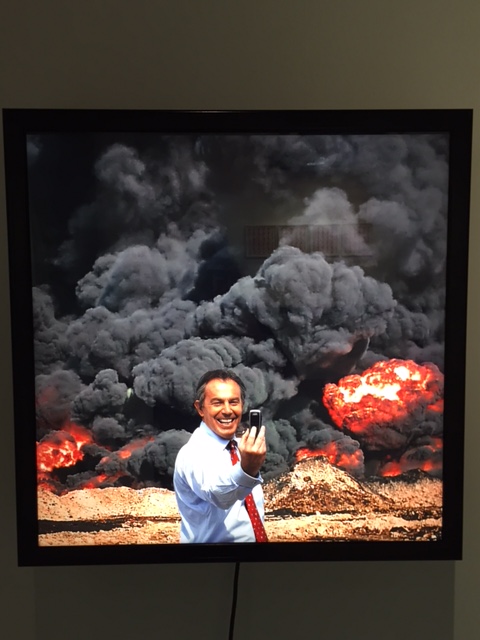
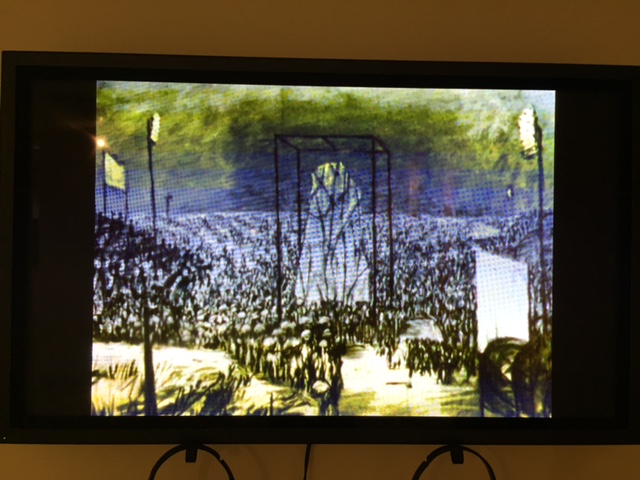
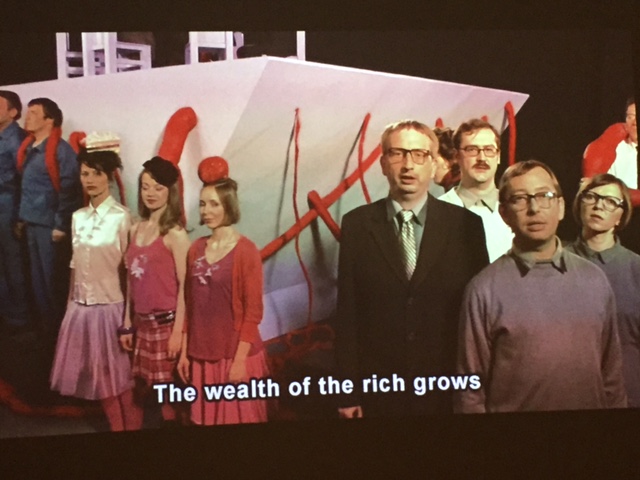
The second museum we visited has a unique focus. It’s called Museum on the Seam: A socio-political contemporary art museum. It’s housed in a former army outpost on the former border (seam) between Israel and Jordan. It was built in 1932 by the Barmki family and stands near the Mandelbaum Gate, the only entry into what was until 1967 the divided city of Jerusalem. The museum was founded by Raphie Etgar, whose goal was (and is) to show art that addresses human rights and civic engagement. The show we saw was “And the Trees Went Forth to Seek a Queen”: our relationship to leaders both public officials and charismatic religious and social leaders.
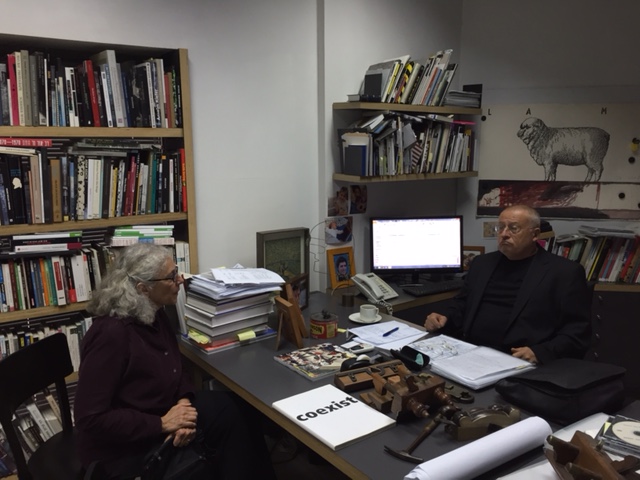
As we were leaving the museum, we met the director/curator Raphie Etgar who gave us the sad news that the benefactor (a German non-Jewish family) who has been the sole support of this museum has decided to no longer fund it. He had just received this news himself and we could tell he was still in shock. It looks like the museum will have to close at the end of this year. Very sad, especially at such a difficult time in peacemaking in this part of the world. The last image in the blog is a photo of us in his office talking about this sad situation and how they might continue their valuable work. We discovered that this museum is responsible for the “Coexist” exhibit that traveled the world and you are likely to have seen the bumper stickers even in our small town of Mendocino. Check out the museum’s website to learn more.
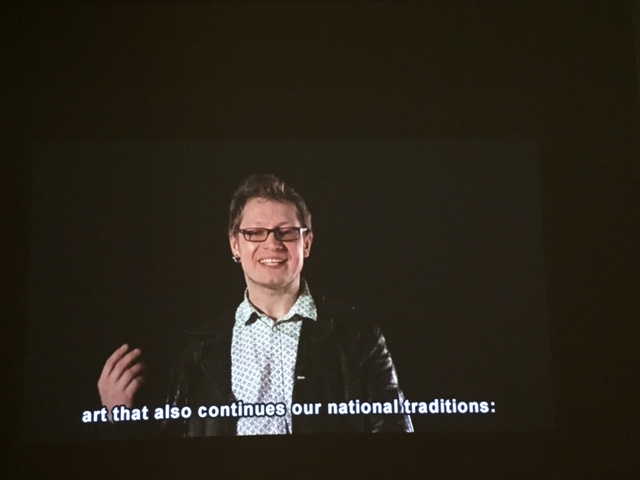
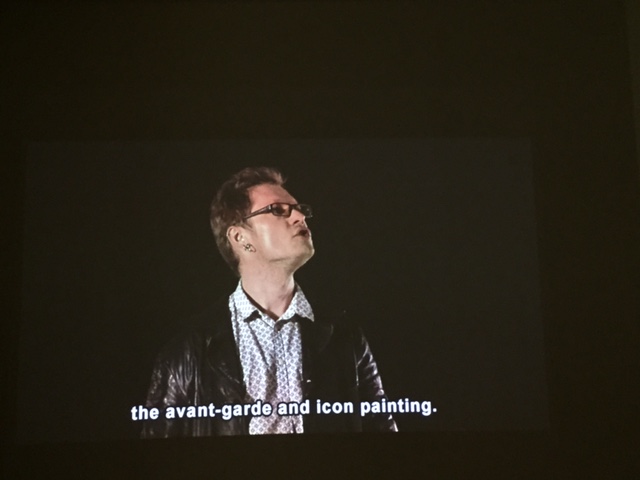
These dresses are from Afghanistan, Iran, and Iraq from the 19th-20th centuries. They look so much like the traditional Muslim shadow.Much of this exhibit focused on modesty in dress, a common theme in Muslim and Jewish traditions.The central platform of the exhibit included dresses for women and robes for men from throughout the world worn in Jewish communities.Detail of dress and robe from Morocco, early 20th centuryIt’s amusing to think these 19th century dresses from France were considered the height of modesty with such emphasis on the bust.Early 20th century Georgian (the country not the state) man’s robe.Detail shows silver niello (remember this from our studies of the Aegean and early Greece) and gunpowder cases.Wedding attire from Turkey, Iraq, and Uzbekistan, 19th centuryChildren’s clothing including outfits for special rituals such as circumcisionA Tallit (prayer shawl) from Western Europe, 18th centuryFound in the Judean Hills, mouth appears to be smiling but the forehead is furrowed.This one seems to have a worried expressionDoes it seem like this mask is staring back at you? This one is made from chalkThese are all limestone masks, particularly liked the teeth.One way to tell if mask was used for ceremonial purposes to to look at the back to see if there are wear marks and to see if the facial features line up. This exhibit allowed the viewer to see both sides.Made from chalk, meant to be placed on a ceremony pillar.This limestone, asphalt, and pigmented mask was found in the world’s oldest cultic hoard along with parts of statues, textiles, beadsThis encapsulates what the show was about.Iranian artist living in Dubai because his own government threatens him.Artist appears as figure in a chador, 2010-2011These artists have been active in the Campaign for Nuclear Disarmament in the 1970s-80s.There were a number of video works in the show and this one had the soundtrack for the song. It is portraits of Kim Jung Il and his son Kim Jung Un of North Korea.Those familiar with his work will recognize the changes in the video as I have included two images.second imageBilly clubs arranged in a Jewish star. They also look like crosses. You might call this a work taking off from Duchamp’s readymades.This was an interesting “play” on a controversial tower that GasProm the equivalent of Chevron was planning for St. Petersburg that would tower over one of the most beautiful old cities in Russia.
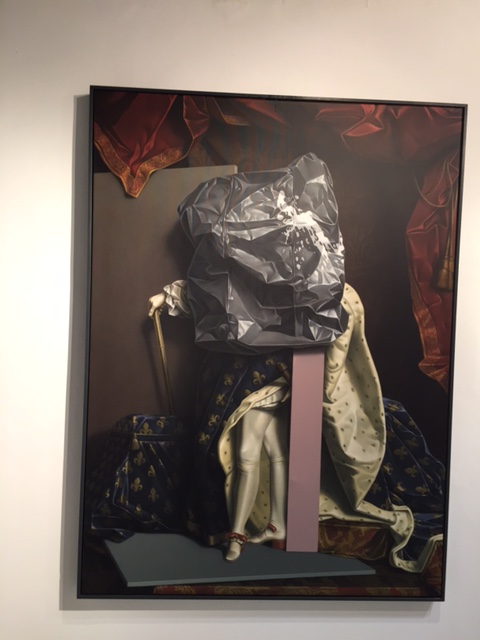
Sorry about the crooked image, based on the Hyacinthe Rigaud portrait of Louis XIV but with a bag over his head!Stairs leading up and down all floors of the museumWith ladders
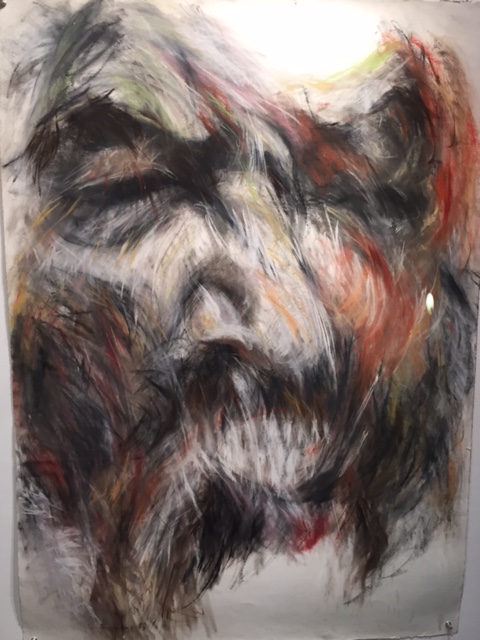
Three portraits in pastel of Meir Kahane, the controversial leader of something he called the Jewish Defense League that was racist and advocated violence against non-Jews. He was assassinated in New York.
Some revile Begin and others praise his accomplishments, probably the most memorable of which was the agreement he worked out with Anwar Sadat of Egypt for which they both received the Nobel Peace Prize.Reminder of what this museum building was before.Just down the street (this is Highway One) is the entrance to the Old City of Jerusalem. Truly “on the seam” right now.
We’ve visited a number of small communities that have reminded us of home but spent the night in the guest house of a Kibbutz (cooperative community). It was a lovely place very quiet and peaceful. They are very good at what we like to call reduce/reuse/recycle. You’ll see what I mean. On the way north we stopped in a nature reserve called Ein Afek and ended up in Tzfat where we’ll be spending a few days quietly relaxing.
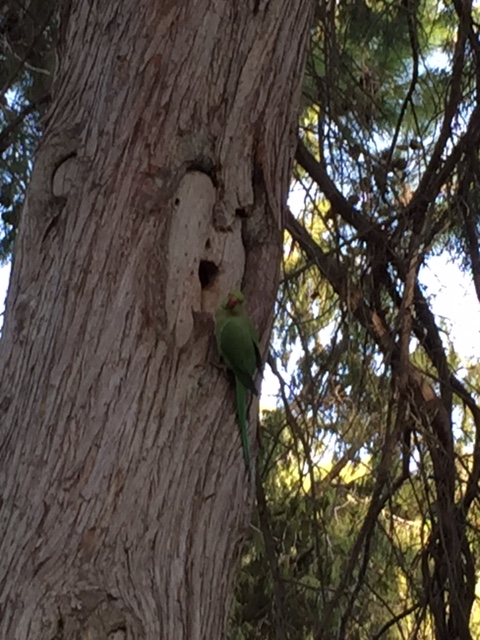
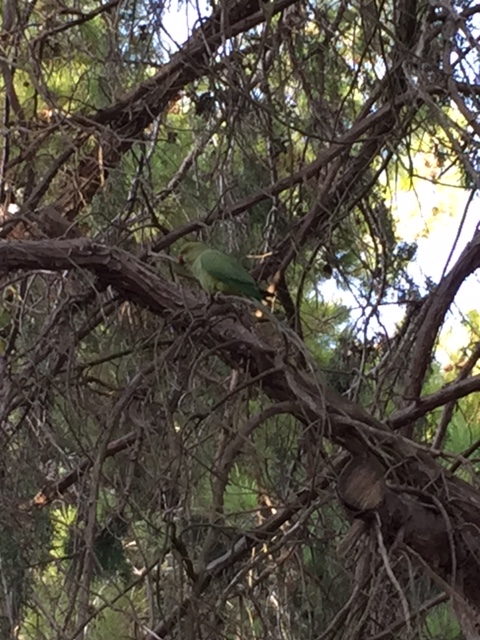
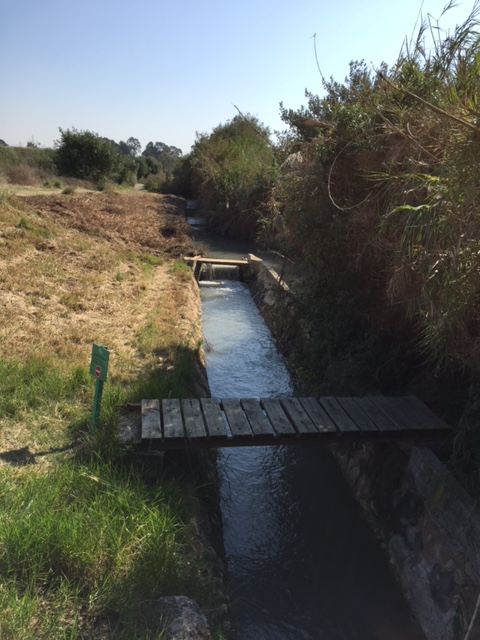
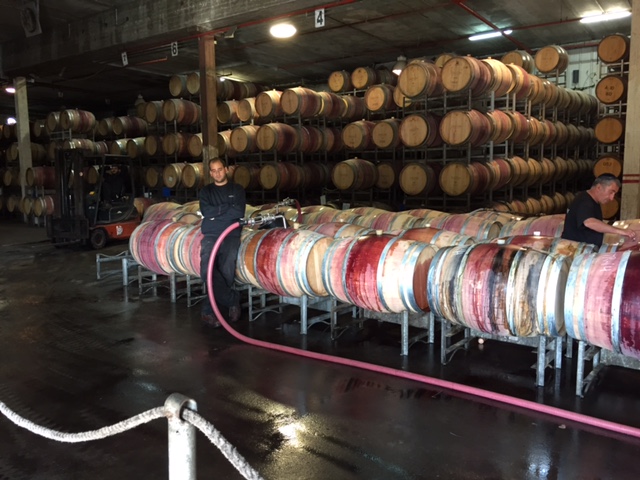
Tractor tires made great planters along the walkways.Close up of one of the plantersConcrete makes great trucks for the kids.No one was quite sure how the parrots got there but they definitely are present in a large quantity.More parrots…parrots of Kibbutz Dalia instead of Parrots of Telegraph HillIt’s amazing no matter where you go in this country you’ll find something ancient- in this case a Crusader fortress with that incongruous British guard tower from 1935 on top.Not far from the coastal city of Haifa is this nature reserve with natural springs.This canal in the reserve was full of carp and catfish.More birds in the trees. Look like a cross between cormorants and ducks.Dalton Winery red wine barrels- the winemaker trained at Navarro Vineyards in Anderson Valley about 13 years ago.Sunset in Tzfat on the balcony surrounded by grapevines and a great bottle of red wine!
The town of Zichron Ya’akov which now has a population of 18,000 was established as a small village in 1882 by the French Baron Edmond de Rothschild who wanted to establish Jewish settlements throughout the north of Israel. Even then it was determined that this was an excellent wine growing region and so establishment of a small town based around winemaking became very successful. Rothschild brought in architects and planners from France to build French style stucco houses with tile roofs, and small gardens. A number of them can still be seen in the historic center of town. This town is the home of the Carmel Winery, which is the largest winery in Israel. It’s the Israeli equivalent of Manischewitz though has more varieties of wines they produced.
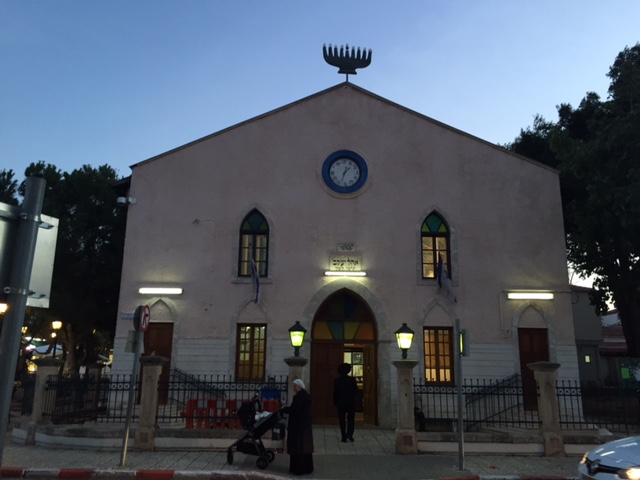
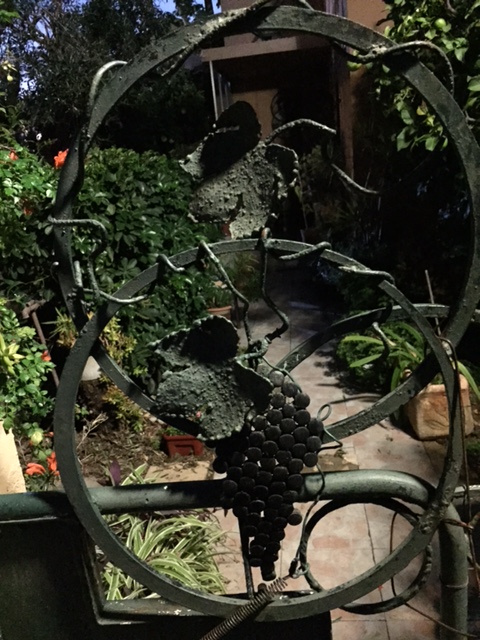
This building that is now a bank was home of a musician from the original settlement of mostly Roumanian Jews.Pedestrian Mall with many of the old houses converted to shops, galleries, and restaurants.Alleys take you to galleries and small houses.Benjamin’s water fountain provided drinking water to the residents.Tishbi Winery tasting room looks like any bistro in small French villages.Interior of a restaurant, very “French” bistro style.Ohel Ya’akov the synagogue in the center of town built in 1866 to honor Rothschild’s father (Ya’akov) also the name for the whole town: Remembrance of Ya’akovInside of Ohel Ya’akov synagogue.A metal gate hinting at the production of wine in the region.Entrance to the winery production area.The old entrance gate to the Carmel Winery. This may be where tours enter.
While Katzrin (also spelled Qatzrin) is a planned town in the Golan of about 7000 people, it has also been inhabited since the Bronze Age and there is an archaeological park well excavated and “restored.” Restoration is always a tricky thing as sometimes it goes too far and becomes more recreation than restoration. We saw that first hand in Myanmar and those of you in Art 1B learning a bit about this in our discussion of Tibet: Temple at Mustang.
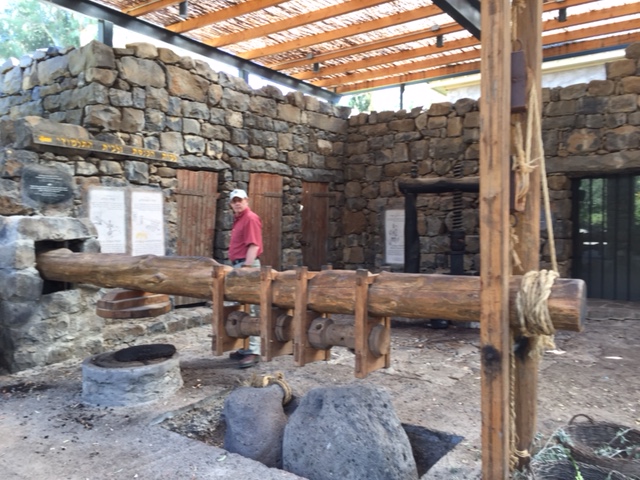
Katzrin has an active educational program where they do demonstrations about life in the 3rd to 4th century when Katzrin was an active Jewish village that was subsequently destroyed by an earthquake and abandoned. We visited on a day that there were no demonstrations so we did some guessing on “life” in Katzrin, especially revolving around olive oil production, something that is a major commodity produced in the Golan today.
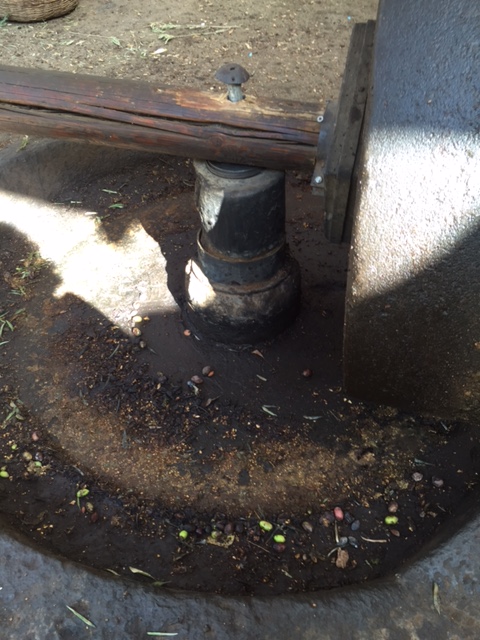
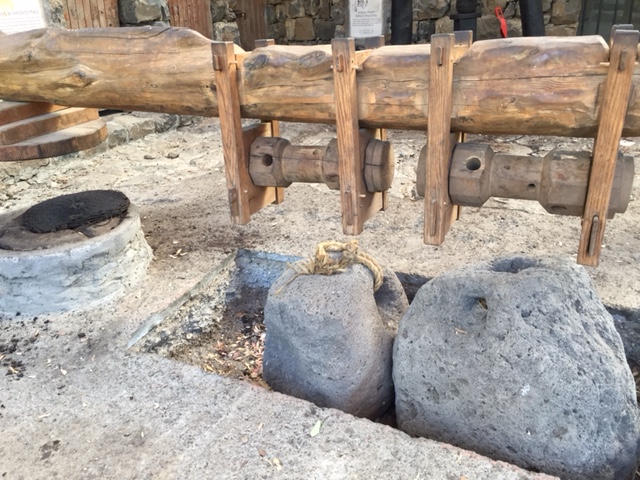
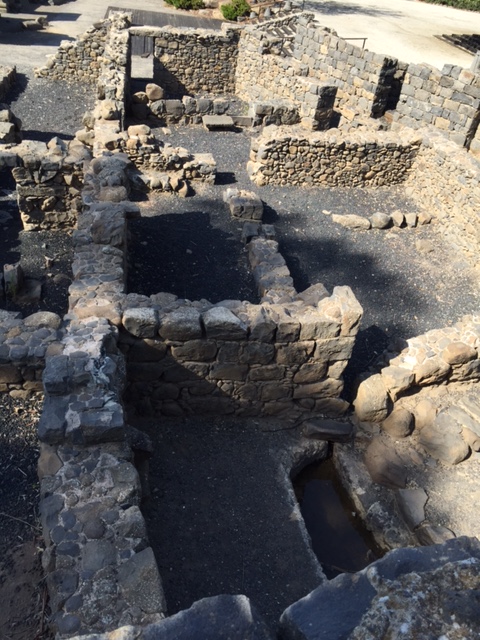
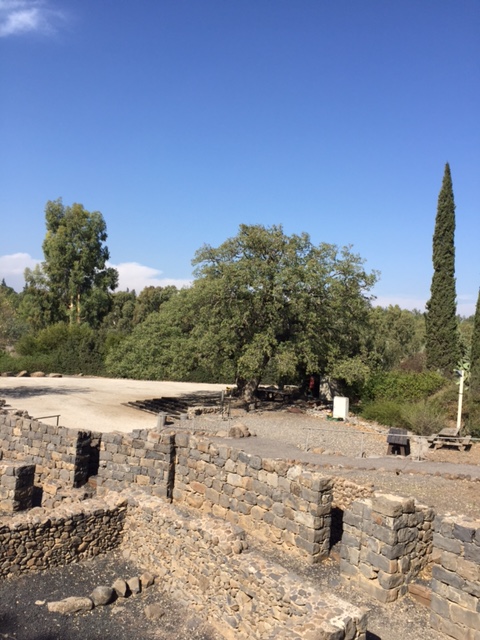
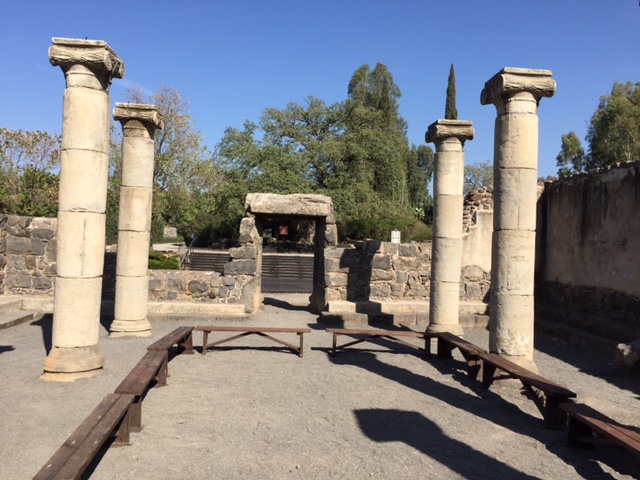
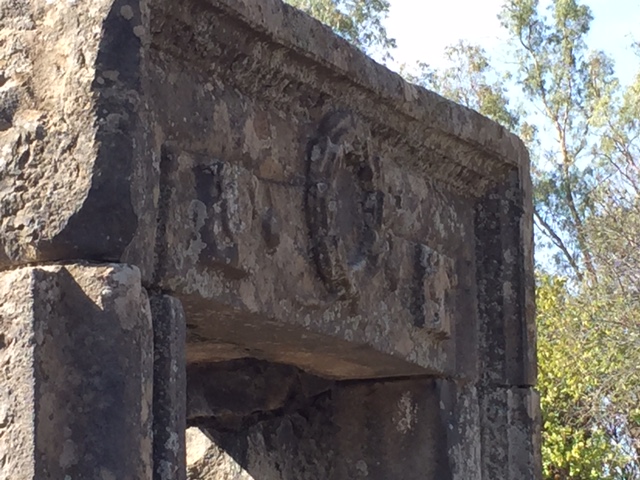
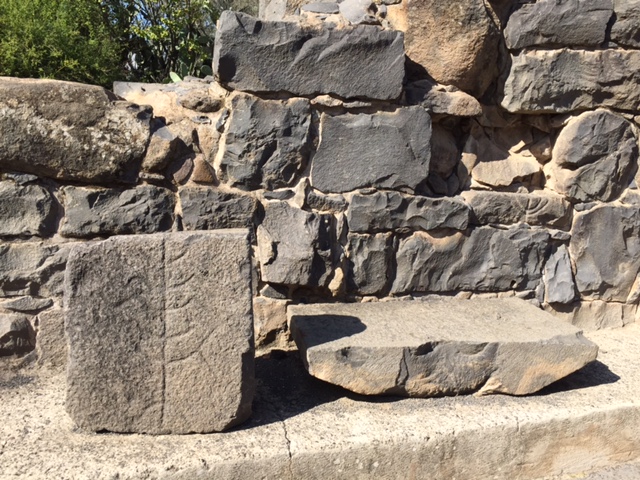
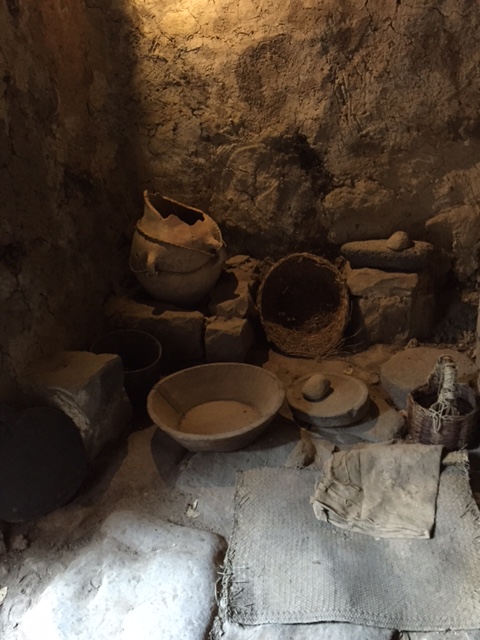
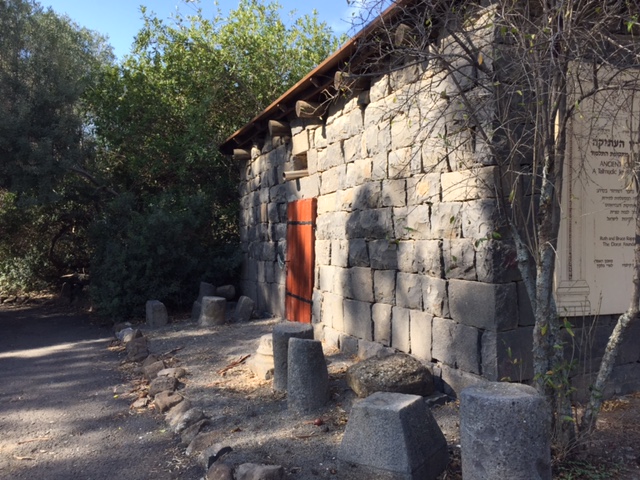
Turning the olive press.You can see remnants of olives actually pressed for demonstrations.Not sure exactly how this one works but can imagine.Close up of stone oil “catchers”?At Jeff’s feet you can see a tin bucket that actually looked like it had olive oil in it.Wall painting demonstrating the oil production.Ruins of the village, over the top of the wall to the right you can see the column tops of the synagogue and top left is the house that has the kitchen and some of the rooms recreated.A spring still produces water.The oak tree you see in the background is 400 years old.Interior of the synagogue. Bar/Bat Mitzvahs are still performed here as are weddings. Now that’s a real “destination” wedding.Outside lintel of the synagogue. It has an inscription that says: this is the Beit Midrash of Rabbi Elazar the Caper (?) Maker.Carved images in the ancient synagogue, one very small in the middle of the right hand side and the lower foreground.Inside the reconstructed house- the cooking areaBowls and assorted potteryAssorted tools for home and field.Assorted clay jarsLadder to the bedroom.Bedhouin house abandoned when Israel took over the Golan in 1967, reconstructed.
As I work on this posting there is a funeral going on downstairs for the head Rabbi of a Yeshiva (school) across the street from my daughter’s apartment. A heinous attack took place in the western part of Jerusalem this morning as people were leaving morning prayers. Four were killed and nine are in the hospital. It’s very subdued here in the city today and we have heavy hearts wondering how peace will ever come to this part of the world.
End of last week we spent some time in my favorite part of Israel, the Galilee and explored a bit of the Golan, the area bordering between Israel and Syria that became part of Israel in 1967.
Rosh Pina is a small town that was established in 1882 by 30 families from Roumania. It reminds me of our small towns in Northern California. In fact this is the town where Jim Klein, winemaker from Navarro Vineyards stays when he comes to the wineries of the Golan.Street scene in Rosh Pina. We made this our base for exploring the area.
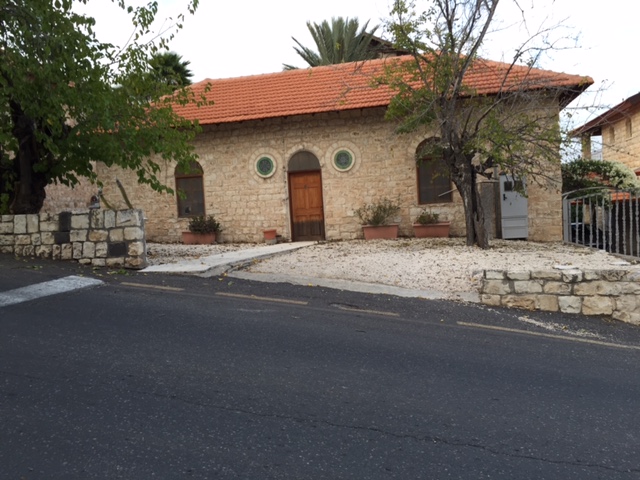
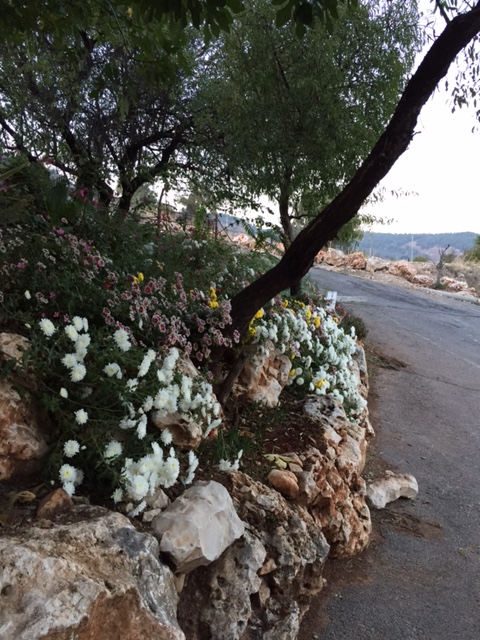
A restored original house in Rosh Pina, once again in stone.Beautiful flowers- we don’t often see carnations in the ground.
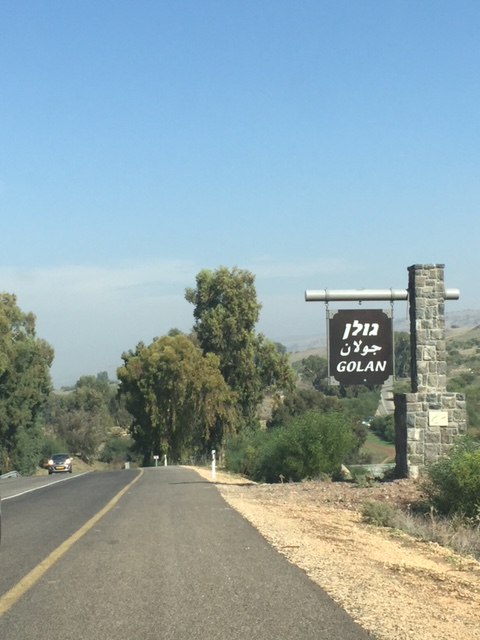
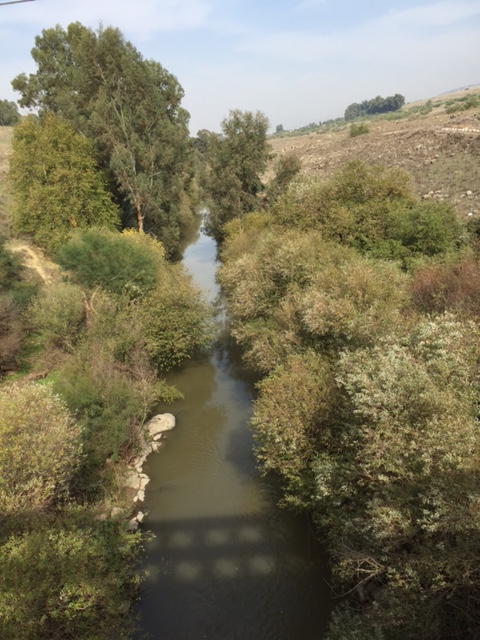
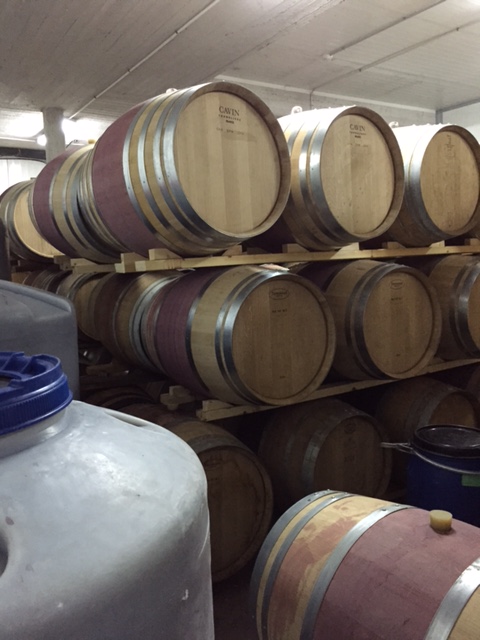
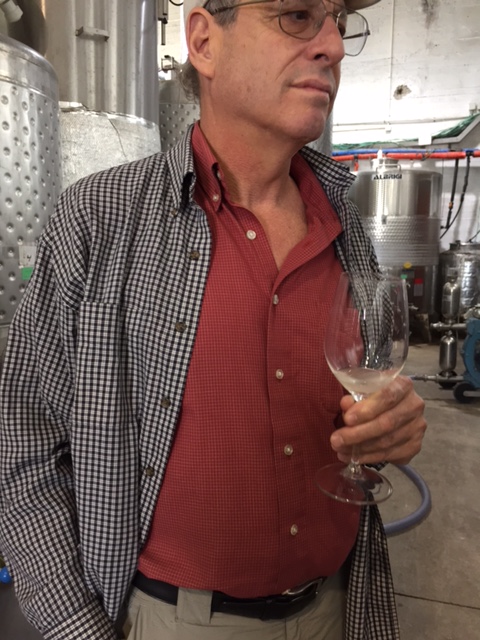
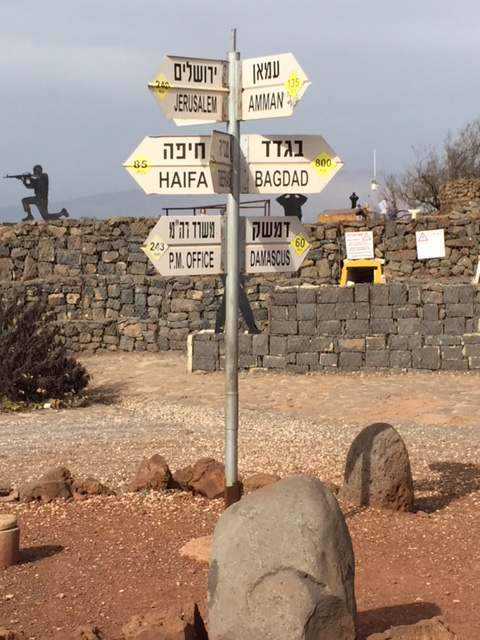
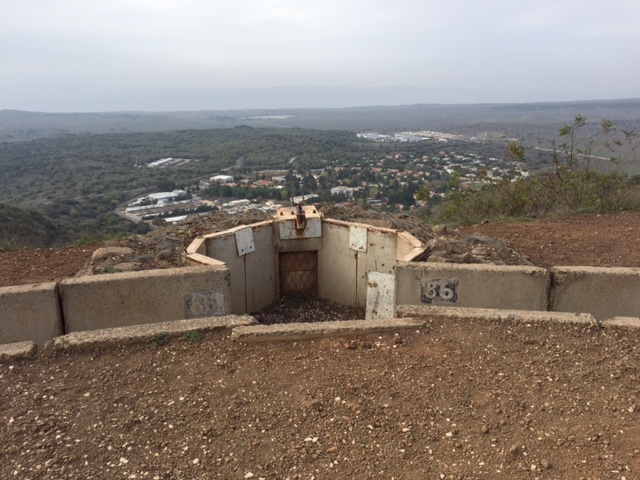
Entrance to the GolanThe Jordan River- hard to imagine that this is the main water source for much of this region.Ein Zivan, one of the closest kibbutzim (collective villages) to the Syrian border. On the left you can see a fortified building from before 1967.Pelter Winery is located at Kibbutz Ein Zivan. These barrels are for the red wine. The Golan is the wine growing region of the country and they produce wine for local consumption as well as for export.Tasting some of the white wines at Pelter a very small winery.At the top of Mt. Bental a short drive from Ein Zivan we visited a former Syrian outpost taken by the Israelis in 1967 after a fierce battle. By looking at the direction signs you can see how close everything is in this part of the world.Sculptures constructed from war machinery left from previous wars. Let’s hope we can turn all war material into works of art someday!Looking out from the gun emplacements atop Mt. Bental looking down towards Israel and the Meditteranean.Kibbutz Merom Golan just below the mountain.Looking towards Syria on the other side, the fields of Quneitra, the border with Syria and new Quneitra in the distance. Quiet at the moment.Two UN peacekeepers we encountered one from Estonia and the other from Norway.

























































 Poetry Without Words