Not what you think. I’ve always wanted to visit the Hermitage Museum in St. Petersburg but not much else in Russia so that seems like a long way to go for a museum. Now I don’t have to go (or not anytime soon). The exhibit at the Foundation Vuitton was an amazing collection of art from the Hermitage. I learn something new almost every day, and this was one of those times that I said to myself, “how come I never heard of this man before”? Sergei Shchukin was one of the greatest collectors of French modern art very similar to Gertrude Stein and her family. The collection included Monet, Matisse, Picasso, Cezanne, Gauguin, Van Gogh and of course the important early 20th century Russians. Once Lenin nationalized the collection and Stalin asserted that art was “bourgeois” the collection was placed in public art collections at the Hermitage and Pushkin Gallery in Moscow.
This is the first time since the work was initially collected that it makes its appearance in France, where most of it was created and first exhibited. If you are a Matisse fan as I am hope you can imagine seeing so many of the most iconic works in one place so unexpectedly. We will be learning about all these artists this semester (unless you are in the ancient art class-sorry but more is coming for you in the next few days).
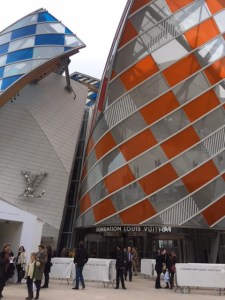
On a side note: The color on the outside of the museum is a temporary site specific work by Daniel Buren. If you want to see more of his work go to:
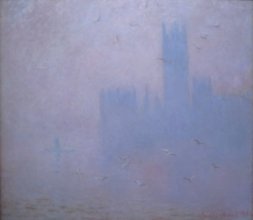
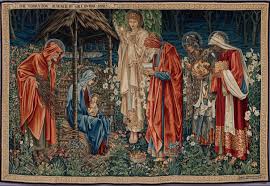
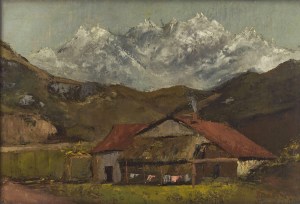
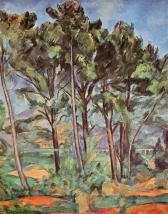
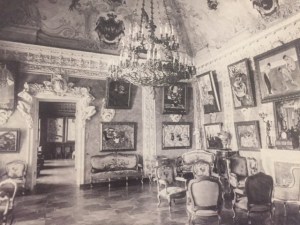
Monet, ” Seagulls, River Thames in London”, 1904Monet, “Luncheon on the Grass”, 1856. Certainly a different take on this theme than Manet’s “Luncheon on the Grass.”Monet, “Vetheuil,” 1901Edward Burne-Jones, “Adoration of the Magi”, tapestry, 1886-1902. It’s so interesting to see this painter’s work in tapestry that looks like one of the Raphael cartoons for tapestry since this artist is a Pre-Raphaelite.Picasso, study for “Saltimbanques”Gustave Courbet, “Chalet in the Mountains”, 1874. Unusual to see a small landscape by this artist known for his massive figurative paintings.Pissarro, “Avenue de l’Opera, Snow Effect”, 1898Matisse, “Bois de Boulogne”, 1902Cezanne, “The Aqueduct,” 1890Photo of one of the rooms showing the collection as it was in Moscow.Matisse, “The Red Room”, probably his most famous painting that you will be learning about this semester.
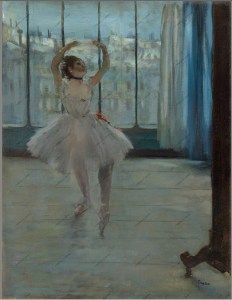
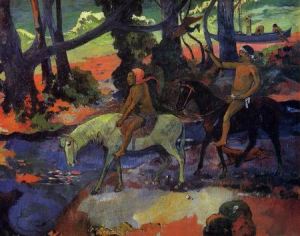
Degas, “Dancer Posing fo a Photographer”, 1875. An interesting image considering that Degas himself used photography to capture dancers and then paint them in his studio without the model.Gauguin, “The Flight”, 1901. Most of his religious paintings were completed when he was still in France so it’s unusual that he did this in Tahiti, including local people in the image.Gauguin, “Sunflowers”, 1901. Gauguin and Van Gogh were close friends and worked side by side until Gauguin left Europe for the South Pacific. Wonder if he was thinking about his old friend when he painted this.
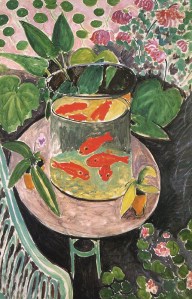
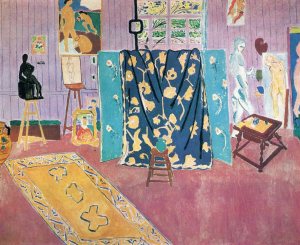
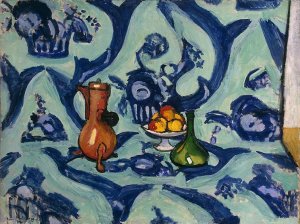
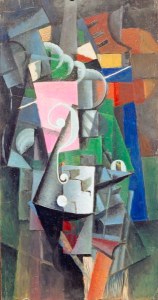
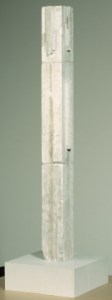
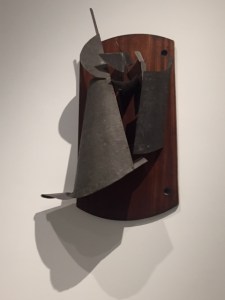
Picasso, “Woman with a Fan”, 1909Sub Sahara, wood sculpture, 19th century. It’s easy to see how much Picasso was influenced by these figures he would have seen in the museum in Paris at the turn of the century.Picasso, “Absinthe Drinker”, 1901. Shchukin said of Monet and Picasso: “If, with Claude Monet everything flows, Picasso’s hand makes everything solid….where in Matisse’s work, there are just silhouettes, with Picasso, there are just volumes.”Matisse, “The Goldfish”, 1912Matisse, “The Pink Studio”, 1911matisse, “Still Life with Blue Tablecloth,” 1909Matisse, “Arum Lilies, Irises, and Mimosa” in a Blue Vase”, 1912Malevich, “A Non-Stopping Station”, 1913Malevich, “Suprematic Architecture Model”, 1927Tattling, Counter Relief, 1916
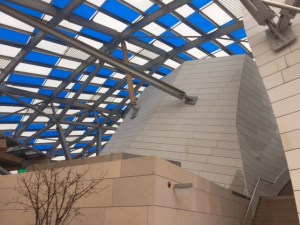
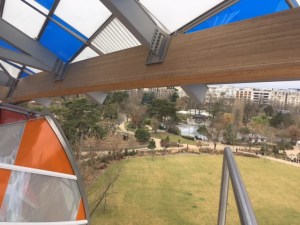
Bernard Arnault commissioned Frank Gehry to design a museum that opened to the public in the Bois du Bologne (equivalent to Golden Gate Park) in 2014. There are artistic commissions for artists who are invited to produce art in harmony with the building, works from the Louis Vuitton art collection, and special exhibits (next blog post). For now this is about the building itself. The geometry of the structure matches the shapes of the surrounding park and the twelve sails play with light and reflections of water from the basin the building “floats” on. While this posting focuses on mostly the exterior (some views from inside) I was most impressed with how well art fits into this space and is not overwhelmed by it.
Note: we are in Jerusalem but grandchildren are occupying our attention at the moment so blogging about the couple of days spend in Paris. Will get to Jerusalem sites in due course.
This aerial view of the museum obviously was not taken by me but is a great one for seeing the overall building.
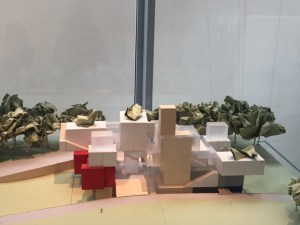
Model shows the inner workings: galleries, offices, restaurant, etc.
Adrian Villar Rojas, “Where the Slaves Live”, 2014, found objects
A good way to see how Gehry approaches architecture as a sculptural practice.
Winter is a great time to visit Paris (as long as there isn’t an arctic vortex) because there are no intense crowds and the weather is actually quite pleasant. I’m one for colder rather than warmer, since if you are cold you can always add another layer, but if you are too hot not much you can do once you’ve stripped down.
Had a day in Paris and did quite a bit of walking. Dramatic gray skies and iconic Paris sights.
Towers of Notre Dame in the distance
Weekend stalls with books of all kinds (mostly in French) along the Seine
Always amazes me that when it was built, it was hated by Parisians because it was a tower without a “skin”.
Looking towards Les Invalides and over the Seine
Champs Elysee
Arc de Triomphe with an insane roundabout with people making their own lanes.
People always ask, “aren’t you afraid to go to Israel” and my answer is always not afraid any more nowadays than going to the movies, into a post office, store, or just walking on the street. It’s a sad commentary. Syria is in the news daily and we visited the Golan Heights captured by Israel in 1967 after the Syrians had constantly barraged Israeli towns and farms from the heights (4000 foot peaks) You can see villages and towns on the Israeli side up to the base of the mountains. It’s safe to say that whatever happens in the future Israel is unlikely to give this strategic area up. There has never been a peace treaty between Israel and Syria as there is with Jordan and Egypt but in the 1970s the UN was able to broker a cease fire with a 9 mile demilitarized (no mans land) between the two. It’s been peaceful ever since.
Things are so complex in this region and more and more it’s hard to know if there is even a way to proceed to peace, whatever that means. While we have been here we’ve heard about the sad events of Nice, Istanbul, killings on the streets of the US and some attacks here as well. It’s a different world and more and more the rest of the world seems to be becoming more like this volatile part of the world. I have to hope for more enlightenment going forward but it’s hard to see how or when.
This is my last blog post for this trip as we are making our way home. It’s been amazing as always and with the “growing” family looks like I’ll be back in Jerusalem very soon.
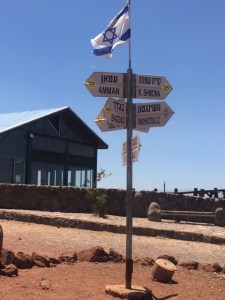
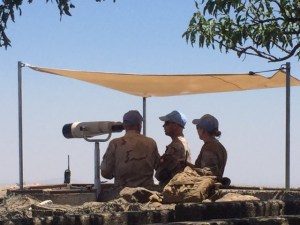
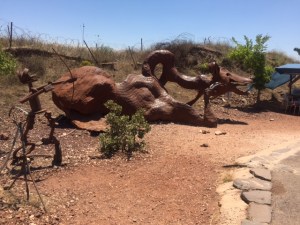
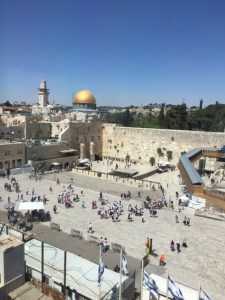
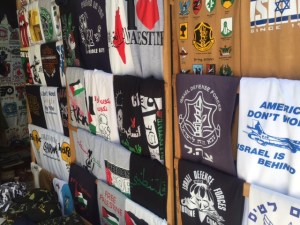
Girls walking to school by themselves. In the US one hardly ever sees children so young without adult supervision. Isn’t it ironic for the place that is supposed to be so “dangerous” that the risk to children is so minimal.In the orthodox communities there is no “screen time” so kids are outside playing, riding bikes, jumping rope, and being kids as we were in the “olden” days.Unfortunately this is part of the security fence that separates Israelis and Palestinians. I would hope that one day this wall could come down but it’s looking less and less likely. There are checkpoints between Palestinian areas and Israeli areas and some within Israel itself especially between Jerusalem and Tel Aviv and close to the airport. I would not be surprised if we start to see this in other countries as well.Building is even going on in the Palestinian areas, which can be seen as a positive thing although this is West Bank, not Gaza.Mileage markers on the Golan Heights to Baghdad (80 kilometers), Damascus (60 kilometers), Jerusalem (240 kilometers)Mileage sign to Washington DC (can’t read how many kilometers but many) and Amman (135 kilometers), Kiryat Shmona on the Lebanese border (25 kilometers)UN observers: New Zealand, Switzerland, Netherlands. They are monitoring the cease fire between Israel and Syria from inside Israel because of the danger inside Syria.Looking out over Syria it’s hard to believe that this peaceful landscape is close to where a war zone and tremendous suffering is happening.Israeli tanks on the road up the adjoining mountain with radar surveillance at the top. The no mans land between Syria and Israel is an area where neither one can be, but the rebels in Syria of course don’t abide by any rules and are there so it requires constant monitoring to keep them out of Israeli territory.On Mount Bental overlooking the Golan Heights are sculptures made from scrapped military hardware. This one is George and the Dragon.This one is a shopping kangaroo!The epic view of one of the holiest sites on the planet and also one of the most hotly contested. From left to right the Muslim quarter with the minaret of a mosque, the Dome of the Rock on the Temple Mount, the Western Wall of the ancient Jewish Temple, and a covered walkway up to the Temple Mount when they have it open for visitors.In the Arab Shuk in Jerusalem you can purchase Jewish, Christian, or Muslim religious articles all in the same place. Also fake antiquities from Egypt and the Near East.And here is the tee shirt seller who has “Free Palestine” tee shirts alongside “Israeli Army” tee shirts. Business in business…
Understanding geography becomes more and more important as we are a global community and as things get more and more complicated around the world. If you look at a map and consider that in some ways the Mediterranean is in the middle of everything look to the most eastern edge of the sea and there is Israel. Jerusalem, only an hour from the sea has for generations been the center of the center and a crossroads in many ways.
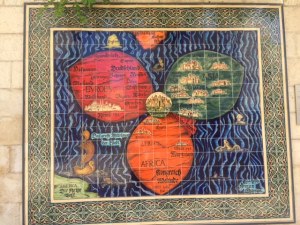
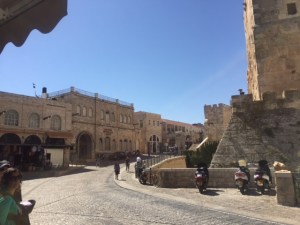
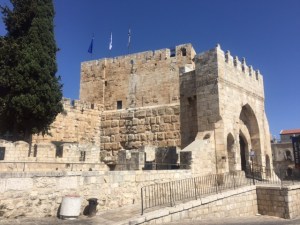
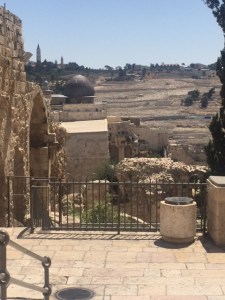
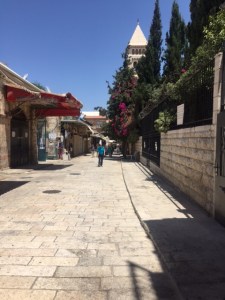
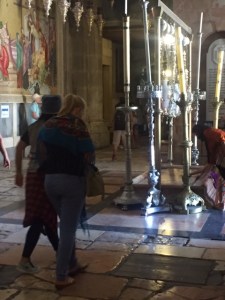
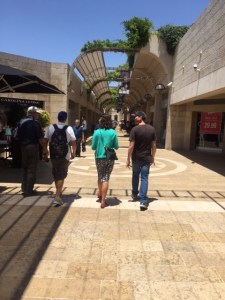
This is a 16th century mosaic of a map that shows Jerusalem at the center of the then known world. It’s on the wall just outside of the Jerusalem City Hall.Inside the Jaffa Gate (one of 13 gates of the city) you find buildings that used to house consulates such as the US consulate. Now they are cultural centers for various countries at the meeting point of the Arab and Armenian quarters.The so called Tower of David has nothing to do with King David. It’s a perfect example of what we’ve been talking about- syncretism. First site was Hasmonean (Maccabee of Chanukah fame), then Herodian, then Byzantine, early Muslim, and finally crusader and Mamluk. This all took place one on top of the other for about 2000 years.Entrance to the Jewish quarter, actually the second smallest quarter in the old city.This viewpoints shows you the Roman Cardo in the foreground, the Jewish quarter in the middle ground wth the dome of the rebuilt Hurva synagogue and a mosque in the background. It’s all in one very small place.The synagogues of the Jewish quarter were blown up by the Jordanians when they took control of the entire old city and for many years the arch you see below the dome of the Hurva synagogue was all that remained. This new structure was rebuilt in the style of the original.Another viewpoint shows us the Mount of Olives cemetery in the background, the Al Aksa Mosque in the middle ground and some of the destroyed and rebuilt sections of the Jewish quarter in the foreground.Left to right are a mosque, Dome of the Rock (on the Temple Mount), the Western Wall holy to Jews, and a covered walkway that takes visitors to the Temple Mount.In the Muslim quarter the roads to various gates intersect. We are standing at the intersection of the road leading to the Jaffa gate (and the port of Jaffa on the Mediterranean where up to the beginning of the 20th century one took a ship to from Europe or elsewhere to visit the holy sites). What we are looking down here in this alley is going to the Damascus Gate and out to East Jerusalem. The Damascus Gate used to take one to Syria, an important trading center for the entire Middle East. Many goods sold in the Shuk (market) were made in Syria and some still are.This is the Christian quarter so you can see how much different this looks with wide streets and lots of light.Exterior of Church of the Holy Sepulchre, not a church exactly, a shrine of the supposed place where Jesus was crucified and then buried inside a burial cave. The next day, of course, his body was gone.Throughout the Christian quarter you can find these kinds of structures, that make you feel like you are in a European city. It’s no coincidence since much of this quarter was built by Europeans mostly in the 19th century.This marks the slab where Jesus body was laid out for Jewish burial rites. Jesus was a Jew and the painting on the wall behind depicts these rites.One must ask the question how all this could have taken place inside the city. Remember the walls of the city changed over a long period of time with constant expansion so where the church is located was actually outside the city at the time.So many denominations have vied for control over the Church of the Holy Sepulcher that over time they’ve been restricted to certain hours and certain sections and no one wants to take care of repairs. They have finally come to an agreement to repair the badly deteriorating interior.As we leave the city and return back to the “modern” Jerusalem we immediately encounter a shopping mall called Mamila designed by the Israeli architect Moshe Safdie. It’s a stark contrast to where we have just been.
Some of the best discoveries happen when you get lost or are hungry or need a bathroom. These are some of the things we discovered just because we did not have a specific destination in mind.
Stayed on a moshav (like a planned community with shared resources but individual households). This is the preschool. I assume the baby carriages are a hot commodity among the children as they are perched on top of the fence for better “distribution”.Looking for a place to get a bite to eat we wandered into Kfar Tavor. That is Har Tavor (Mt. Tavor) in the background. Mt. Tavor is famous for the battle between the Prophetess Deborah and Sisra, a Canaanite general. Deborah sent her maidservant into his tent to poke out his eye while he was asleep. Her name was Yael (my daughter’s name). It ended the battle and Yael is also the Hebrew word for a kind of mountain goat common in Israel (we chose the name because we liked it- no association with eye poking or goats).K’far Tavor is home to the Tavor winery and this little center had a lovely tasting room and restaurant where we had a great “Israeli Salad” lunch. The village was founded in 1901 by immigrants from Sicily. It has that feel.Fitting with the Sicilian theme, there is a marzipan museum. Marzipan is a very sweet dessert made from almond paste. As you can see they’ve gotten pretty creative with it. Enjoy the next few slides of “artistic” marzipan.
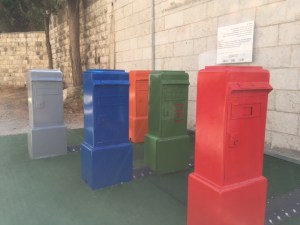
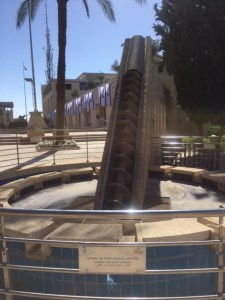
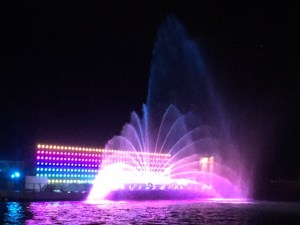
Looking for a bathroom in Safed I found this beautiful gate and arch.Across from the main post office in Jerusalem is this installation of old mailboxes. Shut and Yuvi Gerstein have set these up so that when you tap on the top of each box they make a specific sound and lights go on across the street on the main post office.In front of the Jerusalem City Hall is a fountain that incorporates a well drilling bit, something that reminds one that water is a precious commodity in this arid land.In Tel Aviv strolling through the old port we were treated to a goofy water display to rock music like Lady Gaga and Adele.Just a reminder of home, this truck delivers fresh eggs (which by the way are individually stamped with the date) and the side of the truck says: From nature fresh, organic, free range, and omega.Looking out the window from Aish Ha’Torah (translated as the fire of Torah/the bible) onto a group of disabled students experiencing the Western Wall.Inside that room which was a relief as it was well air conditioned was a Chihuly “fire” work.Down the street from where we are staying in a section of Jerusalem where many artists live (if they can afford it or have lived there for generations) is this sign. I know it is hard to read so in a nut shell: Here lives Morris Katz creator of art shows, the world’s most prolific artist listed in the Guinness Book of World Records. Teacher, author of “Paint Good and Fast”. Would have liked to meet him though his shop was never open.
Many countries have really interesting doors and entry ways. Israel is of course no exception. It also has some interesting stores, especially in old Jaffa.
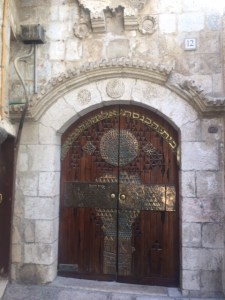
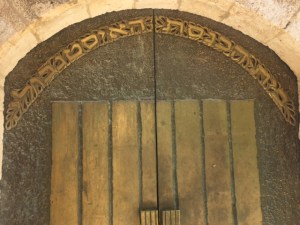
Cabalistic Yeshiva door in the Jewish quarter of JerusalemAnother yeshiva door on the same alley.The door to the Istanbul community synagogue in the Jewish quarter.
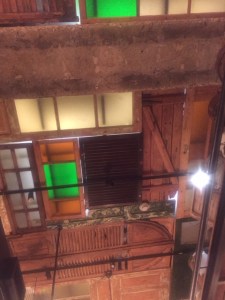
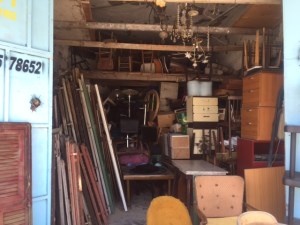
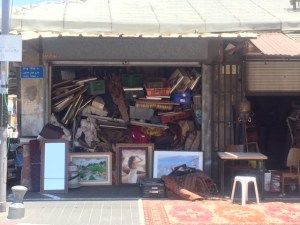
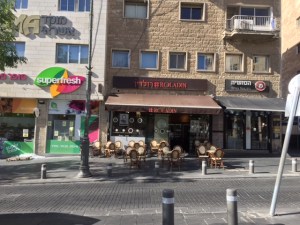
Doors on the ceiling of a restaurant in downtown Jerusalem by the Machane Yehuda market.A store in old Jaffa selling quite a variety of goods.How about a ladder, a movie set light, an acupuncture chart, various clocks, and who knows what else.A hoarder’s idea of a great shop.I looked for this bakery for days and of course my kids stumbled upon it by accident. Most immigration from France over the last few years (16,000 last year alone). Israel allows more immigration than any other country and French Jews are leaving France because of serious anti-semitism there. More are expected this year. Many French bakeries. Tel Aviv’s signage is now in Hebrew, Arabic, English, Russian and French.
We have been staying in Nahlaot a neighborhood in Jerusalem that was established at the end of the 19th century. Prior to that everyone lived inside the old city of Jerusalem. Now in between Nahlaot and the old city an entire modern city has grown up and people say the crane is the national bird of Israel. The old city is divided into quarters (though uneven ones). The muslim quarter has 25,000 residents, the Christian quarter has approximately 5000 residents, the Armenian quarter has approximately 1000 residents, and the Jewish quarter has about 3000 residents. The city has 12 gates though not all are open and functioning (more on this in another posting).
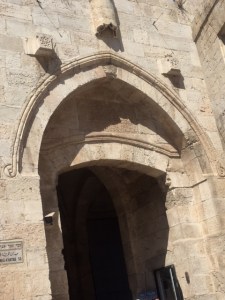
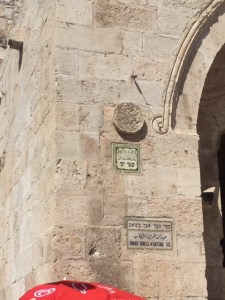
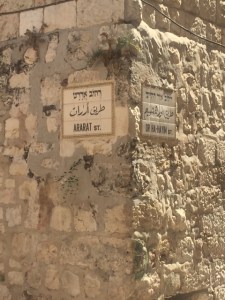
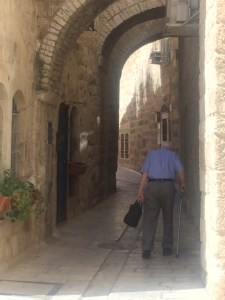
This is the Jaffa Gate, the most well trafficked of all the gates in and out of the city.This view shows you how diverse the visitors through this gate are. Among the individuals are a man waiting for Muslim prayers, an Israeli soldier, orthodox residents, and many tourists.Just inside the gate if you look up there is an inscription carved into the lintel declaring the greatness of Suleiman the Magnificent in 1538.Now to how signs give you such a historical perspective: on the top another carved inscription and below the British road sign first in English and then in Arabic identifying the Jaffa gate. Below that is a sign in Arabic first identifying the gate, then below that in English. In 1967 when Israel captured the old city they added the Hebrew on top of the Arabic/English.After passing through the Jaffa Gate on the way to the Jewish quarter you pass through the Armenian quarter which is walled within the walls of the old city. Unless you are Armenian you can’t enter this section.Intersection signs: Ararat Street (Armenian)- Mount Ararat is where Noah’s ark was supposed to have landed. The other sign is Ohr Chaim (Light of Life) Street leading to the Jewish quarter. Also notice the multiple layers of stone, older closer to the bottom, newer above.This alley leads to the more residential part of the Jewish quarter, a section I had never been to before.Up to 1948 and the establishment of the State of Israel there was a small continuous Jewish community inside the old city though they were at great risk and had to surrender and leave when the old city was taken by the Jordanians. You can see a rifle that is in the window left in place from that time. Until 1967 Jews did not have access to their holiest site, the Western Wall.A boys elementary school inside the Jewish quarter where the students attend 364 days a year! The only day off is Tisha B’Av (coming up next week), a commemoration of the destruction of the Temple in Jerusalem of which the Western Wall is a portion.Across the courtyard is another school, a more modern orthodox school with the regular 6 day a week school week and a month off in the summer.This carved verse from Zechariah (Chapter 8) says: “Once again men and women of ripe old age will sit in the streets of Jerusalem, each of them with cane in hand because of their age. The city streets will be filled with boys and girls playing there.”This elderly gentleman (aged in his 90s) and his wife in her 60s have lived in the old city since the 1970s.
When one visits a city to see the important “sites” there are things you miss in the every day world of the residents. Of course, a city like Jerusalem is full of subtle life elements that an ordinary visitor would certainly miss. Traveling in a country like Israel that is full of history, past and present is always with you. One does not take a step without thinking about what is underfoot from ancient times, how people incorporate the ancient with the new, how people make their faith meaningful for the modern world we live in, all questions that come up daily in this place.
For those of us who live on the North Coast of California we often are confronted with when something is “home” and when it’s a “tourist destination.” When we live in a place, we often don’t see the sites that visitors do and vice versa. And sometimes the places we hold dear, holy, or pristine become tourist destinations in spite of our efforts.
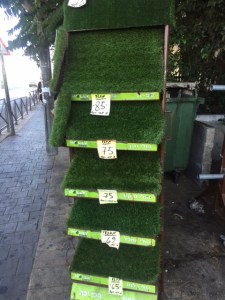
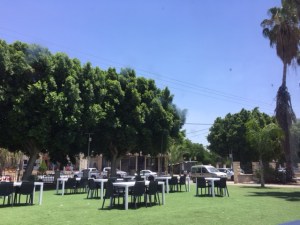
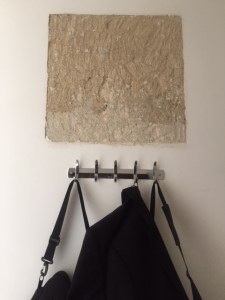
A display of various piles of astroturf. In a desert climate where water is precious and soil is even scarcer in a city environment one might like to have a little greenery. Also, one of the most important Jewish holidays called Sukkoth requires you to build a temporary hut outside your house and often people put down astroturf to make the carpet inside the hut.Looking out the window of the restaurant where we had lunch following our visit to Bet Shean and there it was, the ancient astroturf.In an apartment by the entrance is a patch of stone that is not stuccoed and painted to remind the inhabitants that nothing is “finished” and especially remembering the destruction of the Temple here in Jerusalem. Things remain incomplete so therefore, we should leave a bit of our home incomplete as well.
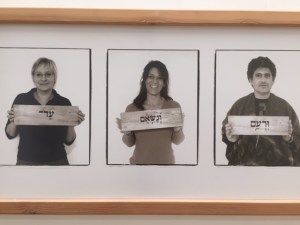
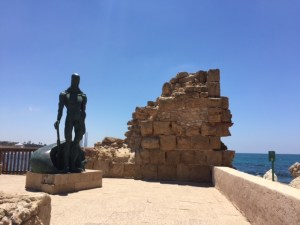
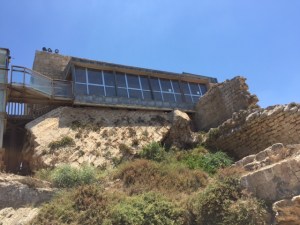
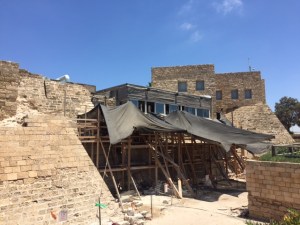
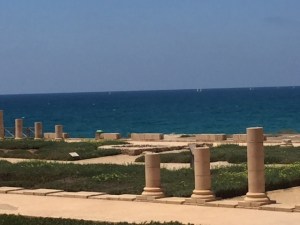
“Do We Have a Minyan?” by Dov Abramson, 2006. A minyan is the quorum of 10 men (or 10 people depending on your tradition) for prayer. It does not generally include anyone under the age of 13. The words they are holding say (right to left): Save Your People Right to left again: And bless your inheritance(Right to left again): And tend them and carry them Forever…. this phrase is part of “Pesukei Dezimra” at the start of the daily morning service.Wall of the breakwater of Caesarea with a modern Neptune like figure similar to one you can buy across the road.Walls of the ancient tower at Caesarea that guided sailors into the harbor at night now a bistro.Excavations on the bottom boutiques on top.Power plant in the background fallen columns in the foreground.Capitals of columns as adornment along the walkway.Sarcophagus in front of the mosque that is in the process of refurbishment. By the way noting that this is “real” grass.Sarcophagus top in front of a crusader structure that is a shop selling Roman glass and artifacts.Rosh Pina is a small town in the north that we really like partly because it reminds us of home. Just as at home it is changing as it’s been “discovered”Old simple homes built by some of the 19th century immigrants from Europe are being turned into bed and breakfast or rental cottages, old stone on the outside IKEA on the inside.Pina Ba’Rosh, one such inn and small world it was the home of the grandparents of the inn owner where we stayed two nights earlier closer to Lake Tiberius.This is the view from Rosh Pina on the top of the hill looking out over the Golan (Syria beyond) but notice the pile of stones below. Do you think they are getting ready for expansion?
I have not been to Caesarea since I was a student in Israel in 1970 when one could enter the park, sleep on the beach, pick up shards of Roman glass or ancient Roman coins occasionally. Now the park is totally developed with an event space for weddings, lots of shops and restaurants scattered among the ruins. So a bit about what Caesarea was.
The original fortified town called Strato’s Tower served as a desirable anchorage starting in 259 BCE. Herod the Great built a port here in approximately 25 BCE called Caesarea Maritime, in honor of the emperor. Remarkably the entire town and port were completed in 12 years. Herod was a mixed bag as a ruler but one thing he excelled in what playing all sides to his advantage. It served as the administrative center for the Roman control of Palestine. It subsequently became an important Byzantine center and was a very prosperous trading center. Eventually it was taken over by Arabs around 630 and they controlled it until the Crusades came to these shores in the 11th century, and even Louis IX came along “for the ride.” It eventually fell into obscurity after a series of earthquakes and is now a national park with active archaeological excavations to this day.
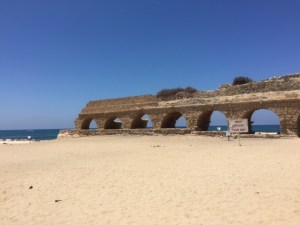
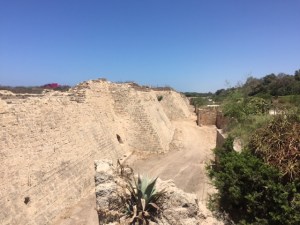
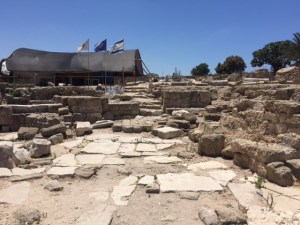
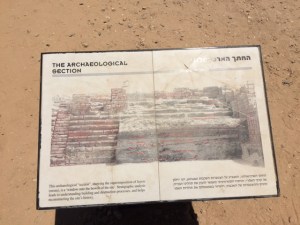
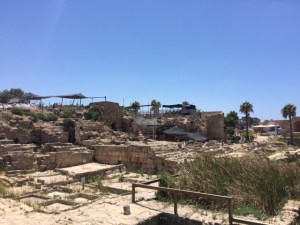
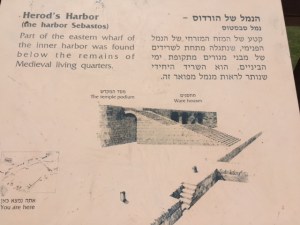
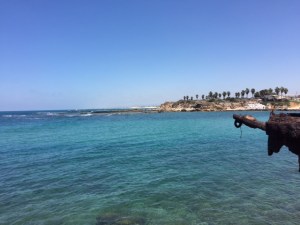
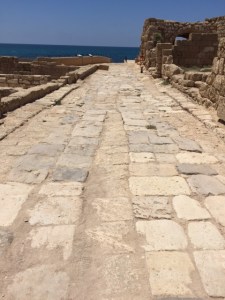
To me the most striking thing is the aqueduct that runs along the shoreline.Today it’s a popular beach for swimming and kayaking though the Mediterranean is always rough.Old city port fortifications from Crusader times. You can see the walls and a moat below. These were last reconstructed by Louis IX in 1251.The entrance is distinctly Frankish.Some of the first ruins you see are called vaults and part of a long term restoration project. Many stones were removed and used at other sites so it’s a challenge to figure out what belongs where.This is a perfect example of how archaeologists do their work. You can see the strata of dirt that has to be removed to unearth what is behind.Diagram that shows the excavation process.These are the main buildings of the port. The water came right up to the steps you see partially restored. Since ancient times this has filled in and the actual sea is now about 500 feet away.This helps to get a sense of what these structures looked like in Herod’s day.A nymphaeum (fountain) that leaves a little less to the imagination than the one we saw in Bet Shean. Here the infinity pool gives you the sense of how it may have looked and the statue is a reproduction.Adjacent to the fountain is the bema (raised platform of the synagogue), all that is left as Caesarea was primarily a non-Jewish city.Looking out to sea where the entrance to the ancient port was.One side of the breakwater- excavations in the distance. Just to give you an idea of this port, stone blocks were lowered into the sea at a depth of 20 fathoms. Most were 50 ft. long, 9 ft. high, and 10 ft. wide, some even larger. On top of this seawalls were built and the harbor structures which are now 80 meters inland from the water.Southern side of the breakwater, now a popular snorkeling spot. There are 17 shipwrecks sunken in the former harbor.Once again a main thoroughfare with shops on both sides. The Cardo boasted an extensive sewer system under the road.
Once again a main thoroughfare with shops on both sides.
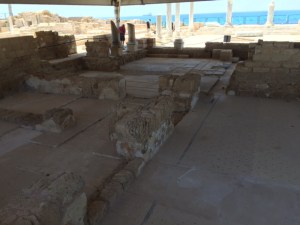
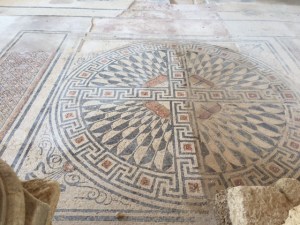
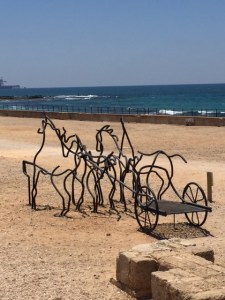
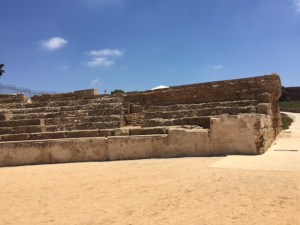
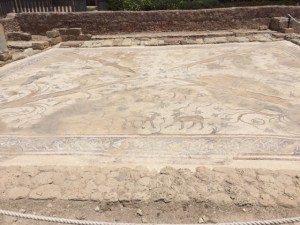
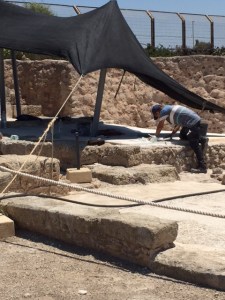
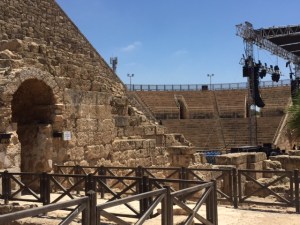
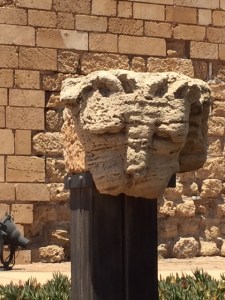
Identified as a tavern on one side of the road.A mosaic floor across the road.The main bathhouseA small segment on mosaic floor randomly placed near the bathhouse.The bathhouse floor, half still visible, the other half destroyed.The outside bath area. Nice location overlooking the sea. Three of the many columns are now in Venice.Emperors private bathCrusader gate to enter the hippodrome.Chariot races held in the most amazing setting.Bronze reproduction of a 1st century ceramic oil lamp showing a 5 horse race that would have taken place in the Hippodrome.Hippodrome built in the 2nd century for equestrian sports. It was used for 100 years.This diagram shows you the flow of the hippodrome which was done counterclockwise ending in front of the dignitaries. Pretty tight turns show the skill of the charioteers.Tiered seating for the spectators of the chariot races.Complex on the east side of the hippodrome added after the hippodrome was no longer in use. Races held there every 5 years.Descending the stairs to the hippodrome.Looking north to the Cardo (main street for commerce).Could not identify the purpose of these niches.Mosaic of IbexesWorking on cleaning mosaics still works in progress.Entrance to the Roman Theatre, displaying portions of sculptures found on the site or reproductions. First Roman theater built in the country, accommodated 4000 viewers.They were preparing for a concert later the day we were there so we couldn’t go inside. During Byzantine times the back of the stage was fortified to become part of the defenses towards the sea.Reconstruction of how the theatre would have looked. You can see how it would be similar to the one in Orange, France which still has it’s stage wall.Portions of the theatre found and nicely displayed. Mostly cornices and portions of arches.An unusual lion capital.A garden for relaxation between the theatre and the hippodrome. The columns are reproductions.Near the theatre a slab with an inscriptions identifying the notorious Pontius Pilate of crucifixion fame.The inscription reads: Pontius Pilate, Prefect of Judaea, made and dedicated the Tiberieum to the Divine Augustus.






































































 Poetry Without Words