It’s easy to see how many artists especially in the 19th and early 20th century would be inspired by Provence. The luminous quality of the light and brilliance of the colors can be seen in Cezanne, Monet, Renoir, Bonnard, Signac, Dufy, Matisse, and of course Picasso. But probably the most significant for this area was Vincent van Gogh.
Van Gogh lived in Arles for 15 months from 1888-89 and during that time painted 300 works though none of them remain in Arles (though the Foundation Van Gogh is having a show here of 31 paintings on loan from the Van Gogh Museum in Amsterdam and the Kroller Muhler Museum in the Netherlands). His works from this time have lots of yellow, ultramarine, and mauve. His subject matter was primarily landscape and reflects his Dutch heritage.
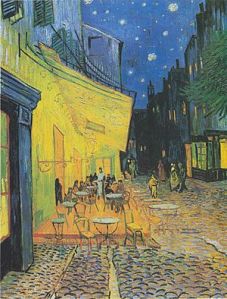
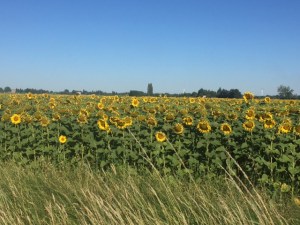
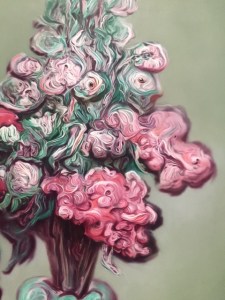
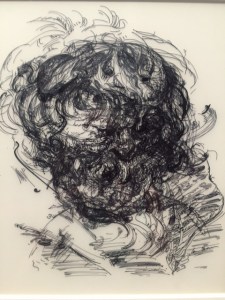
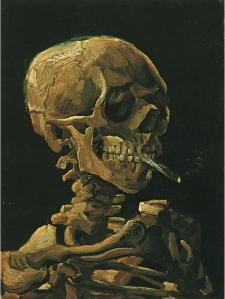
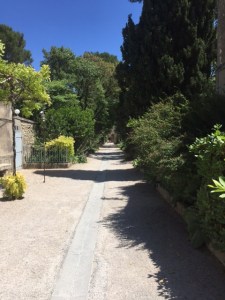
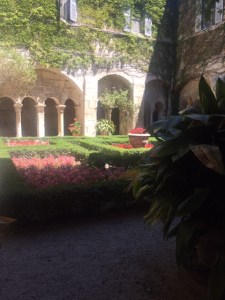
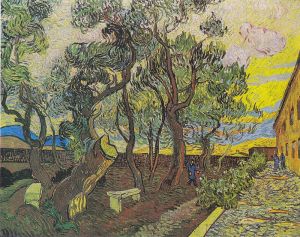
Painted in 1888, now in the collection of the Kroller Muller Museum, Otterloo.The cafe today.Also painted in 1888, this painting is also in the collection of the Kroller Muller Museum.We are here during lavender season and the fields (this one in the distance are everywhere). You can see the flatness of the perspective in van Gogh’s work.During the day the lavender fields are full of bees and the lavender is planted for them to make lavender honey. At dusk you can walk along the rows and take in the scent.While this was painted in Paris there is no doubt that van Gogh would have seen the fields of sunflowers around Arles. This one was painted in 1888 before he came to Arles.Coming and going to Arles fields of sunflowers as far as the eye can see.At the Foundation van Gogh they often have shows of artists influenced by him and this was an interesting take on his subject matter and techniques. This one titled “I do not Feel Embarrassed at Attempting to Express Sadness and Loneliness,” 2001, oil on panel.In this detail you can see van Gogh’s influence especially the way he blurs the edges.Glenn Brown, “Song to the Siren”“After Jordaens”, 2013, ink on two sheets of polypropyleneGlenn Brown “Suffer Well”, 2007, oil on panelVan Gogh, Skull with Burning Cigarette”, 1885In May 1889 after he mutilated his ear he checked himself into the Cloister and Clinic of St. Paul de Mausole in St. Remy de Provence.As you can see it’s a beautiful peaceful place and van Gogh felt very safe there. The monastery is from the 12th century.The monastery and cloisters are from the 12th century.van Gogh, “Hospital in St. Remy”, 1889The man himself holding a bunch of sunflowers.The fields outside his window painted at least 15 times.van Gogh, “Meadow in the Garden of St. Paul”, 1890
“Trees in the Garden of St. Paul’s Hospital”, 1890
Arles is a fairly large city with a small historical center that dates back to Roman times and there are many significant Roman ruins there. It sits along the Rhone River and was also famously the home to Vincent van Gogh from 1888-1889. Because of its strategic location it was inhabited first by Ligurians in 800 BCE and then Romans around 123 BCE expanding the port capabilities. By the 5th century the population was 100,000 and it was considered the center of Gaul.
Emperor Constantine spent considerable time here and built a number of important structures, best known are the baths of which very little remains. Over the centuries it was the location for many conflicts both religious, political, and economic. Once the railroad was built the port diminished and Arles became more of a backwater and hence popular with artists and now tourists.
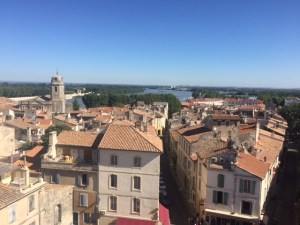
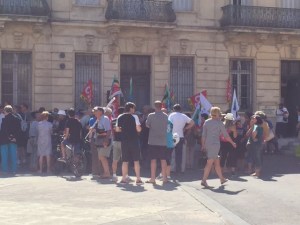
Taken from the tower of the arena looking out over the river in the distanceBuilt in 90 CE one of the most intact (and oval) Roman amphitheaters. It could accommodate 20,000 spectators. It’s 446 X 358 ft. Notice the tower which is an unusual feature of this amphitheater added during the Middle Ages. This structure became a fortress at that time so the towers (4 at the time) were used for defense.Surprisingly they have use the amphitheater today for bull fights brought from Spain.The Romans invented and perfected the use of concrete which made such large structures possible. As you walk around in the amphitheater you see many shells imbedded in the concrete along with small pebbles and sometimes even glass. This particular shell was much larger than usual.It’s easy to see how modern stadiums are designed to be just like the amphitheaters of the Romans, even the way the entrances to the seats are organized.This theater was built during the reign of Augustus (1st century) and plundered during the Middle Ages for building materials it wasn’t rediscovered until the 19th century. Personally I am disappointed to see a theater like this with all the new scaffolding and lights for use in modern times though will admit I’ve been to performances in spaces like this which are quite magical. Another one of those two sides to the argument things.This is a well preserved Romanesque church. The portal is decorated with biblical scenes and figures of important church leaders.Here you can see some of the figurative details on one side of the portal. I especially like the “creatures” depicted in the foreground.Subterranean galleries ventilated by air shafts were part of the forum’s structure.Later used as grain storage spaces they were built in the 1st century BCEThere are three different crossing tunnel sections.The Place de la République is what is on top of the crypto portico today. Notice the obelisk in the center from ancient times.A street demonstration of the communist party protesting the changes in work rules in France. Many teachers in this group have job security but are in solidarity with others who do not.
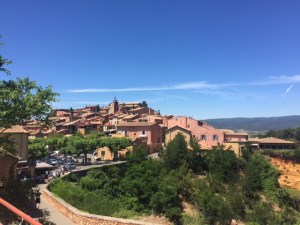
This posting is about three small towns all of which are tourist destinations for different reasons. L’Isle Sur La Sorgue is the closest to where we are staying and is a cute town with a small river (the Sorgue) running through it. There are more ice cream shops than banks and it attracts attention for having a great daily market but the thing that gets the most attention is a once a week antiques market that we avoided. Roussillon is a charming hill town whose buildings are all ochre colored because it is where ochre has been mined since ancient times. There are many galleries and shops where you can buy all kinds of artist pigments. The third town is St. Remy en Provence and its claim to fame is the asylum where Vincent van Gogh spent time and from where he painted many of his most well known works (more on him later).
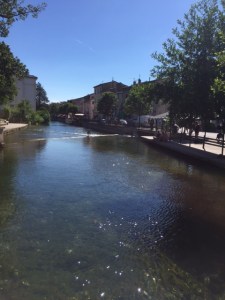
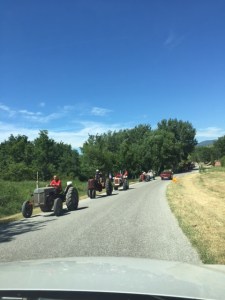
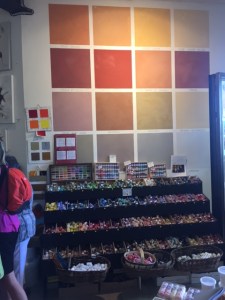
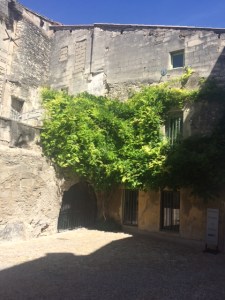
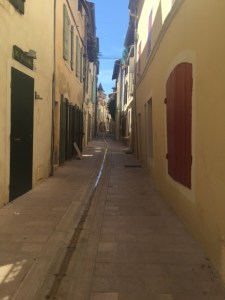
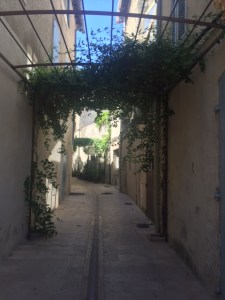
The river runs through the heart of the town and it’s sometimes called the Venice of Provence.These two happy pooches were waiting for their owner who was across the river shopping. When he came out of the store they swam across, jumped up on the dock, and went on their merry way.The open air market covers one side of the river and the restaurants and shops on the other.On the way to Roussillon a demonstration of farmers and their tractors, very patriotic, NOT a protest.Hay “art”Ochre (from yellow to red to orange pigments) has been used since prehistoric times. It was especially in demand in the 18th century for dying textiles and that’s when this town was booming. Now it’s a tourist/artist haven.As you can see the hillsides show the ochre that was mined and processed from the 18th century to 1930.Looking out from the highest point in the town.Entrance to the old mines below the town.The color of the buildings is distinctive because of the ochre.Fun for artists- pigments galoreThese are the different natural colors of the ochre.The town of St Remy en Provence’s architecture is in stark contrast to the color of the buildings in Roussillon.Tenacious wisteriaFor some reason this was a fairly quiet day in this little townAlleyway with a built in sukkahA nice composition of “Frenchness”This is the birthplace of Nostradamus, originally a Jewish French apothecary from the 15th century. He started out in medicine and ended in the occult. His predictions are easily interpreted to mean whatever you want them to.
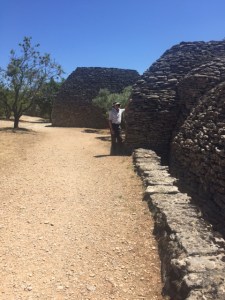
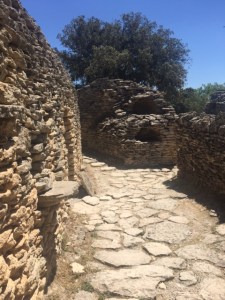
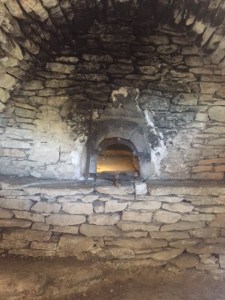
Ancient dwellings called bodies were domed dry masonry buildings made from limestone with walls up to 4 ft. thick. They date from 2000 BCE and were regularly rebuilt using the ancient methods until the 19th century when they were abandoned. Around 3000 of these structures many standing singly in fields (to store things or for short term shelter) or grouped like this in villages can be found around Provence. This village was restored in the mid 20th century. They are all built facing away from the north to avoid the mistral a strong wind that blows (and has been blowing every day since we’ve been here). We haven’t minded since it helps mitigate the heat but we are told can blow up to 100 miles an hour.
From 1309-1377 the popes moved from Rome to Avignon because of a dispute between France and Rome. A French pope (Clement V) decided not to move to Rome and instead established his papacy in Avignon from where the next seven popes ruled. Gregory XI decided to move back to Rome. Upon his death the new pope Urban VI was disliked by some cardinals who reestablished a papacy in Avignon for a short period and considered illegitimate and called anti-popes. This lasted through two popes and ended in 1407.
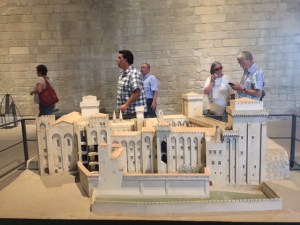
Palais des Papes was home to all this and is the centerpiece of Avignon. Many renovations adding portions and then taking portions away depending on the pope (or anti-pope) and lots of restorations some good and some not so good have taken place since. Well documented for a visit with simulations, reading material, etc.
The Palais des Papes remained under Papal control until taken over by Napoleon.
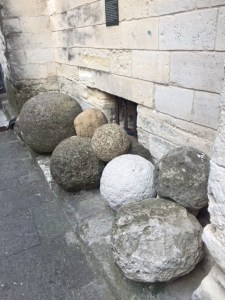
The exterior you see shows many styles and features some of the additions and restorations, one of the primary restorations was the re-addition of the towers (pointed at the top) Most of what you see is what is called International Gothic style.This gives you some idea of the scale of the architecture (from the back).One of the remaining painted ceilings. This is an example of Trompe L’oeil (trick of the eye) and also of rib vaultingWhen you see a ceiling like this you understand that wooden ceilings are rare from this time period as they were susceptible to fire.A view into the inner courtyard, notice the crenelations along the top edges, synonymous with the Middle Ages, decorative and useful for shooting through.The Medieval version of the barrel bombThis architectural element gives you a sense of the decorative quality.Sorry for the blurriness but this gives you an idea of where the gargoyle might be found.Used for obviously big occasions such as festivals and banquets. The popes used 1/4 of their treasury on this building. This is how it looks in its restored state. The ceiling was recreated from frescoes of the time.The wall of the audience hall restores shows some of the Roman style arches.This is a simulation of how the audience hall might have looked in its time.This is a bit of wall painting left that is a great example of Trompe L’oeil.Most of the frescoes that could be saved have been moved for safekeeping. Here is a bit from the chapel.This chapel is 160ft long and is also an example of the International Gothic style.A mythological creature hybrid of a lion and dragon combined, specific to this region of Provence. There is even a town called Tarasque. The story associated with it is a kind of Beauty and the Beast legend.I particularly enjoyed this rendering in front of a closed door where they are renovating and restoring frescoes. It is closed to the public but gives one a glimpse of how this may have looked in “its” day.
A few months ago we arrived in Minneapolis on the day Prince died and it was a somber city for the few days we were there though I learned more about Prince than I ever had before. We arrived in France the day after the British people voted to leave the European Union. It seemed a somber atmosphere at the airport, not many smiling or laughing people but they may also have been jet lagged as we were. We have not had much opportunity to speak with people and our French is not good enough for French TV. We have arrived at our pied-à-terre for the week and most of the conversation has been with our fellow American friends staying here.
What I can say, and what the newspapers are saying, is that people have voted with their emotions instead of their brains. Does this sound like something we should pay attention to?
If you are in my class right now a few of you have remarked about “old” buildings and of course I’m here in the land of old buildings. We are staying in a 400 year old farm house lovingly restored and now shared with others.
We spent the afternoon in Avignon, famous for the song written in the 16th century about the bridge that goes to a dance (which was performed under the bridge). I learned it as a child and never knew what it was all about. Now I do. Avignon is a Medieval walled city that became the papal home and center of power from 1307-1377 with 7 popes residing there before their return to Rome. For a time there were two popes (one in Rome and the other in Avignon) known as the Great Schism. More about this in the next post.
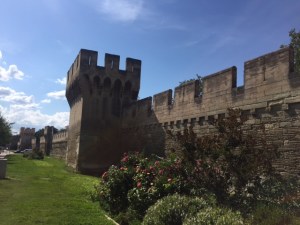
These trees are 400 years old as well and in the foreground is lavender that is in full bloom right now. Expect to see fields of it over the next few days.This is the view looking out from the house. Beautiful sunset and all seems peaceful in the world.A 400 year old farmhouse restored lovingly and shared with others.The outside fortified walls of Avignon, one of the few cities to still have the entire wall intact, built during the time of the popes’ residencies.In addition to protection from invaders the walls also helped protect the city from flooding from the Rhone river which runs alongside.This is the bridge associated with the song “Sous le Pont d’Avignon”Avignon has a population of around 100,000 and 12,000 of them live inside the walls. Unfortunately the “newer” city is fairly uninteresting.
There were so many amazing things to see in Barcelona and as Jeff said it’s a lot like Paris though the people are a lot nicer. Some things didn’t fit so well into a particular topic for a blog post so I’ve left them for one final collage of the city.
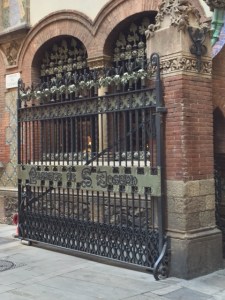
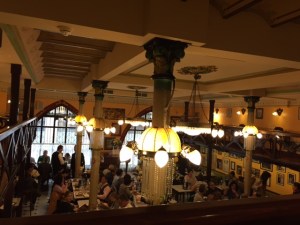
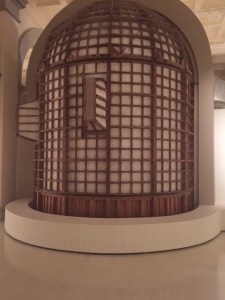
This mural by Picasso is in the cathedral square. It depicts a festival in Barcelona where people build human towers. Picasso refused to come to Spain during the reign of Franco so he sent the drawing to a friend who then executed it.Barcelona used to be called a city with its back to the sea. That is because it was always an industrialized port which is still is. This was true until 1992 when the Olympics created beaches and a beautiful waterfront. There is only one mega hotel which looks rather funny compared to other beach locations. It is in the shape of a sail. Don’t hold out too much hope the skyline will stay like this.There is quite a bit of sculpture along the waterfront probably also left from the Olympics.Rebecca Horn, “The Wounded Shooting Star”, 1992. Commissioned for the Olympics it is dedicated to the rebirth of Barceloneta, the run down fishing district that got new housing (from Olympic Village) and an upgrade.Juan Munoz, “A Room Where it Always Rains” 1992, five bronze figures imprisoned in a cageThis very quiet square has been featured in a number of movies. The significance of the pock marks on the building are a reminder of the horrific Spanish Civil War that resulted in the destruction of Guernica and many believe helped lead to World War II.An example of Modernisme in a functional gate. Note the Art Nouveau style typeface.This city is a feast for the eyes everywhere you look.Food as art: chocolate and candiesBarcelona is home to many breeds of dogs but probably more bull dogs than any other. This gigantic confection of one is now resident in a fantasy of a coffee shop but used to live in a restaurant in Girona that was voted the best restaurant in Europe in 2013, now closed.Stained glass workshop where those working on various Gaudi restoration projects have worked.Everyone can get into Flamenco dancing.Our final mean at 4 Cats, the restaurant that gave Pablo Picasso his first art exhibit.
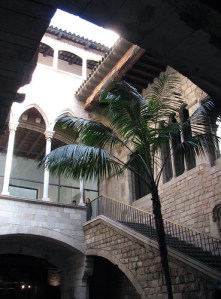
The Picasso Museum contains a large collection of the artist’s own works donated by him because of the fondness he felt for the city where he lived and studied as a young man. The museum itself is a combination of five palaces in the Born neighborhood. We were not permitted to take photographs in the museum at all though I did manage to take some of the interior of the building. I’m sharing a few highlights that stood out to me.
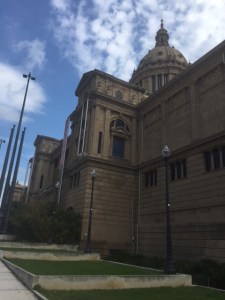
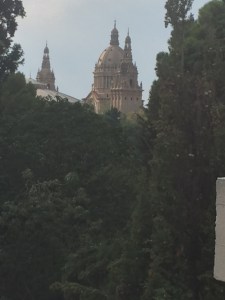
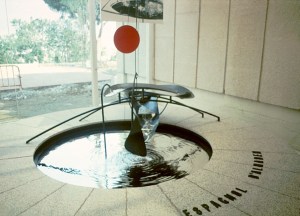
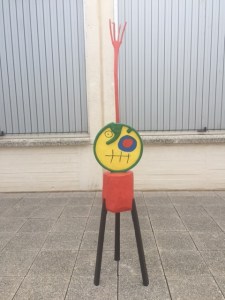
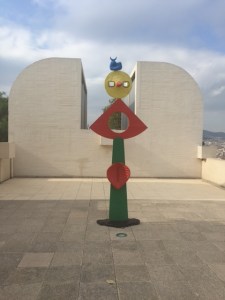
The Palau Nacional that sits on the hill called Montjuic was the built for the Universal Exposition of 1929. Today it houses the Museu Nacioal d’Art de Catalunya. The art spans 1000 years of art and has probably the world’s greatest display of Romanesque art in the world. There are also works on permanent loan from the Thyssen Bornemisza Collection in Madrid and an extensive collection of contemporary art from Catalunya. From there we walked to the Jean Miro Foundation. I’ve never been a big fan of Miro but there is an amazing work by Alexander Calder and the setting is quite nice. Photographs could not be taken inside the museum, only works outdoors and the Calder image comes from the internet.
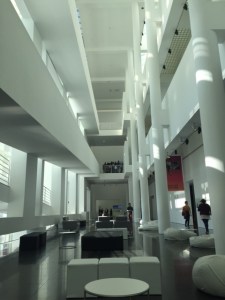
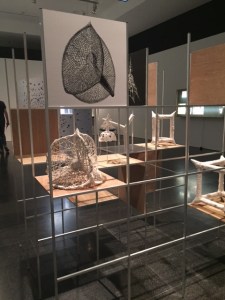
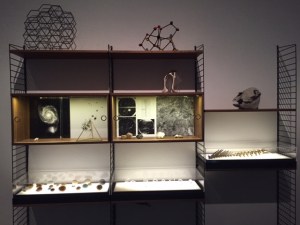
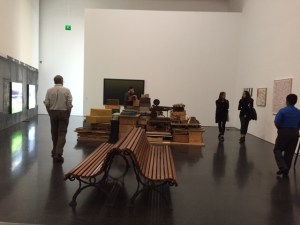
Last museum on our list was the Museum of Contemporary Art, housed in a Richard Meier building (same architect as the Getty Museum in Los Angeles). The exhibit we saw was entitled “Desires and Necessities” with all the work we saw there was related to the idea of what space is and how space and ordinary objects can be exhibits themselves. The exhibit included many recent acquisitions to the museum’s collection and it was wonderful to see the integration of a global collection of works.
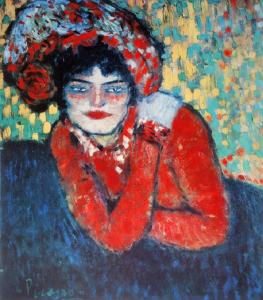
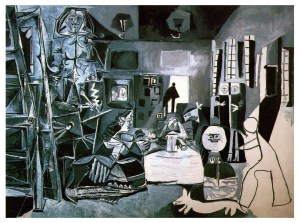
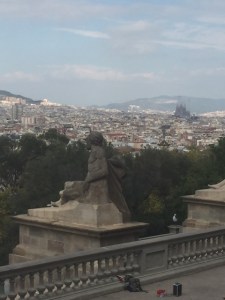
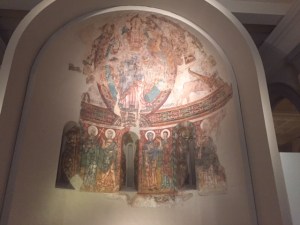
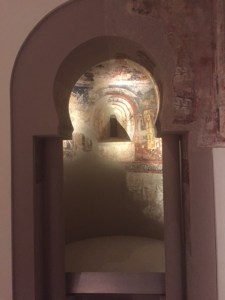
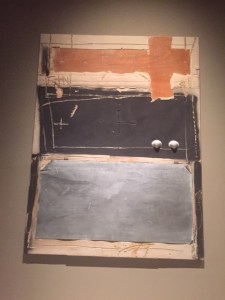
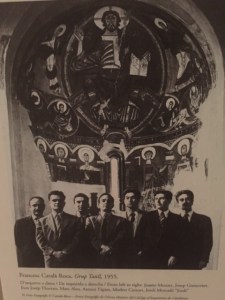
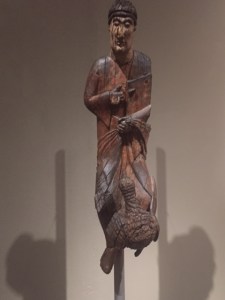
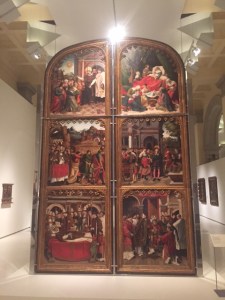
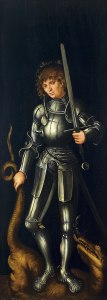
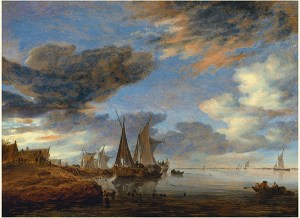
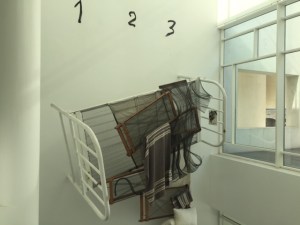
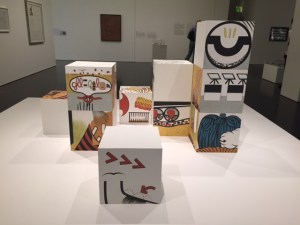
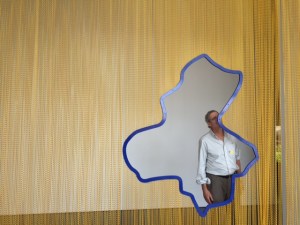
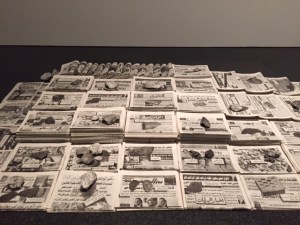
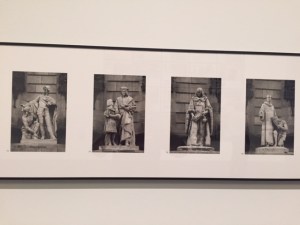
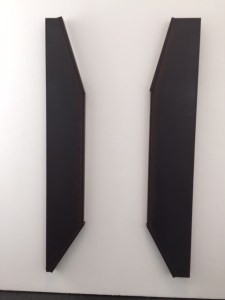
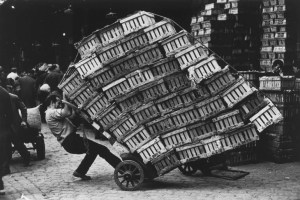
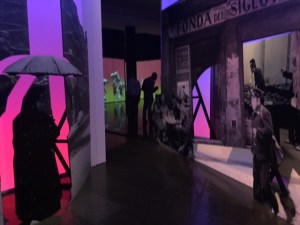
Interior courtyard of the Picasso MuseumPicasso, “Painting of an Old Man”, 1895, painted when the artist was 14 years old.Picasso, Pastel of the artist’s mother painted at age 15. A good portion of the collection is his early works which one almost never gets to see. Remarkable to consider his skill at such a young age.Picasso, “Margot”, 1901. The room that contained this and the next painting were the most interesting as these were painted after his first trip to Paris when he met Toulouse Lautrec and CezannePicasso, Still Life, 1901An entire two rooms were dedicated to Picasso’s interpretation of Velasquez’ “Las Meninas”. It had seen some of these illustrated but it was great to go back and forth. If you are just finished the Baroque in my class you are familiar with this amazing work. Now you can see how another artist interprets it.Here is the Infanta. Picasso makes her look like a birthday cake. It seems like an apt interpretation. This whole series was completed in 1957.Museu Nacional d’Art de CatalunyaView from the museum which includes Sagrada Familia off to the rightThe museum has the greatest collection of Romanesque art in the world. This is one of a number of 12th century frescoes from San Climent de Taull and Le Seu d’Urgell, mountain churches in the Pyrenees where they were in danger of deteriorating completely or being sold to private collectors or museums abroad.The museum wanted to preserve them in Catalonia as part of their heritage and so painstakingly removed them from the walls and installed them in a display that mimics the church they came from.Here is one particularly beautiful niche or apseThis image of Jesus as the Pantokrator is in your textbook if you are in the ancient art history class.This is the back of the display niche for the frescoes. I almost like the back as much as the front side.In the same room as the “Christ in Majesty” is a painting by Antoni Tapies “Matter Metal”, 1993Antoni Tapies, a native son of Barcelona is shown in this photograph with other artists in front of the “Christ in Majesty” when it was installedOther works in the same section of the museum are these wooden sculptures of Mary from the 12th century. I am always amazed when wood survives this long.This grouping of figures is so well displayed it makes for a dramatic scene even though it’s totally out of context in the museum. Notice how abstract work is from this time period.This one is also in the same textbook. I am always pleasantly surprised to find something we are learning about that I had no idea was there. This is the “Batlo Crucifix” from the 12th century.This John the Baptist has been studied with sophisticated spectrometry to determine what the paint pigments are and created a simulation of the bright colors it would have been in the 12th century.In another part of the museum we saw Renaissance and Baroque works including this fresco set by Caracci, 1560 that obviously had also been removed from it’s original location.Large altarpiece doors (front) by Pere Nunyes, 1526. Not an artist I am familiar with but impressed with the scale and in the next slide is the back.Unusual to get to see both sidesAfter our visit to the Dali Museum I’m seeing surrealism everywhere- standing on top of floating baby heads…Francisco Zurbaran, a Spanish Baroque painter. “Immaculate Conception”, 1632Lucas Cranach, “St George and the Dragon” of course the mascot of Barcelona, 1514How fitting to come back to the Dutch Baroque a few days before departing Barcelona back to Amsterdam. This landscape was painted 1660The museum has a huge performance space which was interesting to see since we’d seen the Palau Musica earlier in the day. It was quite a contrast.View of the National Museum from the Miro FoundationMiro Foundation, started in 1975 by Miro himself to showcase his work and to exhibit the works of artists he admired and influenced him.Alexander Calder’s “Mercury Fountain” which is flowing mercury was created at the same time that Picasso’s Guernica was (1937) and in this case to acknowledge and protest the mercury mine at Almaden where slaves and prisoners were put to work and who died from mercury poisoning. It’s enclosed on all sides in glass.This and the following two whimsical works by Miro were the only ones I photographed. This is the mother.The childThe fatherThe interior space of the Museum of Contemporary Art is typical for this architect and his hallmark color is white. This comfortable spot was a great place to relax for a little while on our last day in Barcelona.High above the entrance hall was a three part work by Antoni Tapies who lived his life in Barcelona. We did not get to the Tapies Foundation where the Micro Museum was featured (if you remember from the museum in Ghent). The title for this piece is “Sudden Awakening” and this is part 1Tapies, Sudden Awakening Part 2Tapies, Sudden Awakening Part 3. Sorry I could not get far enough away to not have the railing but you get the idea.I was very happy to see the work of Richard Hamilton. One doesn’t see a lot of this important artist’s work. If you are in the Modern Art class you will find an example of his work in Pop Art where he is often classified. This work is from 195. It was particularly great to see this after seeing so much of Gaudi’s interest in natural forms.In the 1960s, Hamilton was the central focus of an exhibit entities “Growth and Form” where artists explored the concept of the exhibit space as a work of art itself and that nature itself had an aesthetic of its own.Marcel Duchamp figures prominently in thinking about what came to be called installations and conceptual art.Mireia Sallares, “Literature on the Landing”, 2014 is the result of what is known as an intervention in an apartment building in Barcelona where tenants had complained about bad treatment by the landlord and and were evicted from their apartments where they had lived for many years. The vacant apartments were then occupied by various supporters and artists. The publicity about the intervention helped the court case against the landlord and the tenants were victorious.A video about Volkswagen that talks about their factory being a “symbol for transparency and authenticity”. The work includes text added by the artist, Octavi Comeron from Spain titled the work “Transparent Factory”, 2006. How ironic given to current issues with Volkswagen. Note that Barcelona has a large car manufacturing sector as well.John Baldessari, “Dwarf and Rhinoceros With Story Called Lamb”, 1989/2013, from this American artist who abandoned painting for more conceptual work. The dwarf is particularly interesting in this work as Francisco Goya was an influence on Baldessari and Goya’s series “Disasters of War” includes this image often. In this case an American artist paying homage to a Spanish artist of the 18th century.Oyvind Fahlstrom, “Sitting Blocks”, 1966, comic book images of Batman turned into cubist works and stools at the same time. Fahlstrom is from Brazil.Entrance to the room featuring geographic locationsFrancisco Ruiz, “Cairo Newstand”, 2010, stacks of newspapers featuring propaganda related to the Arab Spring uprising. Ruiz is from Barcelona. Note: there were a number of video installations from north African artists (Egypt, Tunisia) but were not reproducible.Daniel Ortiz and Xose Quiroga, 2013, monuments from around Barcelona of people honored in this way even though they were they played major roles in slavery. Ortiz and Quiroga are from PeruMarcel Broodthaers, Atlas, 1975 (very small around 3″ tall). Broodthaers is from BelgiumMarcel Broodthaers (part of the Atlas installation). His graphic work has deliberate errors which are not known to the viewer. I was particularly drawn to this work as I like to see map silhouettes as objects of art in an isolated form.This section of the exhibit had to do with visualizing spaces and uncommon images in them.Of course, I recognized this immediately as we had just been in Jerusalem and had commented about how raw and vulnerable this seems to have massive gas pipes exposed on the outsides of buildings. This work is by an Israeli artist whose work I had seen at a museum in Jerusalem I formerly talked about last year called Museum on the Seam which happily looks like it is reopening. This artist is Sigalit Landay, titled “Angel” , 2014Last work was from another exhibit but fit into this theme and something we had noticed about all the blocks in Bareclona. When turning from one street to another (except for alleys) there is this triangular space at either end of every block that allows for a spaciousness for pedestrians and safety for vehicles turning. Title is “Via Laietana” 1988, Sergi AguilarBefore leaving the museum we saw a special photography exhibit installation of life in Barcelona in the 1960s by local photographer Xavier Miserach, a fitting end to an extraordinary week in this city.Most of the photographs were arranged in an installation that we walked through as if we were on the streets of Barcelona in those days.
Park Guell at the north end of Barcelona high on a hill was Gaudi’s home until he started the project of Sagrada Familia. One of Gaudi’s biggest fans and best patron was Eusebi Guell. This wealthy entrepreneur who would have been richer than Bill Gates in todays dollars entrusted Gaudi with planning an estate for 60 residences on the model of British residential estates (hence the name Park Guell). The project had many roadblocks and was abandoned for the most part by 1914. Instead it was turned into a public park. Both Guell and Gaudi had homes there and Gaudi created an number of structures to enhance the aesthetics of the park. To start it all Guell commissioned Gaudi to remodel at palace for his family including 10 children close to the Rambla. This was Gaudi’s first great project. While Guell was not really involved in this project, another that did manage to be completed has been described as a petrified wave. It is Casa Mila (now called La Pedrera) built 1906-1912. Gaudi was a trained architect though when he graduated the dean said of him, “he’ll either be a madman or a genius.” This reclusive master left an indelible mark on the city of Barcelona and art movements to come after him.
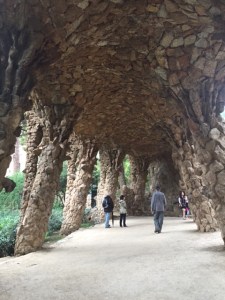
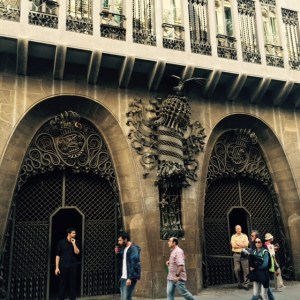
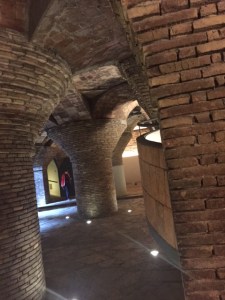
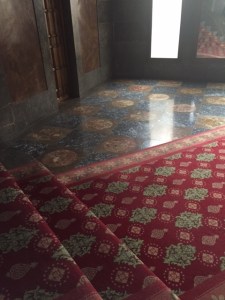
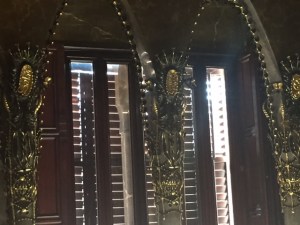
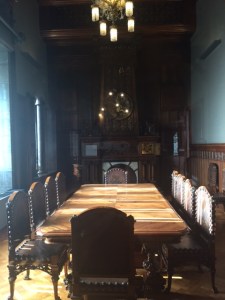
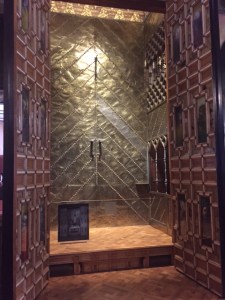
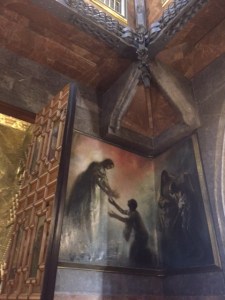
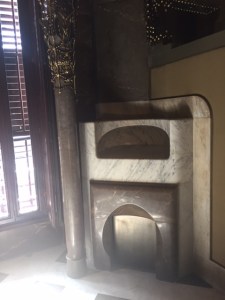
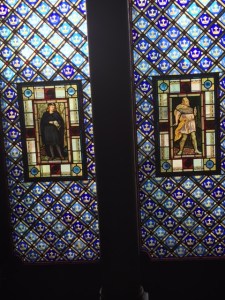
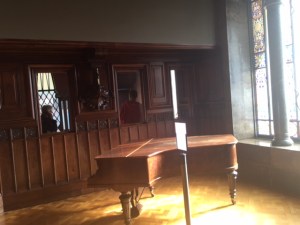
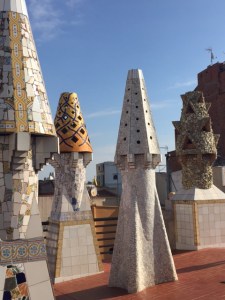
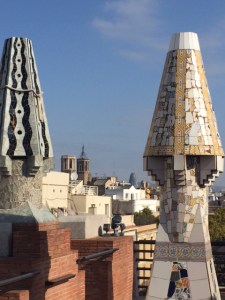
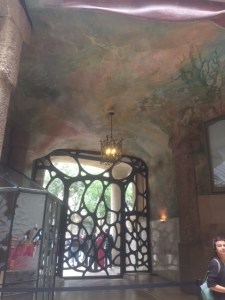
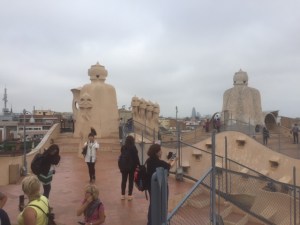
Gaudi’s home where he lived until moving to Sagrada Familia to work full time on that project.Grottos and viaducts form paths throughout the park.Close to Gaudi’s home you can see how much he valued the natural setting.On the upper viaduct. Unfortunately it began to rain so we did not see the rest of the structures except from afar. We’ll just have to return to see them close up.The entry doors to Palau Guell, the palace of Guell family. This was Gaudi’s first major project and you can already see the parabolas and natural elements appearing.From inside the front gates it is possible to see out and for light to come inside but it’s impossible for those outside to see in.Combining traditional materials and imagery with modern lines and natural imagery in the tile work.Even the stables below the entry have beautiful forms though totally functional.Tethering a horse to a unicorn instead of a mere brass ring.Up the stairs to the living quarters.Harmony between the tile patterned floor and the carpeting. It should be noted the Palau was closed from 1990-2011 for extensive renovation to restore the Palau to its former glory.Ceilings throughout hand carved. Gaudi oversaw many artisans of great skill.Upper story windows facing the streetElaborate bay windows and balconies with ingenious shutters and gargoyle drainsMore parabola shapes for the window frames in the bedrooms with intricate brass fitttings.Formal dining roomHand painted chair backsDetail of the wood work and the marquetry (patterns made with small thin veneers of different colors of wood) in the wainscoting.Entrance to the main hallLarge sconces either side of the Neo-Gothic style doorsLooking up to the three story ceiling of the main hall where guests were greeted and entertained. Notice the organ pipes.The organ designed by Gaudi naturally…One wall of the main hall had these huge doors that could be opened to reveal a small chapel where religious services could be conducted or entertainments could be had when the doors were closed.Each of the four walls had paintings especially made to fit the curve of the wall.Most rooms had this type of fireplace designed by Gaudi himself. Notice the parabola once again.Stained glass window with Shakespearean characters in a pre-Raphaelite style and William Morris pattern (Arts and Crafts movement).Stained glass everywhere even in hallways wherever possible. Notice the glass casings around the columns between the windows. That’s the same thing we saw in the Palau Musica Catalunya. Must have been the style of the day.In the piano room you can see how much light comes in and behind are windows in the wall instead of a solid wall.The attic where laundry and other household activities could be accomplished. Notice the undulating walls and ceiling.The hallmark chimney tops in Gaudi’s fanciful style.This close up shows an added lizard. You saw them on the face of the Sagrada Familia as well.This direction you can see the Agbar tower in the distance (not there in Gaudi’s time)From this side you can see both the brick structures as well as the tiled ones.The central tower over the ceiling dome of the main hall.Casa Mila (La Pedrera) from across the wide boulevard where it is located. It is an apartment building that was either loved or reviled at the time and eventually fell into disrepair. Now a UNESCO site it has been refurbished inside and out.The front facade with balconies and undulating levels.Entrance lobby, a combination of form, light, and color.Back to Gaudi’s philosophy of using natural forms, in this case a protozoa.The courtyard is open to the sky letting in natural light wherever possible. Each apartment goes all the way around one apartment per floor.On the roof ventilation and chimneys are no ordinary objects, they became symbolic and animate forms. The entire roof is an undulating mass of forms.Looking to other buildings around you can see how the mechanical objects project in a very haphazard and unappealing way that Gaudi never wanted in his projects.And of course you can see Sagrada Familia from here.Below the roof is the attic which gives you the inside of the undulation. It’s like walking through a serpentine sculpture. Currently it houses a historical display of Gaudi projects.There is one apartment that can be visited and it has been restored to the way it would have looked at the turn of the 20th century. This bedroom window shows the inside of the iron balcony.Many craftspeople were involved in this project but Gaudi oversaw much of the overall aesthetic.Windows on the inside bring added light in and you can see across to the rest of the apartment.
It’s hard to know where to start with Antoni Gaudi and his importance to Barcelona. the next several blog posts will be devoted to him and his work. Just a little background. Antoni Gaudi lived 1852-1926. He was one of the first “organic” architects and is often referred to as a Modernist though he rejected that label (also associated with Art Nouveau). His patrons were the church and the Barcelona elite. He saw architecture as an art form and gave his attention to every detail of his projects from materials selected to the visual affects of the completed structures. He was fascinated with and studied nature and geometry from an early age. I’m going to start with his last project, the Sagrada Familia cathedral which he started on in 1884 and was unfinished at his death. It is a work still very much a construction zone as you will see. Its expected completion date is 2026.
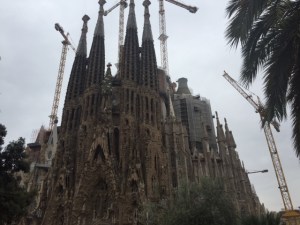
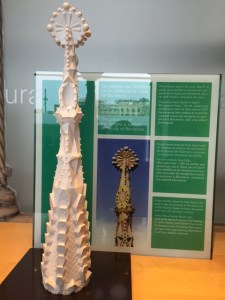
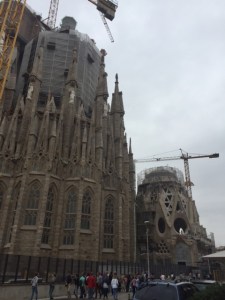
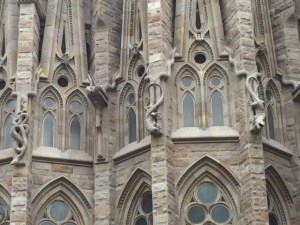
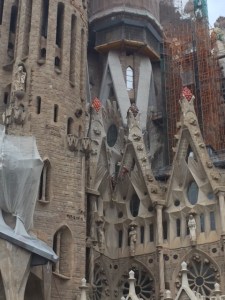
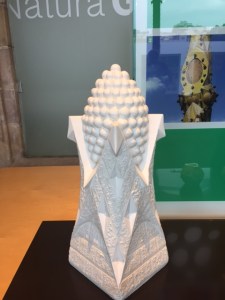
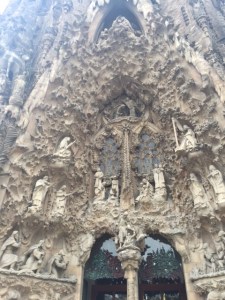
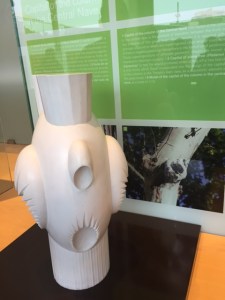
We were fortunate to see an exhibit explaining Gaudi’s philosophy so I’m going to intersperse these models and explanations as we look at the exterior and interior of Sagrada Familia.Sagrada Familia was started in 1883 and after a year the project was turned over to Gaudi who was a deeply religious man. He moved into the cathedral and lived there for the next 14 years. He died unexpectedly and work on his masterpiece continues as you can see.The darker stone that you see is the older portions of the building and the lighter colored stone is the newer portion.The towers are quite unusual as is everything about this building.About the pinnacles of the towers Gaudi said “Look at the top!.. This burst of mosaics is the first thing that sailors will see when approaching Barcelona; it will be a radiant welcome. It is true that Sagrada Familia can be seen from many parts of the city.The base of a new tower that will be added to a make a total of 12 towers.Serpents and lizards slide down the face of the side structures.Notice the workers in red suits in the V between the two triangular shapes.For the design of the capitals of the tops of the towers on the three facades Gaudi chose twinned polyhedrons, the result of studying crystals.The sculptures were completed 1986-2000 by Josep Maria Subirachs, controversial for their abstract quality but most art historians think Gaudi would have approved. Some of the controversy may be because the artist is a confirmed atheist.This is the entry point and the most competed part of the cathedral finished in 1930.
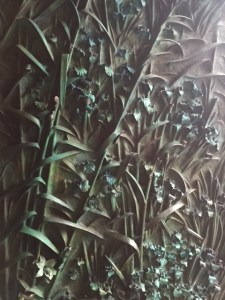
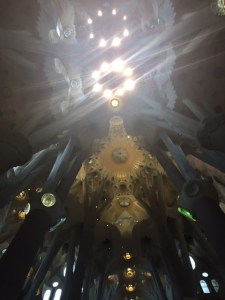
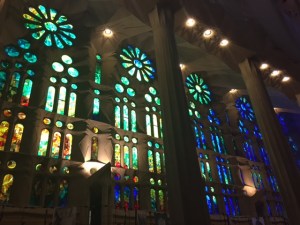
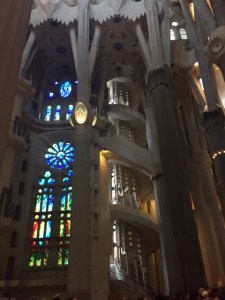
Detail of entry door.Inaugurated in 2010 the nave is a forest of fluted pillars supporting four galleries above the side aisles, while skylights let in natural light.The transeptThe tree like columnsGaudi tried new ways of contracting, first at Colonia Guell (industrial village) and finally here. He is using parabaloid forms in many cases.Stained glass windows in warm colors on one side. Notice the lights at the joints where the branches come off the main columns.Capitol of each column features an ellipsoid form that resembles the tree in the photo behind it. It gives the whole structure added strength.Wall of cool colors opposite.
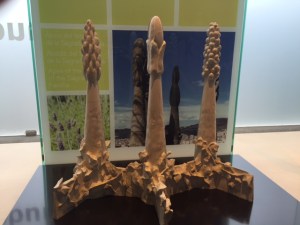
About the new forms Gaudi was trying he said ” the fact that they have not been applied before and that I am the first to do so has made me think a lot…I believe that, convinced as I am of the perfection they represent, it is my duty to apply them.A magnificent work of art that will continue to evolve.Models for some of the natural forms seen at Sagrada Familia
















































































 Poetry Without Words