This cemetery in Nazareth contains Muslim, Christian, and Jewish graves. Some are quite old and it’s in the center of the old city. Apparently there is a group of Israelis that come every year made up of all three faiths who come to clean the graves.
Maimonides, the great Jewish sage is is often referred to as a polymath is one of the most important figures of Medieval Judaism. His grave is located in Tiberias though he died in Egypt while serving as physician to the Sultan Saladin.
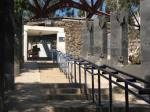
On the way up to the grave we passed pillars each displaying one word representing the topics he wrote about including love, holiness, business, health, law, etc.
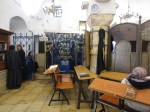
The women’s section- you can see half of the marble tomb on this side.
The Pioneer Cemetery (Kinneret Cemetery) is at the southern end of the Sea of Galilee. It is the burial place of many pioneers who came to Israel in the early 20th century. They mostly came from Eastern Europe.
The cemetery is a bit chaotic with the older stone moved by tree roots and all the graves are above ground in the tradition from ancient times.
As we watched the sun set over the lake there is an automatic music box that plays old pioneer songs. It was quiet and a lovely place to wander.
On our way to Tzfat we stopped at Meron, the burial place of Rabbi Shimon bar Yochai who wrote the Jewish mystical text called the Zohar, a mystical text that is quite complex.
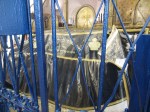
The blue covering is over what is supposed to be the grave though is probably more likely a cenotaph (representation of where the person is buried but no actual remains). There are always people there, women on one side and men on the other.
The son of Rabbi Shimon bar Yochai who is an important Talmudist in his own right is also buried there.
This was a much more nicely appointed site than most I’ve seen.
There were many women and children there and apparently on Lag B’Omer there are 100,000 people at this site coming for pilgrimage.
Cemeteries and graves are interesting places to learn about history. Over the past few days we have managed to encounter a number of them in Nazareth, Tiberias (by the Sea of Galilee), and in the hills of Meron on the way to Tzfat where we will be spending Shabbat. The important things that make a community are schools and cemeteries. In Nazareth we were surprised to learn that people of all three faiths are buried in the same cemetery though usually they are buried in separate cemeteries. On the way to Tzfat we visited the hills of Meron, that look like the forests of the Sierra foothills. We saw a lot of damage from the snow they had a few weeks ago. Apparently Tzfat got 20 inches of snow. The tombs of Rabbis Hillel, Shammai, and Tarfon, among others can be found in the area. I was surprised to see that these rabbis were buried in such a beautiful natural environment. We will be in Tzfat for Shabbat so a short post tomorrow and then rest.
Nazareth’s old city is made up of narrow alleys and after a hair raising driving debacle we found the garage and were escorted on foot to the guest house (combination hostel and hotel)
The view from the second floor of the Fauzi Azar Guest House. The section on the right was recently added after the owners bought the inhabitants a new house.
Who knows how this car even got into the alley let alone the garbage truck you see behind. The town was immaculately clean.
Posters from the last mayor’s election. The woman candidate lost.
Beautiful girls of Nazareth.
The Imam of the White Mosque with our kvetchy tour guide. He was lovely and we saw him later by the mosque where he answered a number of questions for Terri and I.
This could be anywhere- Italy/Spain/Israel….
How about that electrical wiring- code?!
The Nazareth shuk- not for tourists: vegetables and household necessities….
They are building more guest houses to encourage visitors to stay as most people come to Nazareth for a few hours and so don’t really support the local economy.
The courtyard of the Fauzi Azar Inn.
The reception area of the inn: three arched windows- Ottoman design and love the chandelier with energy efficient bulbs. The one in our room had one hold-out “flame” bulb.
A house about to begin renovation.
This is one side of the main courtyard which appears to be quite large but not inhabitable. Architects and archaeologists have looked at various aspects of this structure and you can see there are many conglomerations of styles, stone, etc.
Here we are looking at either a chimney (though it seems there would be soot) or more likely a water source. The woman was one of three Russian women on our tour.
Some of the stones are from Roman times, some from the Crusader period, and still others from Ottoman times.
Inside the archway you see in the background is a room with a Crusader vaulted ceiling.
The woman in the front is from the Caucases region and has been in Israel for 16 years. The woman behind her is from Ukraine and has been in Israel for 3 years. We have encountered many Russians on this trip.
Our tour guide int he front- coast guard in California for 15 years, living in Nazareth for the last 4. Here we see arches again.
We visited the back of the spice shop that has been in business for over 100 years. What you see here is the well which they are not longer using.
Various tools for sifting, grinding spices
This is the old grinding machine which was in use until just a few years ago and had to stop because the neighbors complained about the voice.
The new grinding machine.
Inside the spice shop itself- notice the sifters of all sized and diameters.
Two nargilas ready for break time….the bags you see behind them contain spices coming from China.
Our tour guide claimed this barber was so good that people come from all over the Galilee to get their hair cut and face shaved. She claimed that even a well known rabbi in the region goes there.
Nazareth is supposed to have the best coffee in Israel and we did in fact have very good coffee. This is the roasting machine in a coffee shop we visited.
This is where the shells of the beans are collected.
The red machine is a giant grinder.
Ground coffee- can’t you just smell it?
No visit to Nazareth would be complete with a visit to a carpentry shop as Jesus was supposed to be a carpenter. I especially like the plastic chair on the table-
We stopped at a card room and had one of two yummy drinks- a hot cinnamon drink with chopped walnuts (he’s chopping the walnuts here using a mortar and pestle) or a lemonade and pomegranate juice drink.
The inner sanctum of the card room.
Basilica of the Assumption, current renovation from 1968, preserves the original crusader church.
After a pleasant drive through the Lower Galilee we arrived in Nazareth with what we thought was plenty of time and proceeded to get extremely lost. We have an amazing GPS but the problem was that it was trying to take us to a place that one cannot drive to. So we went around in circles, up and down streets that make most of the streets in San Francisco look flat and along some pretty narrow alleys. We definitely got a good look at most of the old city of Nazareth before we gave in and called the hotel. We were told that we needed to park in a garage (we did pass one that had the name of our hotel on it) and they would send someone to fetch us. We eventually found our way to the garage and the attendant said he saw us drive by a couple of hours before and knew we were destined to the Fauzi Azar Inn. He exaggerated about how long ago he’d seen us but we didn’t waste time trying to correct him. A lovely young Taiwanese woman was waiting for us and ferried us and some of our stuff up the hill to the hotel. We stayed in the Fauzi Azar Inn, a story unto itself. It is both a hostel and a hotel and we were of course among the oldest people there. It was pretty basic but the building has an interesting history. The Azar family fled in the 1948 war that gave Israel its independence though a few family members stayed in part of the house. If a house was abandoned anyone could move in and claim squatters rights, so part of the building went to other people and after a fire the rest of the house was abandoned for many years. Along came Maoz, a Jewish Israeli who was looking for a building to rent to start a guest house in Nazareth because of its central location and the fact that most visitors to Nazareth only come for a few hours. Maoz was a backpacker and also saw the interest that could be generated by the “Jesus Trail”, a 65 mile trail that one could walk through the Galilee to visit all the spots where the historical Jesus lived or did something important. He negotiated with the family and the rest is history as they say (12 years ago). People from all over the world come to stay there and that included us.
Today we took a walking tour of the old city of Nazareth with a tour guide associated with the Inn. She was a combination chamber of commerce, kvetch, and a bit strident but we did get to see some things that aren’t on the usual tourist agenda such as churches and mosques in this town. A word about Nazareth- population 85,000 with 80% Muslim and 20% Christian. It’s economy is based on tourism and with people only spending a few hours at the most it’s been a depressed town for a long time. Those of you who are in the Art 1-A class will see at the end of the semester how towns that had major cathedrals that attracted pilgrims, were prosperous because those pilgrims needed a place to sleep, to eat, and of course to shop. Things in Nazareth seem to be changing with the advent of guest houses such as the one we stayed in. We visited a spice factory, a ruined house that looks like what the Fauzi Azar probably looked like when Maoz started with it, and other things you’ll see in the slides. This evening we visited with Laura (Silvia’s sister- those of you who know the exchange student who lived with us in 1993-94) and her family who live on a kibbutz about 6 kilometers from the bed and breakfast inn we will be staying in for two nights. I’ve stayed here before and it’s most comfortable. They have vineyards and we chatted a bit about wine. More adventures tomorrow and we reconnect with Elana and Yakov.
Sunday we headed north and drove through the heartland of Israel. We passed many Muslim (have mosques with minarets) and Jewish towns on the way.
We stayed at the bottom of Mount Carmel and took the funicular railway up to the top for a view of the city and to see the Bahai Gardens.
I had heard about the Carmelit but this was the first time I rode on it. It is supposedly in the Guinness Book of World Records as the shortest train system in the world (6 stops). Was quite fun and how odd to be on an angle all the time.
This is the view from the top of the port and part of the city of Haifa. About halfway into the distance you can see a tall building that is called the Sail Tower. A close up (from the internet is the next image)
This makes sense in a port city to have a building called the Sail Tower. The architect is an Israeli named Dina Ammar, completed in 2002
Our hotel in Haifa is a converted private residence from the 1870s for the son of the Ottoman governor of Haifa. It has lovely gardens, marble stairs, arches, interesting woodwork and floor detail. During the British Mandate it served as a police station and until recently housed Haifa’s judicial court. Everything above the sign looks like it was a recent edition when it became a hotel.
The Bahai Temple and gardens occupies a central location in Haifa. The temple itself enshrines the boy of Siyyid Al Muhammad who died in 1850, known as the “Bab” who proclaimed the imminent arrival of the Promised One. It is a World Heritage Site designed and built in 1953.
We could not access the bottom part of the gardens and the temple on the day we were there but one can see the amazing terraces (19 total) symmetrically laid out over a kilometer of land. Members of the Bahai faith consider the Temple and gardens to be “a gift to humanity”.
Acre has a humus shop called “Humus Said” where every day they make a certain amount of humus and keep selling it until they run out and then they close. We went for lunch and took out humus, warm pita, and pickles/peppers/tomatoes/olives to a nearby square for an impromptu lunch.
Supposedly people come from all over Israel for this humus. It was pretty darn good.
These two little girls watched us have our picnic and then asked us to take their picture.
The citadel of Acre, expanded by Muslim rulers over the quarters of the Knights of the Hospital (Crusaders) is in the process of being restored. It too is a World Heritage Site.
This is once again a reminder of the structural strength of arches- this huge structure with very tall ceilings is filled with arches.
This room could have served as a dormitory or administrative center during the Middle Ages.
The rooms open up into a very large courtyard. Just to give you an idea, the sign on the wall says only 900 people can be in this space at once. Glad they aren’t here now. You can see the restoration going on above.
My favorite room was this one- the refectory in the Gothic style (rib vaults) has three massive columns in the center of the room.
As we waited to enter the Turkish Bath we were so confused about all the different audio guides they had given us. Terri was wired!
Don’t panic, this isn’t a petrified human body- it’s a bronze or other material they set up in the bath (with a hokey movie) to explain about the Turkish Bath. It was built by el-Jazzar and is in excellent condition though no longer in use. It was described in Crusader times so we know it has existed at least that long.
Israel is a very small country, about the size of New Jersey and one can drive from the furthest point north to the furthest point south in about 5 hours. Haifa is a working port city with a population of about a half million people in the metropolitan area. It sits on a bay of the Mediterranean with a mountain (Mount Carmel) dropping down to the sea so most of it is quite hilly. We had a little driving adventure in the evening when we went out of Haifa to the east to visit some relatives of Terri’s who live in Karmiel, supposedly a half hour from Haifa that turned into a two hour trek. We have a GPS with the car we rented and it did not recognize the spelling of the street they lived on so we made a lot of circuitous tours of Karmiel. The computer voice on the GPS also has the most hilarious pronunciation of Hebrew words so it’s some extra entertainment along the way.
On Monday morning we visited the Bahai Temple which sits in a beautiful garden in the center of Haifa. The Bahai faith is a monotheistic one with a belief in the unity of all humankind. The tenets of this faith are meditation, prayer, and service to others. One can see how a garden and temple such as this could foster that. In the afternoon we drove north to Acre, probably one of the most interesting, and under visited places in Israel or anywhere. It seems everyone from the Egyptians, Crusaders, Alexander the Great, Medieval Italians, Richard the Lion Heart, the Ottomans, and even Napoleon either ruled here or tried to. El-Jazzar, an Albanian soldier of fortune who had taken over the entire Galilee as an independent fiefdom until he was assassinated. Most significantly, with the aid of a British fleet he successfully defended the city of Acre from Napoleon’s troops in 1799. Napoleon was moving north from Egypt in order to open a route to India that would have changed history. In the afternoon we drove to Nazareth and again what should have been about a 40 minute drive ended up taking 2 hours but we arrived safe and sound. More on that next posting.
The pedestrian mall called Ben Yehudah on a normal day- lots of people.
Ben Yehudah on Sabbat- no stores or restaurants open so no people.
Walking to the Western Wall (Kotel) through the Armenian quarter towards the Jewish quarter.
You can tell these boys walking in the Jewish quarter are from the Breslov sect of Hasidim because of the skull caps (yarmulke/kippah) they wear. They are on their way to someone’s home inside the Old City for Shabbat.
The furry hat the man is wearing is called a shtreimel and a special robe only worn on Shabbat by Hasidim
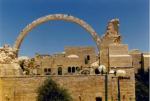
This is the arch of the Hurva Synagogue which is located in the center of the Jewish quarter. It was originally built in the 18th century and was destroyed in 1721. It lay in ruins for 140 years. Hurva means destruction and the arch was erected as a commemoration in 1977. It was a powerful symbol.
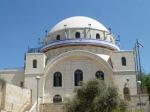
The newly built synagogue in 2010- notice the arch has been incorporated.
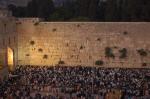
This is about how crowded it was this past Friday night. It’s the most crowded I’ve ever seen. Terri pointed out that one thing we miss out on in the US is having a town square. In addition to those praying there was a lot of meeting and greeting going on in the very large but packed plaza in front of the Wall.
Prayer on the women’s side. Many students from the US are in Israel this time of year as they are on vacation from their universities. Men and women pray separately at the Wall and there has been some contention about what the women are permitted to do or not. Looks like a resolution may be coming soon in another area further away from the men’s section that will allow women who want more active participation to do so.
When it was time to go for dinner we met up with our group and some other friends of Elana and Yakov’s going to the same neighborhood and we went through the Muslim quarter as it’s a “short cut” to the Northeastern neighborhoods. It was heavily guarded the whole way by Israeli soldiers and we walked very quickly. I had not been in the Muslim quarter since 1970. Most of the businesses were closed- lots of arches different from the other quarters. I believe most of the arches are structural as they can carry quite a bit of weight above them.
We exited the Damascus Gate (Sha’ar Shechem) into a Palestinian neighborhood and once again reminded how closely people live to each other and hopefully can do so peacefully for all.
Final slide here is the view of Kikar Shabbat (Shabbat Square). It’s the crossroads of Mea Shearim that I already wrote about and a very busy intersection during the week. Just pedestrians and strollers on Saturday.
The Shabbat starts at sundown Friday and lasts until sundown Saturday. In all of Israel public transportation stops and in certain neighborhoods cars are not allowed and most stores are closed (it’s like Christmas Day in the US though it happens every week). So by 4 pm Friday the busy street our hotel is on, suddenly went silent. We hustled around after we returned from the Dead Sea trip to get food for Saturday as all the stores/restaurants would be closed. Everyone else was bustling around too and one thing I’ve always loved about Shabbat in Israel is that many people have flower bouquets they are taking home for Friday night dinner. We walked to the Western Wall along with a sea of other people and then to Elana and Yakov’s home for dinner (our daughter and son-in-law) who also invited two young women, both Russian, who are studying here. It was lovely to talk with them. It’s traditional to have guests Friday night and there is a man at the Western Wall who has made it his business to help anyone who needs a home to go to for dinner find one. He has a list of people who will take any stranger and he sets people up.
All the images on this posting came from the internet as it is not permitted to photograph on the Sabbath (for Jewish people). We had a lovely restful time and we really needed it. Saturday during the day we went to the Bible Lands Museum, the Shrine of the Book, and the Israel Museum all of which were open. We prepared ourselves for many of the sites we will be visiting in coming days. One thing I’ve learned teaching art history, is how wonderful it is when works of art stay in their home country so that one can really get an understanding of the context for it all.
Sunrise over the Dead Sea with the mountains of Jordan on the other side.
A little later in the morning, you can begin to see the terrain.
This is the Judean desert on the Israeli side of the Dead Sea.
Planted palms at the foot of Masada. We saw hundreds of planted date palms on the way back from Masada.
Masada: the people ascending the snake path look like little ants.
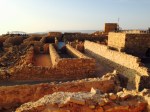
The excavated ruins atop Masada.
The excavated synagogue on top of Masada. Many ceremonies are held here nowadays including Bar and Bat Mitzvahs (coming of age ceremony) and military ceremonies for the Israeli army.
Shore of the Dead Sea (in Hebrew it is translated as the Salt Sea), lowest point on earth, 400 meters below sea level.
The Dead Sea has so much salt in it, that it is impossible to sink and you can read a newspaper while floating with no effort at all. The large group you see in the center is one of the youth trips for Americans 19-26 who have never been to Israel before. Since they are university students this is one of the busiest times for these trips and they were everywhere we went. It’s great for the kids but difficult to be around.
Oasis of Ein Gedi, natural springs about 15 miles from Masada
Caves above the oasis are similar to the caves that the Dead Sea Scrolls were found in and not far from where they were found.
Ibex that are native to Ein Gedi. In Hebrew they are called Yael which is also the name of my younger daughter though she is definitely better looking.
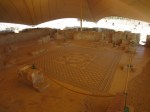
Mosaic from ancient synagogue discovered at Ein Gedi Kibbutz next door to the park. It was discovered when they were digging a new field and has been excavated and studied. The mosaic was in surprisingly good condition considering it is from the 3rd-6th century CE
Upon our return to Jerusalem we saw evidence of the devastation from the 3 day snowstorm of a couple of weeks ago. There are lots of trees that had to be cut down and debris everywhere. This is Sachar Park, a large park close to the Knesset (Parliament building) and the Israel Museum.
Friday morning we left Jerusalem at 4 am to travel south the Masada. Of course it was dark the whole way there, and the reason we wanted to do that was to have sunrise at Masada. I had an injury in October and am not completely steady on the feet so I opted not to climb the mountain but have been there many times before so I stayed with the bus, chatted with the driver (an 8th generation Jerusalemite) and did some sunrise drawings. A bit about Masada: In 72-3 CE, almost 1000 Jewish rebels sought refuge atop Masada, a mountain in the desert south of Jerusalem that Herod had developed for himself complete with two palaces, baths, etc. The Temple had been destroyed in 70 CE and this was a kind of last stand against Rome. The rebels were besieged by the Romans though they were able to hold out for two years while the Romans built a giant ramp to access the top (on the west side). When the rebels realized they were going to be defeated, the chose mass suicide rather than submit to Roman death or enslavement. Terri provided the photographs of the ruins on top of the mountain.
After she came back down (cable car down and a 45 minute hike up) we traveled to the Dead Sea for a dip and to Ein Gedi, an oasis nearby that has a National Park preserve alongside the Kibbutz which grows dates. Ein Gedi is a spring fed oasis with gorges and waterfalls, ibex, and interesting plants and trees including Acacias and something called the Sodom Apple (poisonous if eaten). This would have been a complete enough day as is but we returned to Jerusalem to prepare for Shabbat which will give us a much needed rest. After Shabbat we will be leaving Jerusalem for the coast and the north for more adventures.
One thing that Israel does well is monuments and museums. There are lots of opportunities for propaganda (note to CR students: we’ll be discussing propaganda and it’s not necessarily a negative thing). Yad Vashem, the Holocaust Memorial is one such example as is the Shrine of the Book at the Israel Museum. The images I’ve chosen will illustrate this for you.
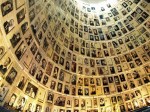
This room at Yad Vashem is a domed space that is filled with photographs of individuals lost in the Holocaust. Below them are endless bookshelves containing books inscribed with the word “Yiskor” (Remember) containing the names of all of the 6 million Jews murdered in the Holocaust.
This is a model for the Valley of the Communities at Yad Vashem. It is laid out as a map of all of Europe and is pillars of stones inscribed with the names of Jewish communities, large and small that were destroyed in the Holocaust. One can wander through to find a town that is significant to them, take a rubbing, say a prayer, light a candle.
Unfortunately we got there just before closing time so we had just a short time to explore. The valley begins with Russia. This is how it looks, kind of mysterious at dusk.
The wall to the right includes the name Sochi where the 2014 Winter Olympics will be played in February.
A closer up view that includes a fire pit for placing memorial candles. Jews light these candles to commemorate those they have lost and the candles burn for 24 hours.
This is how one would travel from one part of the monument to the next. As you might imagine Russia and Poland have a large section of this monument.
As you leave Yad Vashem you look out over the modern city of Jerusalem so coming out of the darkness of loss into the understanding of what it means for the Jewish people to have their own homeland.
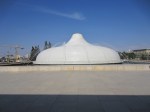
The Shrine of the Book contains the Dead Sea Scrolls discovered in the late 1940s and brought together for safekeeping and study in the 1950s. The building itself is juxtaposed against a black marble rectangle to represent the forces of light vs. the forces of darkness, something recorded in the scrolls. The water pouring over the sides of the Shrine represents purity, another element the people who produced the scrolls valued.
The Shrine of the Book is designed with special hydraulics so that in the event of a bombardment from the air the entire building would sink into the ground. The building was designed by Armand Philip Bartos and John Kiesler
An example of one of the scrolls (from the internet- not permitted to take photos inside)
Terri and I at the Dead Sea. More about the Dead Sea later, just wanted those of you who don’t know her to “meet” her
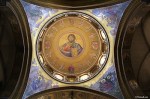
Dome, Church of the Holy Sepulchre, 11th century
Looks like there have been renovations to the Church of the Holy Sepulchre since I had been there last.
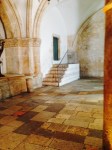
The supposed room of Jesus’ Last Supper
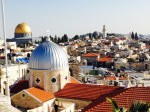
A great view of the Christian and Muslim quarters of the Old City.
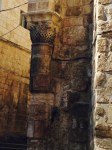
A basket capital, an unusual option for a column top.
My friend Terri took a tour of the Old City so I have included some images that she took along with a couple from the internet (the church interior). Since I have been to Israel many times and to the Old City more times than I can count, I opted to meet up with some of my relatives for lunch while Terri took the tour. Many more Christians visit Israel than Jews or Muslims so it looks like the focus of her tour was for the visitors that are Christian. What we realized on Shabbat on the way to the Western Wall, is that they skipped over the Jewish quarter so was glad I got to show her that a little bit. One thing Terri noticed is within the small space of the Old City Armenian Christians, Jews, Muslims, and Christians live in close proximity in relative harmony. Maybe it’s the sacredness of this place that fosters cooperation. I was happy to hear and to see that the Church of the Holy Sepulchre has been renovated as the last time I was there, it was pretty moldy and dusty and the various Christian factions were arguing about control.
Shmoozing is universal no matter where you go. These boys are enjoying a little tea and conversation outside the Machane Yehuda market.
This mansion on the edge of Mea Shearim was built by an early pioneer who came from Germany in the late 1800s. While here I’m reading a new book entitled “My Promised Land” by Ari Shavit. Right now in this book he is talking about his great grandfather and his peers who immigrated to Palestine, a harsh and primitive environment when they had successful and comfortable lives in Western Europe. It’s interesting to ponder that and to read his explanations. We just came upon this building as we were walking. That’s why I always like reading something related to where I am traveling. We couldn’t go inside as it’s now some kind of government building which would have meant going through security.
The families living right inside this ultra orthodox neighborhood have lived here for generations, often in very cramped quarters since they have lots of children. There are also many synagogues, schools, and yeshivot (for adult learners) along with stores that cater to the needs of the community. We did some shopping here for a bar mitzvah gift.
The community asks visitors to respect their rules for modest dress.
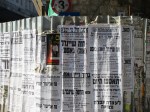
Instead of reading a newspaper, anything you might need to know from news to death notices to classes is posted on the walls everywhere you look.
Does it look cold? About the same as Mendocino temperature but to Jerusalemites this is cold. The boys are walking away front the old city whose walls/ramparts you can see behind them.
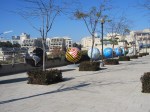
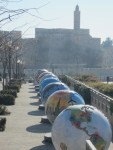
Cool globes, presented by the Clinton Global Initiative, addresses climate change in many different ways. Notice the trees looking pretty sad. These look a lot better than most of the rest we’ve seen, bent or broken from the three day snow storm Jerusalem experienced about two weeks ago.
This is a temporary exhibit that has been here since April, 2013. Not sure who most of the artists are but seems like most of them are Americans, and some are school groups.
Behind the globes is a tower from one of the churches in the Armenian quarter of the old city which is divided into four sections: Armenian, Jewish, Muslim, and Christian.
This was one of my favorite globes covered with the bottoms of aluminum cans. All around it says: Reduce, Reuse, Recycle. Behind the globe you can see the new city including the ubiquitous cranes that have always been on the skyline of Jerusalem and probably always will be.
This one looks like it came from California. You get a good view of the Jaffa Gate, one of the main entrances to the old city.
On our second day, we experienced both the old city and the new city of Jerusalem. When I say “we” I mean my friend Terri who is with me on this trip. This is her first time in Israel so she took a tour of the old city and I spent some time with my daughter doing some shopping in the Mea Shearim neighborhood. I’ll be sharing some of Terri’s photos with you in the next blog post but for how a little about the new city and Mea Shearim in particular. New city is relative since the “modern” city of Jerusalem probably began to grow at the end of the 19th century and once Israel was granted independence in 1948 it grew even more as Israel was deprived of access to the old city. After 1967 Israel captured the old city from Jordan and then of course additional territory that has made life complicated for all ever since.
Jerusalem is a modern Westernized city that still retains its early 20th century flavor and even earlier. This is one of those places where every step you take you are walking next to or stepping over history. There are always surprises. Almost all the buildings are built from a certain kind of stone called Jerusalem stone that glows pink at sunset. It’s pretty magical. The neighborhood you’ll see in the photos houses families that have lived there for centuries often in very small spaces with lots of children. Can you imagine living in a two bedroom apartment with 10-12 children? Somehow they manage.
The tea was both visually beautiful and amazingly aromatic. Look forward to trying it when we get home.
The two towers you see are saffron, obviously common here, and much less expensive than at home. Savor the selection of colors for a moment.
Yes this is the Middle East but didn’t expect to find the QR code. The world truly is wired.
Beats the olive bar at Harvest Market!
It’s an aquired taste but obviously if you like Halva you would be in heaven here. Halva is made from a variety of nut butters most commonly sesame seed butter.
I spent the first day of 2014 in Jerusalem and it was just like any other work day here. Since the Jewish new years celebration is in September or October this day is no different from an ordinary day. After a very long trip (leaving Monday and not arriving until early today/Wednesday) we are very far from California. I’m making this trip with my very good friend Terri and this is her first time so it’s interesting to see things through her eyes and I am here to visit with my daughter and son-in-law who make their home here.
Our only major excursion today was to the Machane Yehuda market an indoor and outdoor market in the heart of Jerusalem. One thing one notices pretty quickly is that here unlike in the US the only fruits and vegetables one sees are what is in season and it’s all quite appetizing. Another thing one notices is that we are in the Middle East so spices abound, looking and smelling glorious. We are recovering from our journey and expect tomorrow to be our first jam-packed day.
I’ve looked at lots of blogs in the course of putting this one together and wanted to keep this on a more serious note partly because I’m also in the midst of teaching two art history classes and am excited to share as much with my students as I can since I can’t have them here with me. But there are some things that just don’t fit into that “serious” thing so this post will cover those other things. Hope you’ve enjoyed this little journey- we certainly did.
For the car we rented, we wished we had a bumper sticker that said “Avis made us rent this car.” It was twice the size of any other car on the road and now that you’ve seen how narrow some of the streets in these towns are you can see what a disadvantage that is. We figure here in Sicily perhaps this car makes us appear to be part of that group that you are not supposed to mention (you know the one that sparked a TV show about “singers” in the opera). It’a a good rationalization for the looks we get from passersby. We turned it in filthy, from road dust, lots of bird poop from parking under trees, and plenty of scratches but don’t worry we never met insurance we didn’t feel we had to buy. A man we met at the AVIS counter asked Jeff how he enjoyed the car as I guess it’s considered a “luxury” model and Jeff’s response was just get all the insurance.
About the cats, it truly makes us feel we were in a Mediterranean country, and one more tied to the Middle East since the British brought cats to Israel and Egypt when they were part of their empire to take care of the rats. Since the British were probably the only ones who were not in Sicily (except maybe during WWII) we can blame the French or anyone else you like. Anyway, they are only annoying if you have food otherwise they have virtually no interest in you. Saw very few stray dogs but they haven’t got the pooper scooper thing yet so in addition to being sure we didn’t sprain something by stepping into a hole we had to watch out for that as well.
For those who are reading this blog and are Jewish you know that we are in the midst of a whole season of continuous holidays. Sukkot (the one we are in now) is one of my favorites and probably the one I miss not celebrating at home the most. So, we were delighted to find a “sukkah” restaurant in Ragusa. The food has been very good though the beef is nor very high quality and there is no chicken on the menu in Sicily so if you are not a seafood eater you are probably a vegetarian by now. We are having no problem in that department though finally figured out that we were eating too much and are ordering much less. Hard to imagine that people can eat an appetizer, a first course (pasta), a main course, and dessert.
So last night we were in our last hotel, and I dreamt that the hotel had a section of floor that was from the 3rd century. We of course went in search of it (in my dream) and did find it in some out of the way corridor and were the only ones “looking” at it. Kind of a funny dream but made me think about how we had, as one of my students put it, “stood in the temples” and I am amazed to think that we spent so much time immersed in ancient history that is still with us today though who knows for how long. We are happy to come home to one of the places people go on vacation instead of vice versa. By tomorrow it will probably seem like we never left.









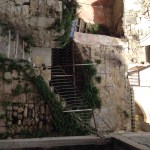







































 Poetry Without Words