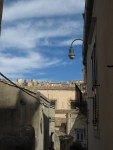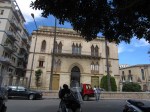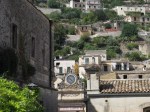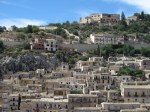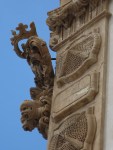
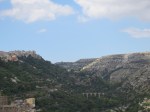
Looking up

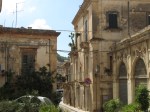
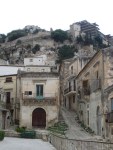
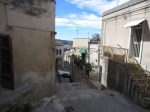
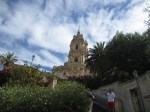
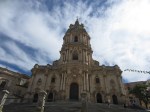
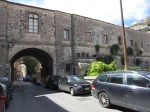
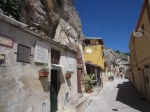
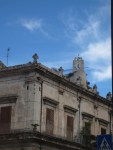
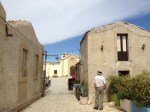
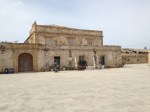
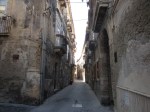
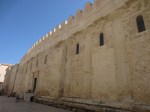
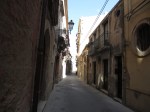
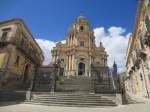
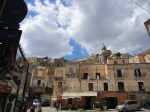
Today we are in Ragusa, traveling only 16 kilometers but a very different place from Modica.  Ragusa is much bigger (about 20,000 people more) but from where we are you would never know it.  Ragusa was once two separate cities and in some ways still is.  This ancient city was founded with the Sikels moved into the interior away from the sea to escape from the Greek colonists.  They settled in what they called Ibla, which was as everything else in this area destroyed in 1693.  The town fathers decided to rebuilt higher up on the hills but the nobility wanted to stay where they had been and refused to move.  As a result, funny as it sounds the “new” Ragusa built in the Baroque town plan (very regular) and a bit a dull was created on top and down below Ibla retained its Medieval plan- that is no plan at all.  Lots of tiny alley and lots of stairs going up and down the hillside.  In 1926 the two towns became one and as a reward Ragusa was made the provincial capital.   Since we only have one day here, we decided to skip the upper town and have explored Ibla where we are also staying overnight.

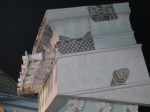
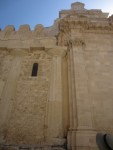
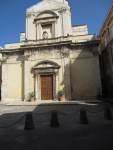
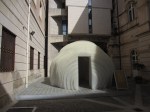
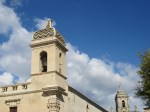
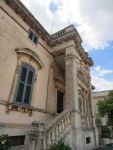
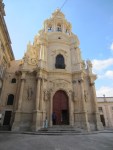
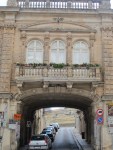
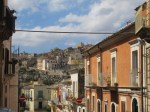
I find myself looking up all the time because the old palazzos have amazing gargoyle like creatures, beautiful balustrades and the churches seem to go straight up.  Of course there are the distant views looking up as it’s quite hilly in this region and the weather is a bit closer to ours.  A bit cooler than we’ve had so far.  Ibla is not like Modica or Scicli that feel “lived in”.  This feels like another tourist only place so while it’s very pretty we’re glad to only be here one night.  We basically explored the whole thing in a few hours.

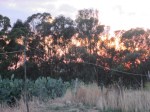
We skipped a day of touring around and relaxed at a farm/inn (Agroturismo) and were still looking up at the hills, the sunset, and the views all around.

Small Spaces

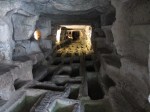
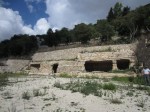
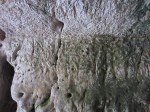
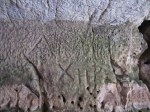
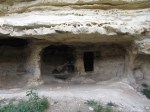
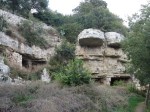
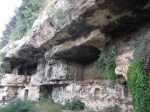
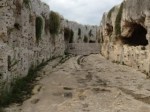
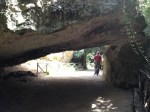
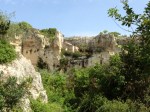
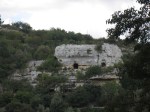
Today we toured around the area outside of Modica and visted Cava D’Ispica, a valley filled with catacombs and caves.  The caves were carved out of the limestone to create tombs, hermitages, and dwellings from the Bronze Age until the early years of the 20th century.  It’s a strange place and reminded us of the Anasazi ruins we’ve seen in Utah.  There is also an area identified as a Gymnasium from ancient Roman times as well as several areas designated as churches though it’s hard to tell that’s what they were at this point.

We also visited the smaller town of Scicli from which the name Sicily comes.  It’s an interesting Baroque town with some especially interesting architecture.  You will see that the cemetery just outside of town has some mausoleums that look bigger than most of the houses in the town.

We’ve been lucky to have a GPS in the car we rented and even though it’s all in Italian it’s kept us from getting super lost.  It took us as long to get back to our hotel from Scicli as it took to go there and back.  Tomorrow we move on for yet again more adventures.

Steps and Views

Arrived in Modica which is another UNESCO World Heritage site.  It has been inhabited since the era of the Siculi culture (1300-700 BCE).  The name Sicily comes from this early people.  They were eventually absorbed into what is known as Magna Graecia.  They are mentioned in the Odyssey by Homer.  Modica rebelled against Roman rule in 212 BCE and thanks to its strategic location became one of the most important towns in medieval and Renaissance Sicily.  From 844-1091 Modica was an important Arab city called Mohac. So it has quite a diverse history.

It is perched on a rocky outcropping between two rivers that flooded so that they chanelled them into culverts and built the main street over the top.  As you walk on the mail street between the two hills (like in a gorge) you can sense where the river flowed.  Then of course there was the great earthquake of 1693 that devastated Modica as well as the other towns in this region.  The rebuilding, unlike in Noto, followed the original layout of the streets, up the sides of the two steep hills with wealthy families building their palaces down the center.  These were flooded out at some point and they moved them up the hill.

Modica is known for its chocolate, introduced here by the Spaniards in the Middle Ages who had brought cocoa beans from the Aztecs in Mexico.  It’s still made the same way it was then, 1000 years ago and is called glass chocolate.  It is made from only cacao and sugar.  The cacoa beans are toasted and then ground using a metate (like a mill stone).  The beans are gently warmed, sugar is added though it never gets hotter than 40 degrees centigrade, hence “glass” crunchy, not smooth.  Dark chocolate only with some added flavors like nuts, citrus, etc.

The TV commercial goes like this:  An American is stuck in a tree with his parachute and a little girl comes along, he offers her a Hershey bar, and she pulls out a Modica chocolate bar.  It’s yummy, may try to bring some home.

So all this about hills brings us to the title of this post- lots of steps and lots of interesting views of both sides of the valley.  We really like this town- it’s lively, the food is amazing (good up until now but this food is fabulous), and we are getting our exercise! Good if we want to eat lots of chocolate.

Stage Sets

Many of the towns in this part of Sicily are UNESCO World Heritage Sites so our expectations were high for what we might find.  We started in Noto, which is even described as a “stage set.”  If you have never seen the film “Cinema Paradiso” you should.  It’s set in Sicily and filmed here and is one of the sweetest films ever.  So perhaps I was looking for that when we arrived in Noto.
We are staying at a Villa/Hotel a little out of town so had the added adventure of driving into the historic part of town and finding a parking place.  We had great instructions from our hotel and managed fine except for a few bumps and scrapes to the car (we bought full coverage so we aren’t worried).  We just love to buy insurance!

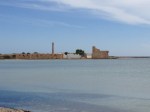
The heart of the town is a pedestrian only area and strangely we did not see many locals nor many tourists but the focus was on tourists- souvenir and gelato shops abounded.  You will see the Baroque architecture in the pictures but we were not terribly excited about the town all together.  Next day we traveled south to the much smaller town of Marzamemi, which apparently is a popular summer resort.  It’s mostly deserted this time of year but we walked around the small center of the town and really felt as though it was a stage set.  There is some Arab influence here, no surprise since at this point we are fairly close to North Africa.  Tuna fishing is the biggest industry here and has been since ancient times.
Of course, it’s entirely possible that we don’t see any Italians because we manage to come in the middle of the day when they are in siesta (everything closes down 12-4 and then reopens until 7 pm).  We’ll see what happens next stop where we are staying right in town.

Even our hotel (former villa) is a bit of a stage set. I expect the actors from Cinema Paradiso to walk down the stairs at any moment.  Tomorrow we move on to Modica, another UNESCO World Heritage site so more on that later.

A drive in the country

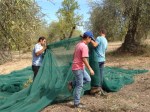
We spent the day exploring around the very southern tip of Sicily and enjoyed being out in the countryside with olive trees full of olives, almond trees, vineyards, and some lovely surprises.  We watched some people harvest almonds by beating on the trees with long sticks and a farmer tilling in between olive trees that looked quite ancient.  We visited a Reserve on the coast that will remind you of the kind of place we fight hard to keep from development (nothing new here) and they managed to do it!  We saw pillboxes dotting the hills as this was a landing point for the Allies in World War II.  All history all the time…

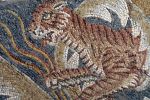
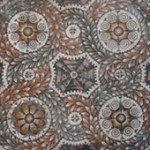
The highlight was a visit to an ancient Roman villa called Tellaro where some of the most beautiful mosaics I’ve ever seen are displayed.

Tellaro is one of those places that most people don’t visit because it’s out of the way and many people just don’t know about it.  It’s a relatively recent archaeological discovery so that might be part of it but lucky for us.  No crowds. It dates from the 4th century CE decorated with extremely detailed mosaic floors that were badly damaged, took 30 years to reconstruct and was just opened in 2008.  The villa was destroyed in a fire probably during some barbarian invasion.  The fire damaged the mosaics of course and a farmhouse was built over the site in the 18th century.

The photos I took did not come out so well so I’ve included some from the internet.  I’m going to work on the ones I took when I get home (don’t have Photoshop on this computer).

Archaeology of Southeastern Sicily

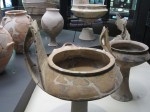
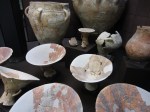
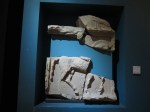
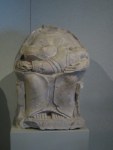
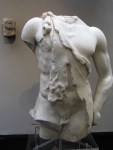
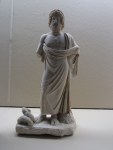
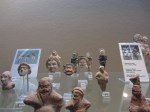
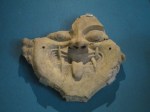
The Archaeological Museum in Syracuse occupies the grounds of Villa Landolina.  It is named after Paolo Orsi, a famous archaeologist who worked in this region.  The museum was opened in 1988 and contains 18,000 works with more planned to be displayed on the top floor.  As we made our way around we saw placards indicating works that have been loaned to other museums including the Capitoline Museum in Rome and the Getty Museum in Malibu.  Since it was hard to identify many of the works this post will explain the different sections and captions will indicate which section the work was found in:

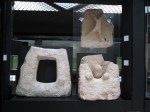
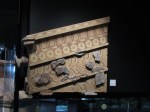
Section A: geological and prehistoric displays including slab doors from a tomb with phallic designs, translucent red clay pottery, reconstructed tombs

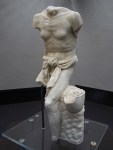
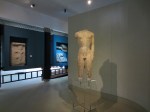
Section B: Greek colonization of Sicily beginning 8th century BCE including a Venus, headless kouros (male nude figure), goddess suckling twins, vases, models of temples of Athena and Apollo and the Ionic temple near the duomo.

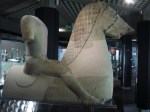
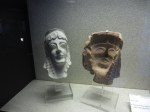
Section C: Sub-colonies of Syracuse and Hellenized communities.  Some highlights are terra-cotta horses, bronze statuette of athlete, vases, and votive busts.

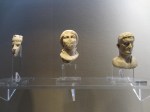
Section D: Some Roman era figures and busts beginning of the final section of the museum

Ancient Greeks and Romans

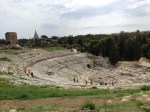
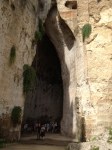
Full day of exploring the archaeological park called (Neapolis).  We chose this part of Sicily to visit because it has the largest concentration of ancient Greek sites.  The biggest colonies developed by the Greeks were located in this part of Sicily.  The park contains both Greek and Roman ruins.  This post will combine some of what we saw (the next day) at the Archaeological Museum which is one of the finest I’ve ever seen with 18,000 works on display in one of the most well thought out museums ever.  You were given a path to follow from earliest works (2500 BCE) to about 200 BCE for the entire region.  As you made your way through you could see all sides of the sculptural forms.  There was no catalog to buy and much of the signage was not in English although occasionally it was so much of what I’ll share with you will not be properly labeled, sorry.  Just enjoy them for what they are.  I’m going to include some here and some in a separate post just showing some of the highlights of the museum.

For the key to understanding the “Sections”:

Section A: geological and prehistoric displays including slab doors from a tomb with phallic designs, translucent red clay pottery, reconstructed tombs

Section B: Greek colonization of Sicily beginning 8th century BCE including a Venus, headless kouros (male nude figure), goddess suckling twins, vases, models of temples of Athena and Apollo and the Ionic temple near the duomo.

Section C: Sub-colonies of Syracuse and Hellenized communities.  Some highlights are terra-cotta horses, bronze statuette of athlete, vases, and votive busts.

Section D: Some Roman era figures and busts beginning of the final section of the museum

Syracuse (not New York)

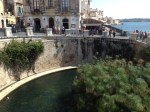
We arrived in Sicily yesterday, had some travel adventures with rental car (GPS in Italian, etc.) but arrived safe and sound in Syracuse.  A bit about Sicilian history- it is an island that famously has Mt. Etna which has erupted numerous times, there have been many earthquakes, it’s actually geographically close to North Africa (Tunisia especially) about 600 miles.  It has been conquered and occupied by many different groups including Arabs, Spanish, Byzantine, Germans in Middle Ages, Greeks, Normans, and of course Romans.  It was a separate entity until it became part of the Italian Republic in the 19th century.   It has a distinct culture, cuisine, and is rich in art through the 17th century.  We are of course, not supposed to talk about the “godfathers” or “sopranos” but you can see lots of tee shirts alluding to that part of Sicilian heritage.  It is mostly a rural economy and though it has had times of great prosperity it is mostly an economically deprived region.

We have not seen much economic depravation so far as there are many tourists in Syracuse.  The setting as you will see is quite beautiful by the Mediterranean and even at night you can see the bottom of the sea close to shore.  Enjoy the photos from our first day in Sicily.

Commerce, Pleasure, and the Unexpected

At the end of our time in Rome, we visited Trajan’s Forum and Market.  It has been heavily reconstructed and was a bit confusing to visit as we were not sure where to go from one section to the other.  Trajan’s Market was built probably in 100-110 CE and could be considered the largest shopping mall.  There were administrative offices as well as apartments above.  Unexpectedly as we wandered through we found exhibits of all kinds of contemporary works (photographs mostly) and in one small corner a photographic survey of the occupation of Afghanistan with photos from the 19th century juxtaposed with photos from 2010.  Pretty interesting in a setting of the powerful Roman empire.

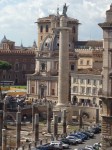
Trajan’s column was a bit of a disappointment from photographs I’d seen though from above it is quite a monument.  It’s similar to the triumphal column of Marcus Aurellius we saw a few days before.  Of course, statues of the emperors were eventually replaced with statues of saints.  Not sure which ones.

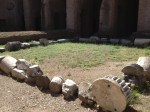
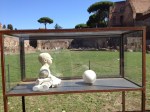
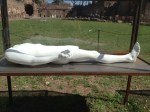
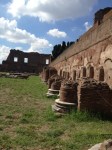
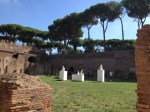
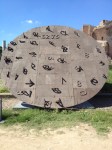
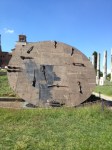
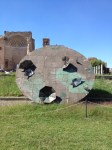
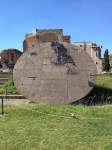
We also made a visit to the Palatine Hill and saw the ruins of the pleasure gardens, fountains, and shady parks the emperors enjoyed and there are great views overlooking the Colosseum and the Forum which one forgets is right in the middle of town.  It really is remarkable that people actually live in historic Rome unlike the other Italian cities of Florence and Venice which seem more and more to be tourist amusement parks.  Probably the most interesting thing to us was the “Post Classici” exhibit of contemporary Italian art throughout the Palatine Hill and the Forum.  Much food for thought- now on to Sicily.