We can always learn something new, and I’m always thrilled and a bit perplexed when I learn about something I knew nothing about before. So it was with the special exhibit at the Stedelijk Museum in Amsterdam. The exhibit was entitled “Zero” and chronicled the artists of an artistic movement of the 1950s and 1960s that saw themselves as a reaction to abstract expressionism. Many of the artists included in the exhibit are better known for other artistic movements such as Arte Povera, Minimalism, New Realism,Op Art, and Kinetic Art.
In manifestos published by the group it sought to eliminate color, emotion, and individual expression. You may be familiar with some of these artists though likely haven’t seen these particular works and will be seeing some more of their work as we progress to modern art in our class. Some of this may be difficult to accept but keep an open mind.
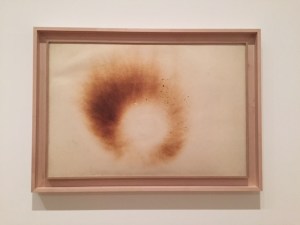
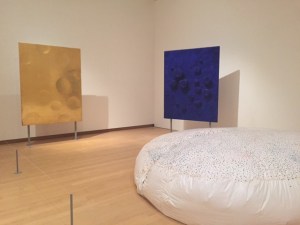
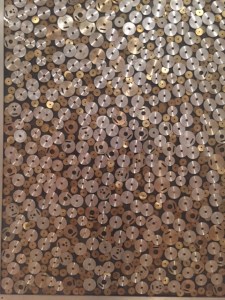
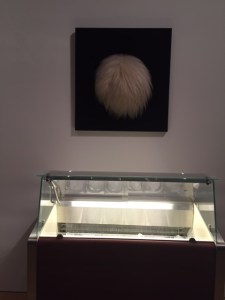
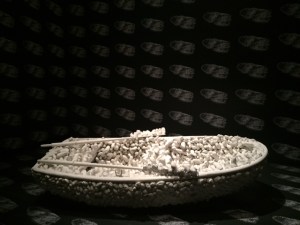
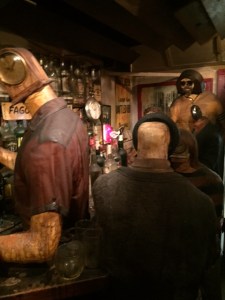
Yves Klein, Untitled Fire Painting, 1961. This work was accompanied by a video that showed the artist burning the work with a fireman spraying with a hose alongside.Mario Merz, “Unreal City”, 1969, metal, gauze, beeswax, neonYves Klein, Blue Painting, Gold Painting, Splattered cushion (not the title), 1962Arman, “Nuclear Particle”, 1964, gear wheels, plastic, woodSaburo Murakami, “Six Holes”, 1955, wood, paperHenk Peeters, “Ice. Polar Bear, Freezer #61”, 1961Carl Andre, “Bloody Angle”, 1985, Western Red CedarYayoi Kusama, “Aggregation 1000 Boats”, 1963, plastic, textile, leather, metal paintEdward Kienholtz, The Beanery, 1965Kienholtz, The Beanery, interiorKienholtz, The Beanery, interior
Got stuck in rush hour bike traffic last morning in Ghent on the way to the train station for our return trip to Amsterdam. On our last morning in Holland we stopped at the Stedelijk Museum of Contemporary Art. It too had major renovations and has incorporated the old building into a state of the art new wing.
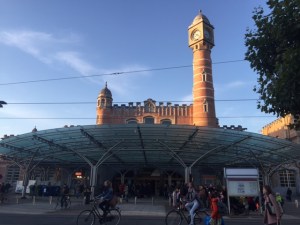
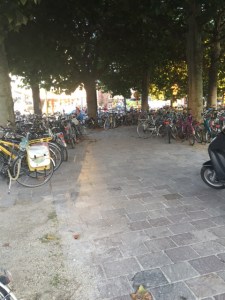
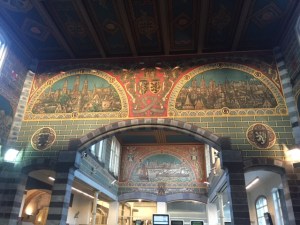
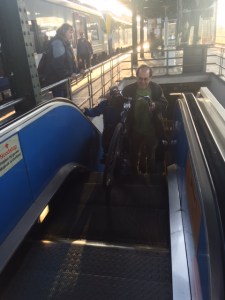
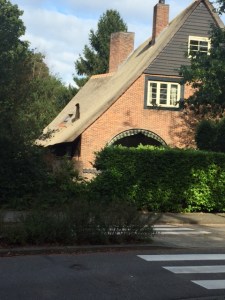
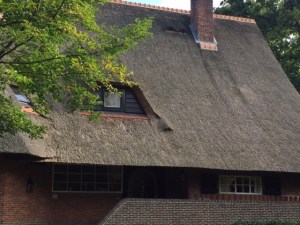
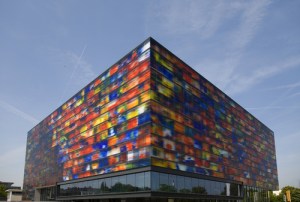
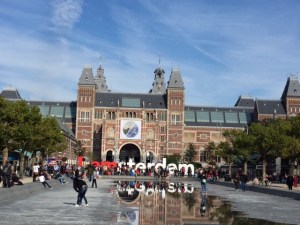
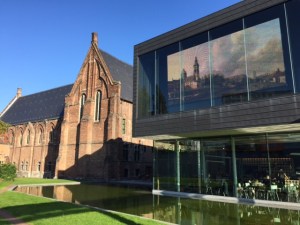
The old main train station in Ghent with a new entrance.Bicycle parking early in the morning from the commuter rush.Inside main hall of the ghent train station.We’ve seen some nice stations and it’s odd that one of the biggest (Amsterdam) is quite ugly on the inside though similar in architecture to the Rijksmuseum on the outside.Had to take the bikes up the escalator. Definitely not ADA compliant.Back in Bussum we walked past a private home that still has a thatched roof. Must be expensive to replace but so beautiful.There are fewer and fewer of these roofs but they are quite lovely. Hope people keep them up!On the way to returning our bikes we pass the Netherlands Institute for Sound and Vision, a stunning modern building.The new facade of the Stedelijk MuseumLooking from the entrance of the Stedelijk is a Richard Serra sculpture, the Van Gogh Museum, and the Rijksemuseum in the distance.Farewell to Holland and Europe (for now) to a very different world. On to Jerusalem.
The main attraction for art lovers in Ghent is the “Adoration of the Mystic Lamb” in St. Bavo’s Cathedral by Jan (and Hubert) van Eyck. If you want to see the work in a way that makes sense I will attach a link for you. The subject of this blog is what’s happened to this work over the years. If you are in the Renaissance to Contemporary class we have already spent some time studying the iconography and formal aspects of this work. The work was finished in 1432 and was a major shift from the stiff depictions of the Middle Ages to Renaissance humanism. It’s also the first work signed by Jan van Eyck though his brother had some hand in the work as well.
It’s actually quite amazing this work has survived at all given it’s been the victim of 6 thefts, probably the mot stolen painting in existence. In 1566 Protestant iconoclasts wanted to burn it though the priests had hidden it away. In 1794 Napoleon carried it off to the Louvre. In 1821 the king of Prussia tools several pieces to Germany. Those panels were so prized by the world community that the Treaty of Versailles (ended World War I) ordered Germany to return the panels. In 1934, someone broke into St. Bavo’s and stole the “Just Judges” panel which is still missing. It has an excellent copy in place until it can be found. In World War II the Allies Monuments Men were in the process of moving it for protection with it was intercepted by the Nazis who stored it in a salt mine until the end of the war. It’s now back in St. Bavo’s in a dark secured chapel.
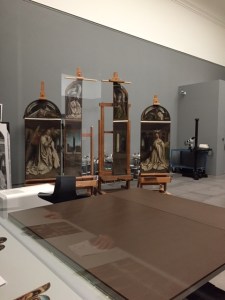
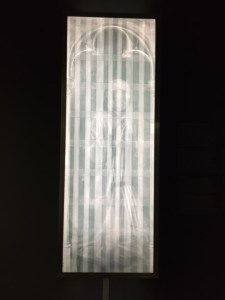
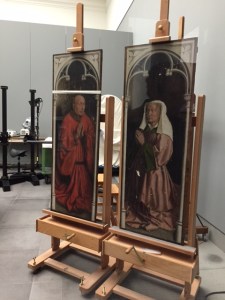
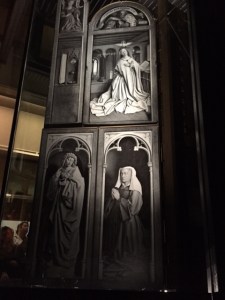
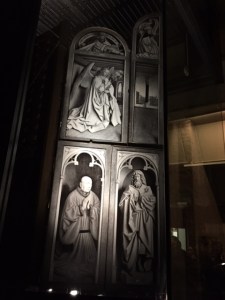
St. Bavo’s is a large Gothic cathedral built in 1350 on the site of an earlier structure dating to 942.The “Adoration of the Mystic Lamb” behind bullet proof glass with a limited number of visitors permitted entry. Restoration work is planned for the next few years to stabilize the condition of the altarpiece.In the 18th century two panels for Adam and Eve were substituted for the nude panels on the altarpiece. When they were returned to the altarpiece the reproductions were hung elsewhere in the cathedral.The altarpiece is in need of major restoration and the lab is at the Fine Arts Museum. Here you can see the panels that are in restoration at the moment.An xray for one of the patron panels.These are the two panels of the patrons for the altarpiece (they are on the closed side)The back side showing black and white photo images of the portions in restoration.Second side of front panel. These panels would be what you see when the altarpiece is closed though I don’t think it ever is now.
Ghent as I’ve said has a lively art scene and not as “local” as the art we saw in Bruges. We spent one full day exploring the city and found some unexpected inspiration. We started at the city museum and then the Museum of Fine Arts in the Ghent equivalent of Golden Gate Park. The rest of the day was spent wandering the squares and alleys of the historic district.
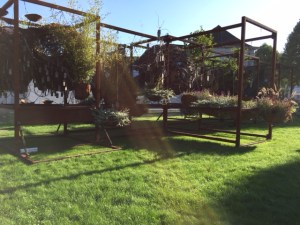
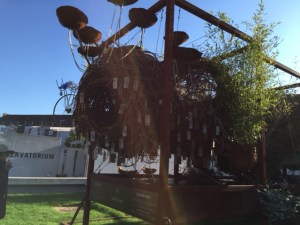
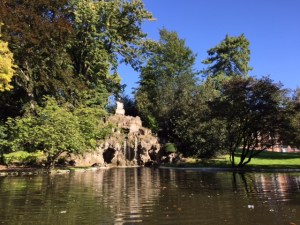
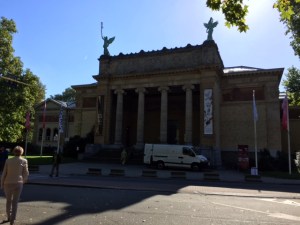
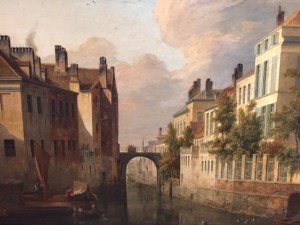
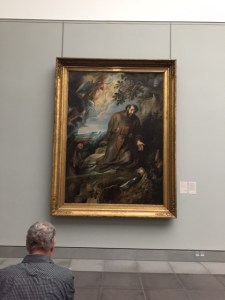
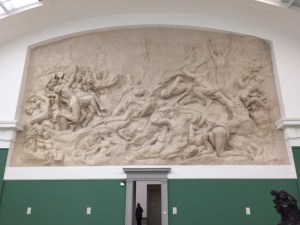
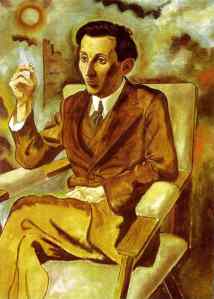
City Museum close to the university. The large screen is a slide show of historical images and personalities in the city’s long history. The museum is located in a converted 14th century abbey.Outside the city museum we found this environmental work titled “The Cocoon”Another view of “The Cocoon”Next stop was the Museum of Fine Arts in the Citadelpark, a beautiful oasis in the middle of the newer city otherwise a fairly nondescript place. This gazebo looks like it’s probably the site for summer concerts and gatherings.This manmade grotto reminds me of some of the ones you find in Golden Gate Park in San Francisco and even at Versailles.The Fine Arts Museum itself is a Neoclassical style building that contains a good collection of Northern European art including artists from countries outside of Belgium as well.View of St. Bavo’st, Pierre Noter, Dommerson, 19th centuryA View of Ghent by Pieter Dommerson, 19th centuryHeymans (Dutch artist), “Sunset on the Heath”, 1877Rubens, “St. Francis of Assisi”. For those of you who have looked at Rubens work this gives you an idea of the scale of his work.“Human Passions”, Jef Lambeaux, 1877, was controversial about the way figures were portrayed and commission not accepted. Plaster cast ended up in the museum.Paula Modersohn Becker, “Girl in Birch Forest”, 1903. An artist whose work you don’t get to see too often. A nice surprise to see this one.James Ensor, “The Skeleton Looking at Chinoiseries”, 1885Max Ernst, “Vegetation”, 1925George Grosz. “The Author Walter Mehring”. Both Mehring and Grosz were socialists, dadaists, and rebels.Art Nouveau pastel, Fernand Khnopff, “Incense”, 1898. This work was a real surprise, never heard of the artist but the work and the frame were quite beautiful.Detail of fabric from pastel “Incense”
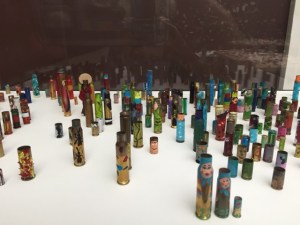
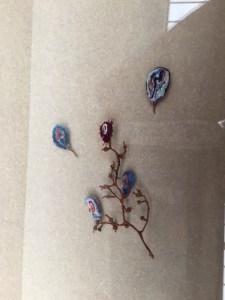
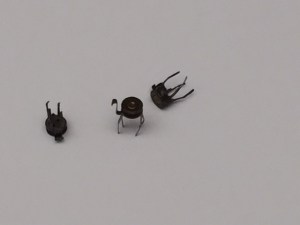
The most interesting work in the museum was a room dedicated to a group calling themselves Micromuseum. These two young Russian artists were in residence at the museum for 2 months and repurposed old and simple materials into works of art. These are painted bullet casings.Repurposing the stems from a cluster of grapes using twined fabric.The community was invited in to create from lots of materials made available to them- here shards of glass and pottery.Gunshell crittersMy favorite- the gunshell forest
The city of Ghent (with a guttural Gh or French version is Gent) is very different from Bruges in some ways and the same in some ways. Both cities were prosperous in the Middle Ages from trade in textiles and both went into decline though Ghent remained a “living” city while Bruges became a jewel box for tourists. It might be hard to image but Ghent was at one time the largest city in Europe. It really is a living city with a university, lots of young people, and seems to have a bit more grittiness than Bruges.
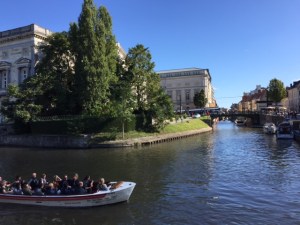
The Korenmarkt, one of several squares in the city each one specialized in a different kind of commerce. Today all home to shops and restaurants.The city is at the confluence of two rivers so moving bodies of water with lots of boat traffic (business as well as pleasure).Where the two rivers (the Leie and the Scheldt) meet. The large buildings you see are government buildings I think.The Castle of Counts built in 1180 not to protect the people of Ghent but to intimate them as they were fairly independent minded. At the time it was outside the city walls, now it’s in the center of the historic district.There are several major churches built during Ghent’s most prosperous time. One the Cathedral of St. Bavo will be the subject of the next post as it is home to the most important work of art in Ghent, van Eyck’s “Mystic Lamb” altarpiece.Another square in the district of the cathedral is a gathering place for visitors and locals alike.
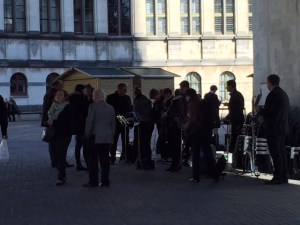
Th University of Gent is the largest in Belgium and lends a liveliness to the city. The arts seem to play a prominent role.This shelter or band shell in the midst of the churches is an interesting construction and has incredible acoustics. As we wandered by there was a great quartet playing.The quartetAs they played a whole other group of musicians showed up to play after them.
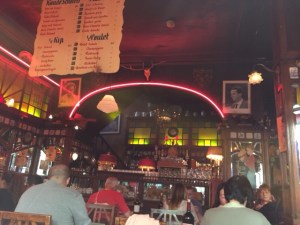
One of these buildings had the date of 1669 on the facade. They are at the entrance to the Patershol neighborhood that used to be pretty down and out and now boasts lots of interesting shops and restaurants.A typical restaurant establishment in Patershol. Hanging down is an old menu in Flemish and French showing us the division in this country between the Flemish speaking north and the French speaking south. The prices are in francs. At either end of the neon are portraits of the king and queen.Next blog post will include works from the Fine Arts Museum and you’ll see some paintings of Ghent that look as if they are still the same.
We departed from Bruges and had a fairly uneventful day bicycling through the Belgian countryside from Bruges to Ghent, a trip of about 26 miles. We only had a few backtracks and most of the way we were one a separate bike trail separated from the road by a designated lane for bikes, one for walkers, and and often a barrier, hedges, or along a canal. It was a lovely day and a fun way to travel through the country.
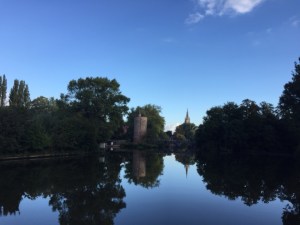
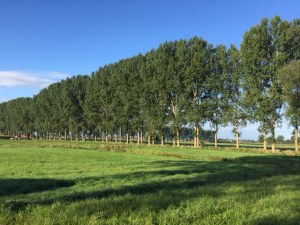
As we said goodbye to Bruges this is the view on our way out of town. Such a beautiful jewel box like place.Beautiful and green and flat!Bunkers left from World War I and World War II are now home to various animals especially bats. Belgium saw some of the bloodiest battles of both wars (Arden and Flanders Field) though you’d never know it from the peaceful countryside.A good portion of the way we traveled along canals dug in the 18th century as Belgium was the second country to industrialize after England in the Industrial Revolution. We saw a few barges still delivering goods to small villages and towns.Here’s the group stopping for the first break.
A small village along the way was our lunch stop.Village church
Art in Bruges takes all forms, from musical groups on the streets, to the requisite mimes, to installations of contemporary art and of course the art of the region in the museums. This is a good example of a city that has invited international artists to “respond” to the environment of Bruges with installations throughout the city. It is also a city whose museum is limited to artists who have had a relationship with the city hence, leaving out Belgian artists who have created amazing works of art and concentrating on native sons and daughters whose work is completely derivative and not so interesting. The not so primitive Flemish Primitives are of course the stars. Not much of interest past the 15th century in the Groeninge Museum.
A Bach serenade in the Burg square. Check out the lute on wheels, and an accordion playing Bach! Quite good.A neon artist whose narrative single words and phrases appeared in interesting places. Food for thought?This odd shaped sculpture reflective on all sides in the center of the main square looks like one of the devices that was used to haul goods off the boats that would have moored there in the 15th century.Doors and windows make an interesting installation next to the St Steven church.
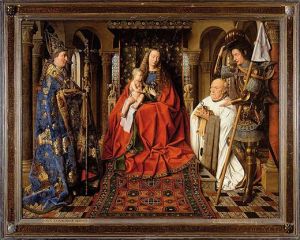
The exterior of the Groeninge Museum that exhibits work from the 15th to the 20th century. There are 10 galleries so it’s a relatively small venue though the collection is much larger.I wanted a better reproduction to share with you of this Hieronymus Bosch but could not find any other reference to it online. It’s a triptych of the “Trial of Job”.Detail of “Trial of Job” lower left hand corner. Has the definite imagery of a Bosch fantasy.Jan van Eyck’s “Virgin and Child with Canon Joris van der Paele” from 1436 is hardly “primitive”. It’s a spectacular image of luminous painting and incredible gem like details. A link for closer examination is attached.Rogier van der Weyden, Luke Drawing the Virgin from 1435 can be seen in our textbook for Northern European Renaissance. Luke was presumed to be an artist in his own right and is naturally the patron saint of artists. Notice the city of Bruges out the window.Last but not least is van Eyck’s portrait of his wife Margareta (1439) one of the first non religious portraits and a good match for van Eyck’s self portrait (the man in the red turban). If you saw it in reality you’d be amazed at how well van Eyck is able to portrait cloth, velvet, and fur. So much for “primitive artists”.Getting closer to modern times were some small etchings by James Ensor of the Virtues and Vices. Just like we guessed about the Breughels in class which one is this?
Hans Memling, Jan van Eyck, Rogier van der Weyden, Hugo van der Goes were amazing artists of the Flemish school of the 15th century. While Italy was in full blown Renaissance, northern Europe was still transitioning from the Gothic style and conventions of the Middle Ages. So these artists were called “primitives”. It’s a term that couldn’t be more misleading.
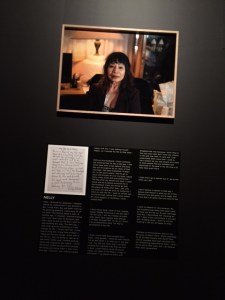
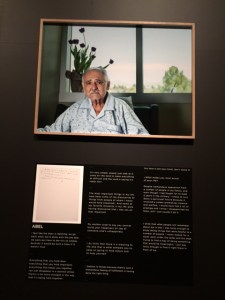
Hans Memling’s paintings were serene,motionless, expressionless scenes of extreme devotion that was quickly fading in the rest of Europe. He became extremely successful because Europeans who passed through Bruges fell in love with it, took it home with them and thereby affected art making in many other places. His work is exquisite in its painting quality, attention to detail and miniature elements, landscape, and of course ability to tell a story. The Memling Museum is located in the former St. John’s Hospital which actually functioned as a hospital until 1975. The museum has some of Memling’s best work combined with work of some of his peers and various hospital related tools, furniture, and depictions of medical care dating back to the Middle Ages. Upstairs was an interesting photographic exhibit by an American photographer (sorry forgot to write down his name) who spoke with hospitalized patients who were close to death and asked them about their illness, how they felt about dying, what they regret, who they love, do they believe in God (a fair number did not), and how do they want to be remembered. It was powerful especially in this place.
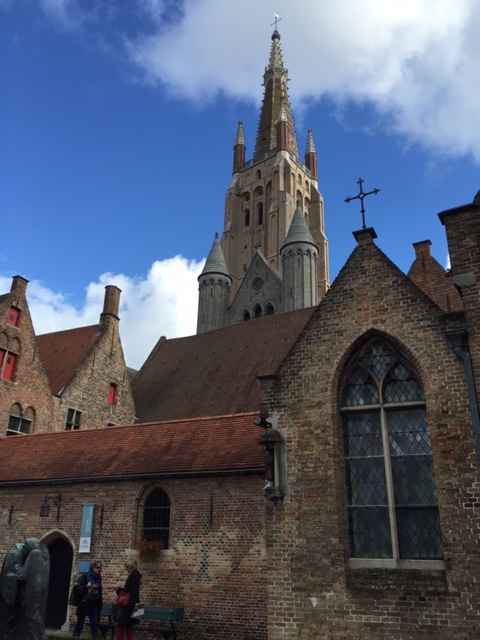
The Memling Museum is located inside St. John’s Hospital.From the canal side of the hospital an array of beautiful old windows.A display of medical instruments from the 15th century, in this case for eye surgery.How about this portrait of the eye surgeon? Hope his hair doesn’t fall into the victim’s (patient’s) eye.A devotional work by Memling from 1489 (Diptych of Martin van Nieuwenhove) includes some Renaissance elements that give it some realism. The figures appear to be occupying the same space in the same room and behind Mary is a tiny mirror that shows both their back’s as a device similar to Van Eyck’s mirror in the “Arnolfini Portrait”. Having the donor included in a portrait with Mary and Jesus gives him security for the world to come.Memling’s St John’s Altar in the main chapel, , 1474. This would be the place one would come to pray for healing for a family member or themselves in the hospital.
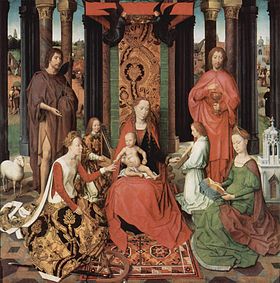
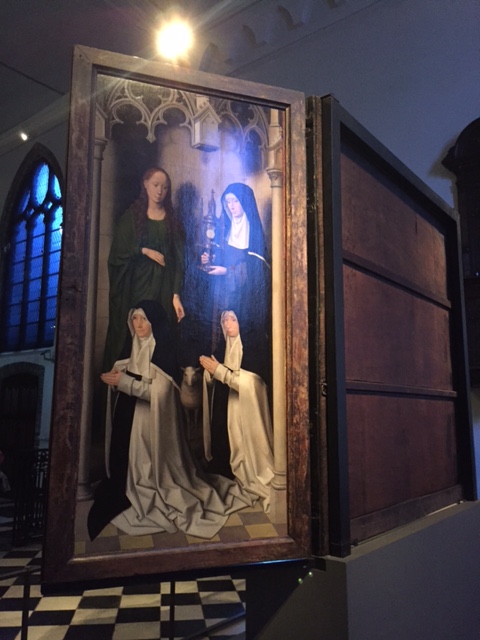
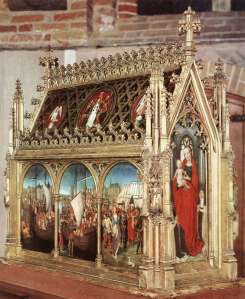
This is the central panel of “The Mystical Marriage of St. Catherine,” There is so much going on in this work and if you are interested I’m giving you a link. Notice the amazing fabrics, the flow of cloth, unbelievable details, luminous color in the interior scene as well as the town behind.In class you’ve asked what the outside panels look like so here is the back right panel. The altar would most of the time be closed and only opened for special ceremonies. The women are probably the nurses of the hospital at the time it was painted.Left side, showing the patrons who would have paid for the panel and officials of he hospital.Detail of St. Barbara (the equivalent of Rapunzel), notice her elaborate hairstyle.This reliquary that contains remains of St. Ursula (martyred with 11,000 virgins at Cologne) is quite elaborate. We talked about this work when looking at the Northern Europe Renaissance as an example of the cross over from Gothic to Renaissance. Each panel is like a stained glass window. I’m including a link so you can see the amazing detail and also the motionless and expressionless style of Memling.Side panel that shows Ursula about to be beheaded by the Huns. In the background you see the Cologne Cathedral where you will find the bones of the 11,000 virgins.I chose one portrait of a woman and one of a man. Sorry you can’t read their statements and what the wrote in their own hand.
Yesterday afternoon and evening we strolled through the town and today we packed in a lot of exploring and looking at art. So a little history to start. This city which is reduced to a very small historic district surrounded by a much larger city is a tourist destination for sure. Once again resolved never to travel in Europe in the summer. It’s crowded by manageable. The name of the town comes from the Viking word for wharf. From the start Bruges was an important trading center. In the 11th century it became wealthy based on it’s cloth trade. Lace and tapestry still abound though mostly in souvenir shops tucked in among the 600 Belgian Beer shops, chocolate shops, and every chain store from the US and other parts of Europe- it’s always a puzzle to me why you would leave home just to drop in on the H & M store in Bruges?!
By the 14th century the town’s population had grown to 35,000 as large as London at the time. Because of its location it was the middleman in the sea trade between Northern and Southern Europe. In the 15th century while England and France were killing each other in the Hundred Years’ War Bruges became a popular place to live for powerful French families. Needless to say commerce and art thrived. The artists Hans Memling and Jan van Eyck lived here.
But by the 16th century the harbor had silted up and the economy collapsed. The French went home, Belgium became part of the Habsburg empire and Bruges’ Golden Age came to an end. For many years it was considered a dead city. In the 19th century a new port revived the city and by the 20th century tourists discovered the town. It is a uniquely well preserved Gothic city and actually it’s not the worst place to be a tourist, especially if you stick to the side streets.
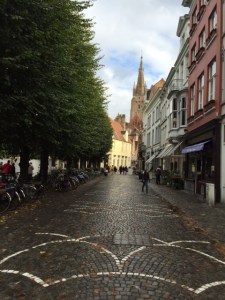
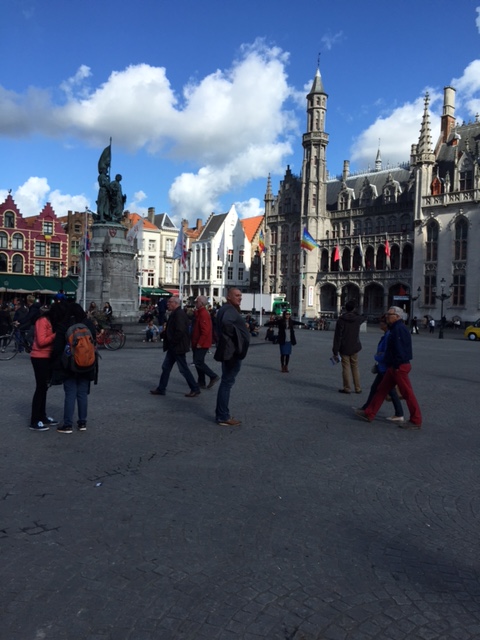
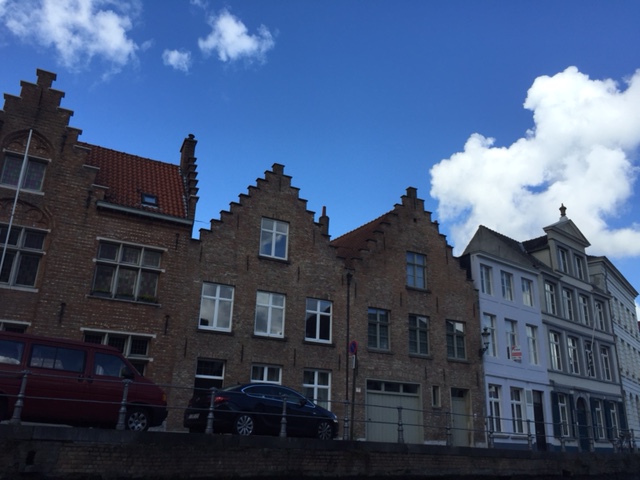
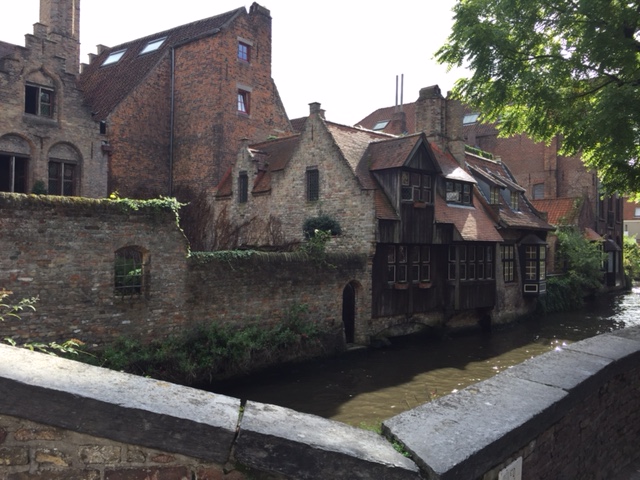
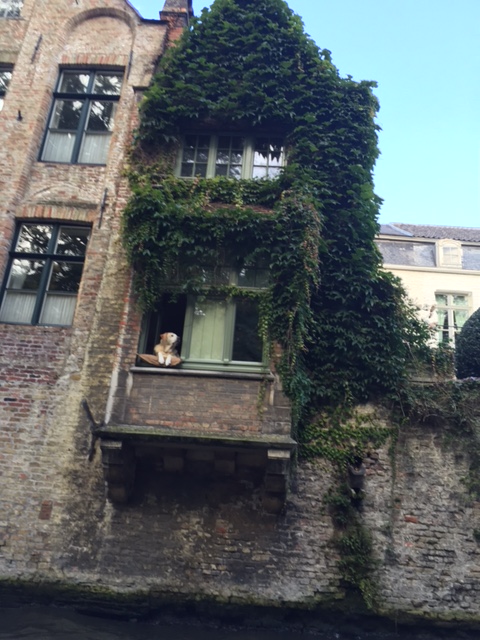
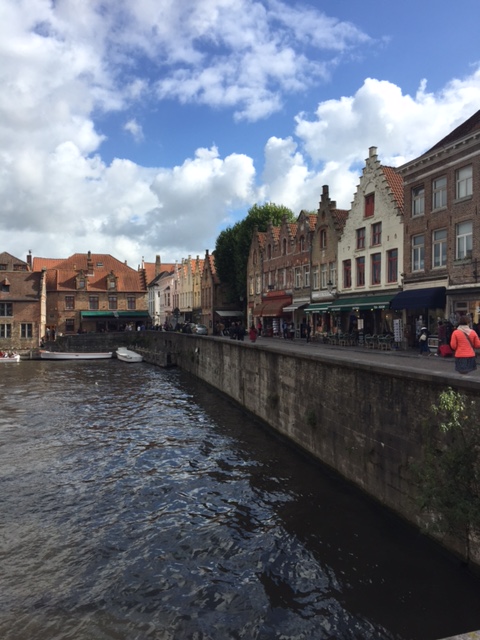
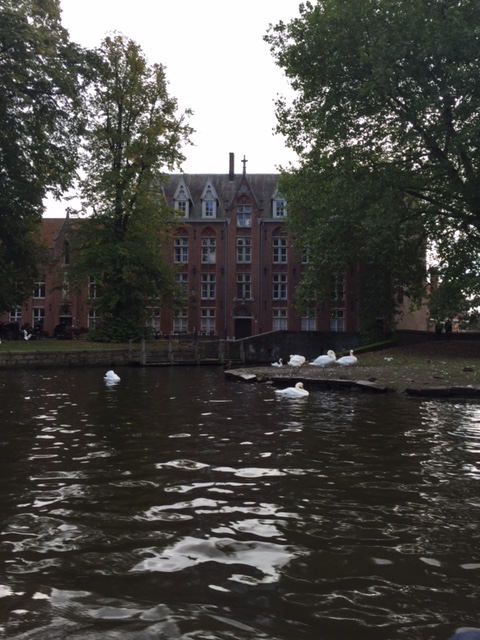
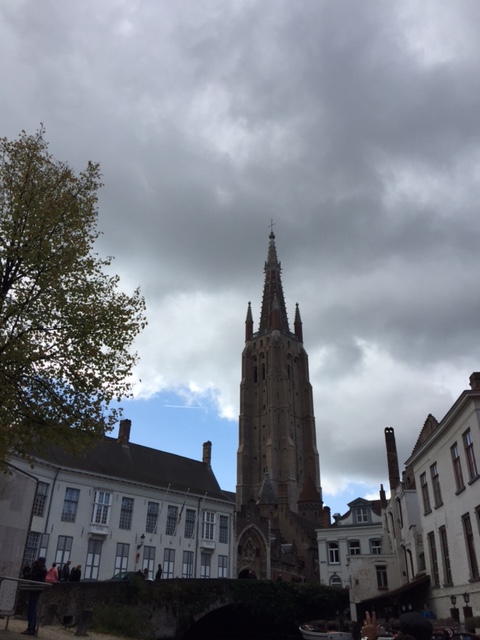
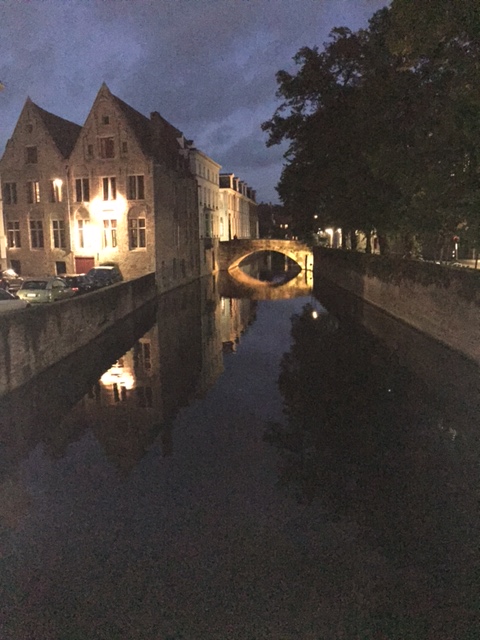
One of the first squares you come to upon entering the old part of Bruges (St. Stevinplein)The Markt Square is supposed to be one of the most enjoyable town squares in Belgium. As you can see it’s quite lively.The post office was rebuilt in the 19th century to out Gothic the Gothic style.Peaked and crenellated roofs along the canals are a hallmark of the Flemish style of architecture.This building had the date 1675 on the front.And here are some renovated, reconstructed, and brand new architecture that all fits very nicely together.These houses really make you feel as though you’ve gone back in a time machine to about the 1300s.The houses are along canals that run through the town center and have quite a few resident swans to add to the charm.Seeing the city from the water was an interesting perspective showing the variety of structures.A friendly face in the window. On the way back he (or she) was fast asleep.Shops and restaurants along the main canal.One of the canals has been dammed at the end to create a “Lover’s Lake” where there are 100s of swans and ducks.Church steeples and a bell tower dominate the skyline but it also helps orient oneself as to where you are in the narrow alleys.This arch has golden statues of one of the city’s prosperous families from the city’s Golden Ages on Blind Donkey Street.Going further afield for some quiet exploring we found the Lace Center where we saw beautiful lace from the 19th century to now. Yet again another church tower.And as is usually the case in a place where everything closes at 5 pm the best time to stroll is at night and the town sparkles.
Today was a travel day from the Netherlands to Belgium. We were reminiscing on the train about how before the European Union the train would stop at the borders of European countries and an official would come on the train and check everyone’s passport. That of course is a thing of the past unless you are a refugee trying to make your way to Europe. We haven’t seen any though have had numerous conversations about how this impacts all of Europe. Lots to look at our the window of the train. We traveled with our bicycles and had very little trouble making the connections. The challenge will be to find our way to the right road to Ghent, our next stop. For the next few days we are in Bruges, a beautiful historical city (at least the historical center is).
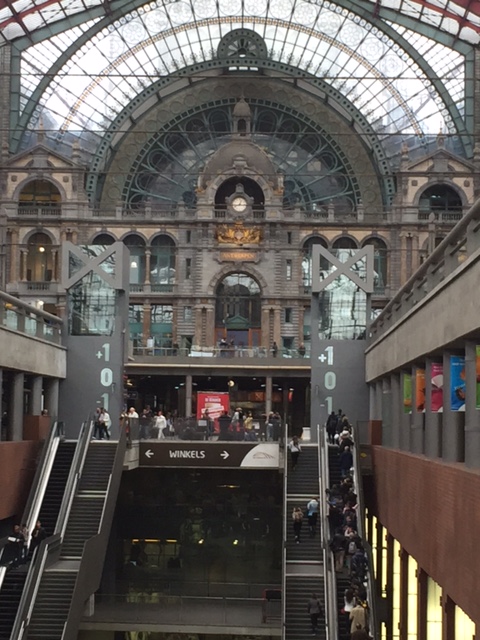
I never get tired of looking at a landscape that looks like the paintings and looking at paintings that look like the photographs.Pamela and her childhood friend chatting with the conductor. He’s showing us the high tech green light sign.Windmills are everywhere expected to provide up to 20% of the power for the Netherlands by 2020. Most are in the North Sea but you can see them across the landscape. A bit different from the windmills of yesteryear but obviously a good location for them.Crossing the border into Belgium a distinct difference in architecture, a lighter colored brick and buildings not so tall. Belgium is about the same size as Holland but has fewer people so they have more space.Elaborate graffiti on most trains and walls close to stations.The Central Station of Antwerp. We had to make our second train change here with the bikes. It was built 1895-1905. It’s another amazing thing that it wasn’t destroyed during World War II.The lobby of the train station in Antwerp, considered one of the greatest stations in the world (for architectural beauty).













































 Poetry Without Words