Art in Bruges takes all forms, from musical groups on the streets, to the requisite mimes, to installations of contemporary art and of course the art of the region in the museums. This is a good example of a city that has invited international artists to “respond” to the environment of Bruges with installations throughout the city. It is also a city whose museum is limited to artists who have had a relationship with the city hence, leaving out Belgian artists who have created amazing works of art and concentrating on native sons and daughters whose work is completely derivative and not so interesting. The not so primitive Flemish Primitives are of course the stars. Not much of interest past the 15th century in the Groeninge Museum.
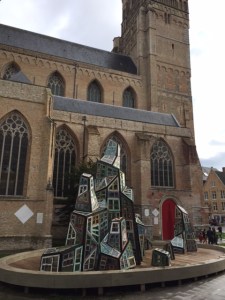
A Bach serenade in the Burg square. Check out the lute on wheels, and an accordion playing Bach! Quite good.A neon artist whose narrative single words and phrases appeared in interesting places. Food for thought?This odd shaped sculpture reflective on all sides in the center of the main square looks like one of the devices that was used to haul goods off the boats that would have moored there in the 15th century.Doors and windows make an interesting installation next to the St Steven church.
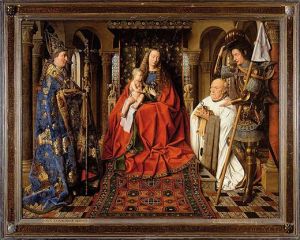
The exterior of the Groeninge Museum that exhibits work from the 15th to the 20th century. There are 10 galleries so it’s a relatively small venue though the collection is much larger.I wanted a better reproduction to share with you of this Hieronymus Bosch but could not find any other reference to it online. It’s a triptych of the “Trial of Job”.Detail of “Trial of Job” lower left hand corner. Has the definite imagery of a Bosch fantasy.Jan van Eyck’s “Virgin and Child with Canon Joris van der Paele” from 1436 is hardly “primitive”. It’s a spectacular image of luminous painting and incredible gem like details. A link for closer examination is attached.Rogier van der Weyden, Luke Drawing the Virgin from 1435 can be seen in our textbook for Northern European Renaissance. Luke was presumed to be an artist in his own right and is naturally the patron saint of artists. Notice the city of Bruges out the window.Last but not least is van Eyck’s portrait of his wife Margareta (1439) one of the first non religious portraits and a good match for van Eyck’s self portrait (the man in the red turban). If you saw it in reality you’d be amazed at how well van Eyck is able to portrait cloth, velvet, and fur. So much for “primitive artists”.Getting closer to modern times were some small etchings by James Ensor of the Virtues and Vices. Just like we guessed about the Breughels in class which one is this?
Hans Memling, Jan van Eyck, Rogier van der Weyden, Hugo van der Goes were amazing artists of the Flemish school of the 15th century. While Italy was in full blown Renaissance, northern Europe was still transitioning from the Gothic style and conventions of the Middle Ages. So these artists were called “primitives”. It’s a term that couldn’t be more misleading.
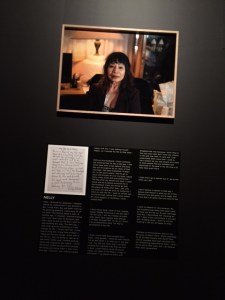
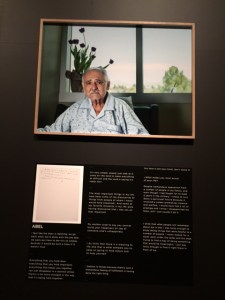
Hans Memling’s paintings were serene,motionless, expressionless scenes of extreme devotion that was quickly fading in the rest of Europe. He became extremely successful because Europeans who passed through Bruges fell in love with it, took it home with them and thereby affected art making in many other places. His work is exquisite in its painting quality, attention to detail and miniature elements, landscape, and of course ability to tell a story. The Memling Museum is located in the former St. John’s Hospital which actually functioned as a hospital until 1975. The museum has some of Memling’s best work combined with work of some of his peers and various hospital related tools, furniture, and depictions of medical care dating back to the Middle Ages. Upstairs was an interesting photographic exhibit by an American photographer (sorry forgot to write down his name) who spoke with hospitalized patients who were close to death and asked them about their illness, how they felt about dying, what they regret, who they love, do they believe in God (a fair number did not), and how do they want to be remembered. It was powerful especially in this place.
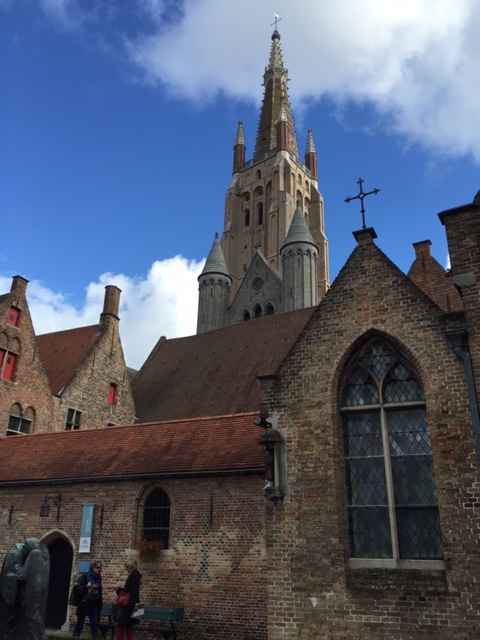
The Memling Museum is located inside St. John’s Hospital.From the canal side of the hospital an array of beautiful old windows.A display of medical instruments from the 15th century, in this case for eye surgery.How about this portrait of the eye surgeon? Hope his hair doesn’t fall into the victim’s (patient’s) eye.A devotional work by Memling from 1489 (Diptych of Martin van Nieuwenhove) includes some Renaissance elements that give it some realism. The figures appear to be occupying the same space in the same room and behind Mary is a tiny mirror that shows both their back’s as a device similar to Van Eyck’s mirror in the “Arnolfini Portrait”. Having the donor included in a portrait with Mary and Jesus gives him security for the world to come.Memling’s St John’s Altar in the main chapel, , 1474. This would be the place one would come to pray for healing for a family member or themselves in the hospital.
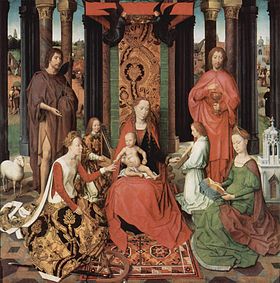
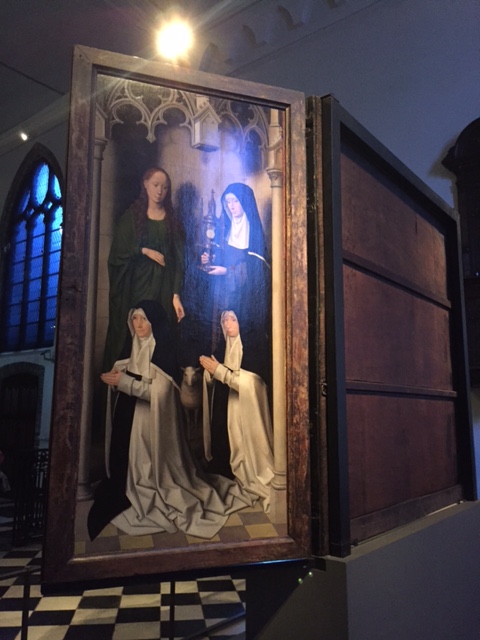
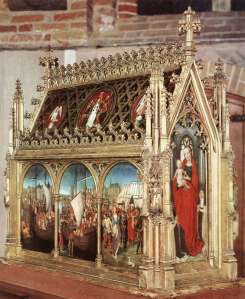
This is the central panel of “The Mystical Marriage of St. Catherine,” There is so much going on in this work and if you are interested I’m giving you a link. Notice the amazing fabrics, the flow of cloth, unbelievable details, luminous color in the interior scene as well as the town behind.In class you’ve asked what the outside panels look like so here is the back right panel. The altar would most of the time be closed and only opened for special ceremonies. The women are probably the nurses of the hospital at the time it was painted.Left side, showing the patrons who would have paid for the panel and officials of he hospital.Detail of St. Barbara (the equivalent of Rapunzel), notice her elaborate hairstyle.This reliquary that contains remains of St. Ursula (martyred with 11,000 virgins at Cologne) is quite elaborate. We talked about this work when looking at the Northern Europe Renaissance as an example of the cross over from Gothic to Renaissance. Each panel is like a stained glass window. I’m including a link so you can see the amazing detail and also the motionless and expressionless style of Memling.Side panel that shows Ursula about to be beheaded by the Huns. In the background you see the Cologne Cathedral where you will find the bones of the 11,000 virgins.I chose one portrait of a woman and one of a man. Sorry you can’t read their statements and what the wrote in their own hand.
Yesterday afternoon and evening we strolled through the town and today we packed in a lot of exploring and looking at art. So a little history to start. This city which is reduced to a very small historic district surrounded by a much larger city is a tourist destination for sure. Once again resolved never to travel in Europe in the summer. It’s crowded by manageable. The name of the town comes from the Viking word for wharf. From the start Bruges was an important trading center. In the 11th century it became wealthy based on it’s cloth trade. Lace and tapestry still abound though mostly in souvenir shops tucked in among the 600 Belgian Beer shops, chocolate shops, and every chain store from the US and other parts of Europe- it’s always a puzzle to me why you would leave home just to drop in on the H & M store in Bruges?!
By the 14th century the town’s population had grown to 35,000 as large as London at the time. Because of its location it was the middleman in the sea trade between Northern and Southern Europe. In the 15th century while England and France were killing each other in the Hundred Years’ War Bruges became a popular place to live for powerful French families. Needless to say commerce and art thrived. The artists Hans Memling and Jan van Eyck lived here.
But by the 16th century the harbor had silted up and the economy collapsed. The French went home, Belgium became part of the Habsburg empire and Bruges’ Golden Age came to an end. For many years it was considered a dead city. In the 19th century a new port revived the city and by the 20th century tourists discovered the town. It is a uniquely well preserved Gothic city and actually it’s not the worst place to be a tourist, especially if you stick to the side streets.
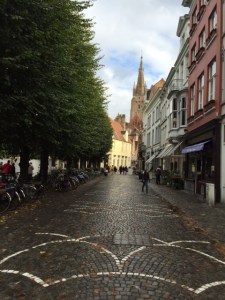
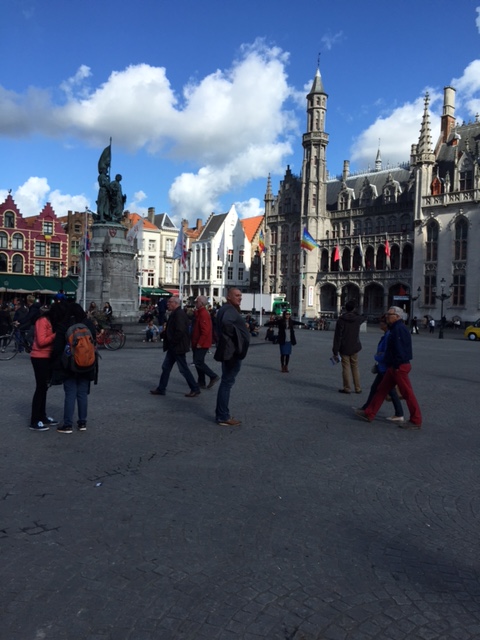
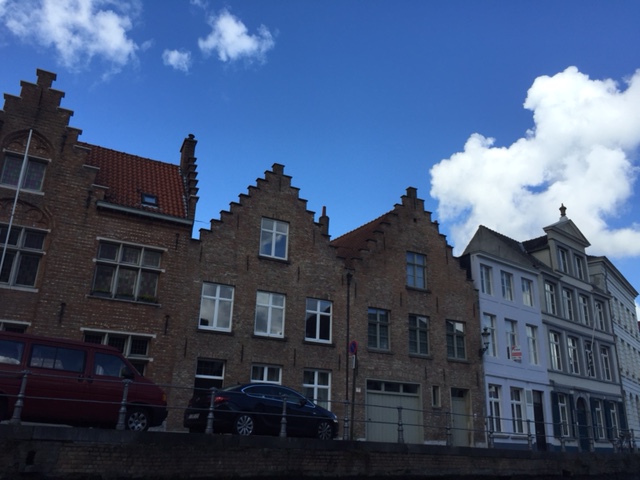
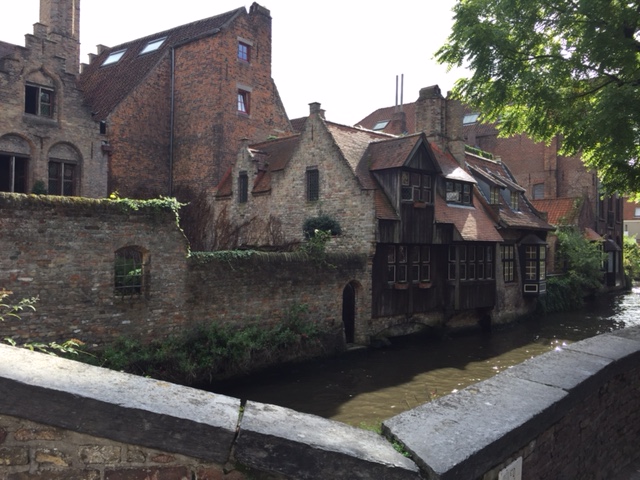
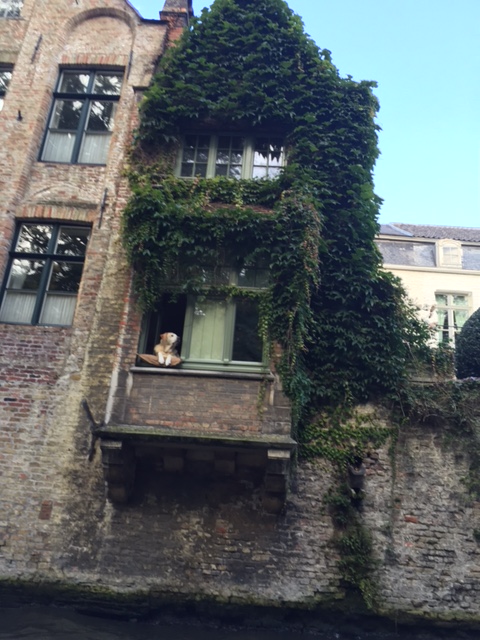
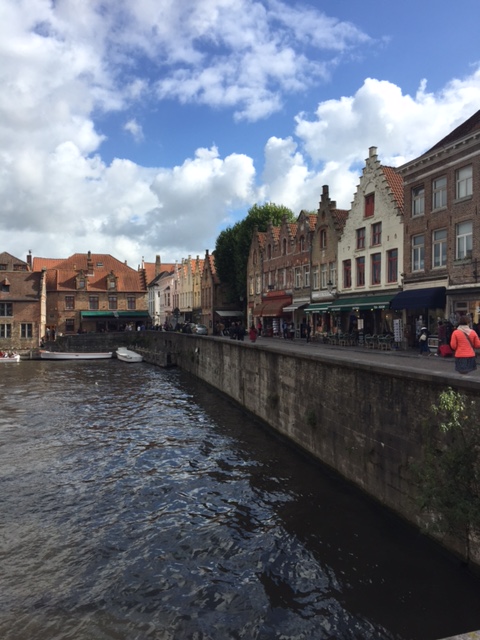
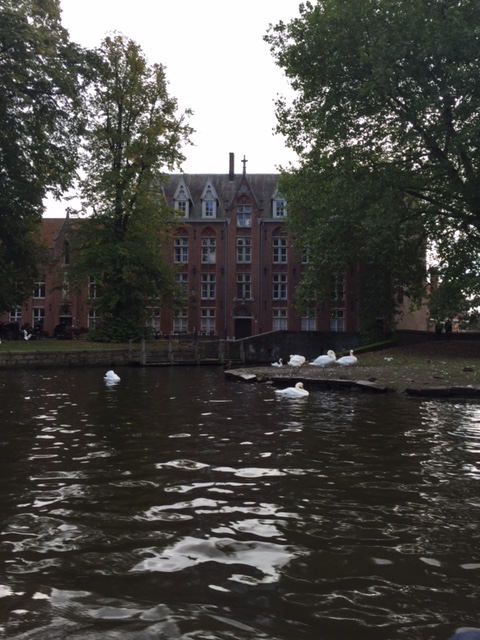
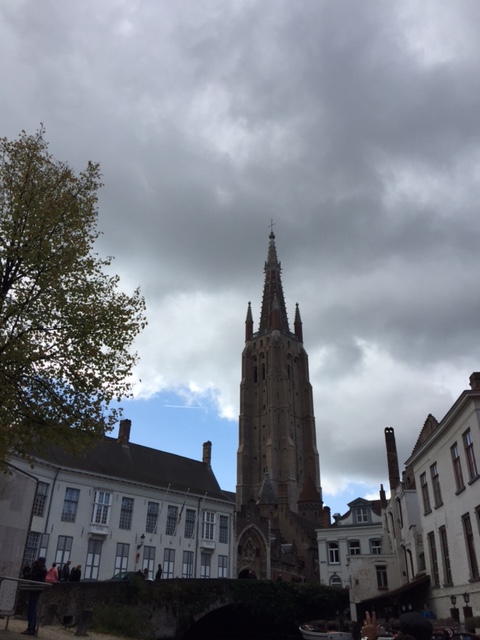
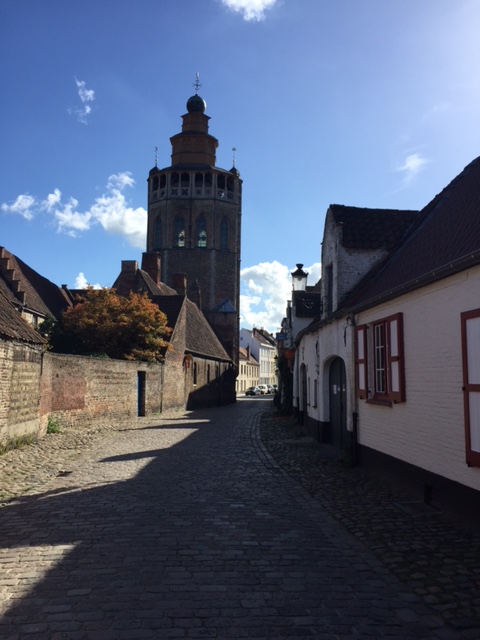
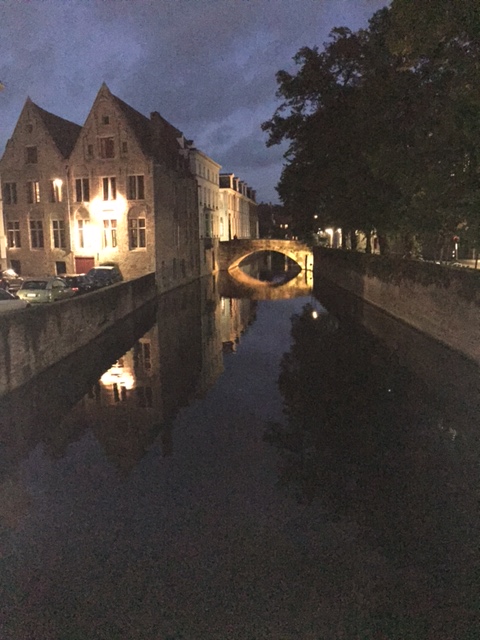
One of the first squares you come to upon entering the old part of Bruges (St. Stevinplein)The Markt Square is supposed to be one of the most enjoyable town squares in Belgium. As you can see it’s quite lively.The post office was rebuilt in the 19th century to out Gothic the Gothic style.Peaked and crenellated roofs along the canals are a hallmark of the Flemish style of architecture.This building had the date 1675 on the front.And here are some renovated, reconstructed, and brand new architecture that all fits very nicely together.These houses really make you feel as though you’ve gone back in a time machine to about the 1300s.The houses are along canals that run through the town center and have quite a few resident swans to add to the charm.Seeing the city from the water was an interesting perspective showing the variety of structures.A friendly face in the window. On the way back he (or she) was fast asleep.Shops and restaurants along the main canal.One of the canals has been dammed at the end to create a “Lover’s Lake” where there are 100s of swans and ducks.Church steeples and a bell tower dominate the skyline but it also helps orient oneself as to where you are in the narrow alleys.This arch has golden statues of one of the city’s prosperous families from the city’s Golden Ages on Blind Donkey Street.Going further afield for some quiet exploring we found the Lace Center where we saw beautiful lace from the 19th century to now. Yet again another church tower.And as is usually the case in a place where everything closes at 5 pm the best time to stroll is at night and the town sparkles.
Today was a travel day from the Netherlands to Belgium. We were reminiscing on the train about how before the European Union the train would stop at the borders of European countries and an official would come on the train and check everyone’s passport. That of course is a thing of the past unless you are a refugee trying to make your way to Europe. We haven’t seen any though have had numerous conversations about how this impacts all of Europe. Lots to look at our the window of the train. We traveled with our bicycles and had very little trouble making the connections. The challenge will be to find our way to the right road to Ghent, our next stop. For the next few days we are in Bruges, a beautiful historical city (at least the historical center is).
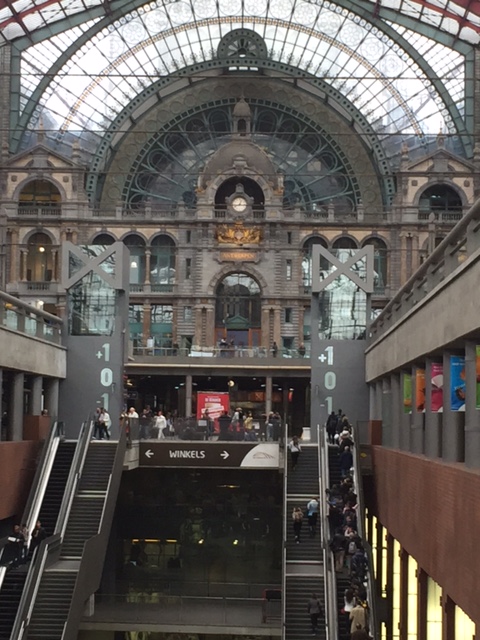
I never get tired of looking at a landscape that looks like the paintings and looking at paintings that look like the photographs.Pamela and her childhood friend chatting with the conductor. He’s showing us the high tech green light sign.Windmills are everywhere expected to provide up to 20% of the power for the Netherlands by 2020. Most are in the North Sea but you can see them across the landscape. A bit different from the windmills of yesteryear but obviously a good location for them.Crossing the border into Belgium a distinct difference in architecture, a lighter colored brick and buildings not so tall. Belgium is about the same size as Holland but has fewer people so they have more space.Elaborate graffiti on most trains and walls close to stations.The Central Station of Antwerp. We had to make our second train change here with the bikes. It was built 1895-1905. It’s another amazing thing that it wasn’t destroyed during World War II.The lobby of the train station in Antwerp, considered one of the greatest stations in the world (for architectural beauty).
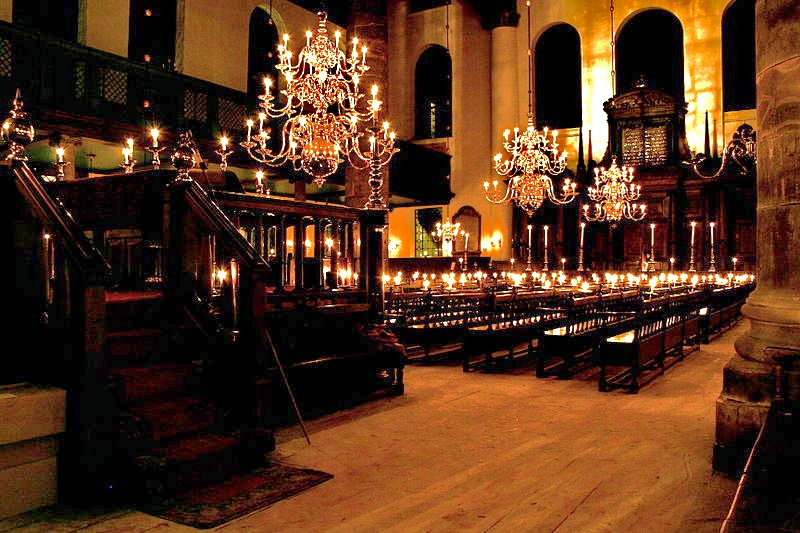
Before departing for our adventure in Belgium we attended Yom Kippur services at the synagogue in Amsterdam from the 17th century. In the interest of full disclosure, I did not take the photograph of the synagogue interior as it’s disrespectful to photograph during a religious service. The photograph comes from the internet. The synagogue is used for cultural events as well as religious services. We also took some nice walks and have overall had a lovely and relaxed time in Holland.
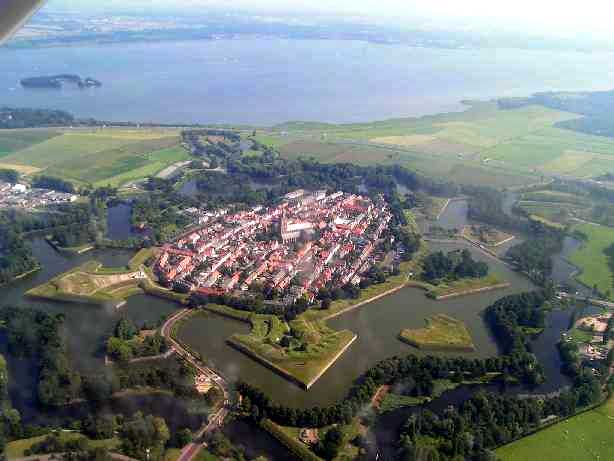
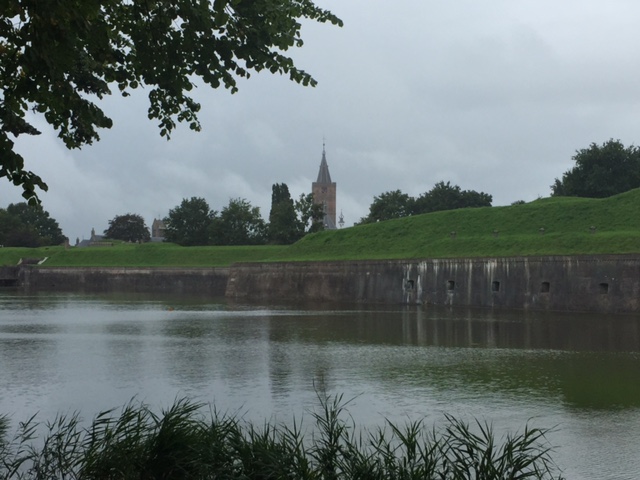
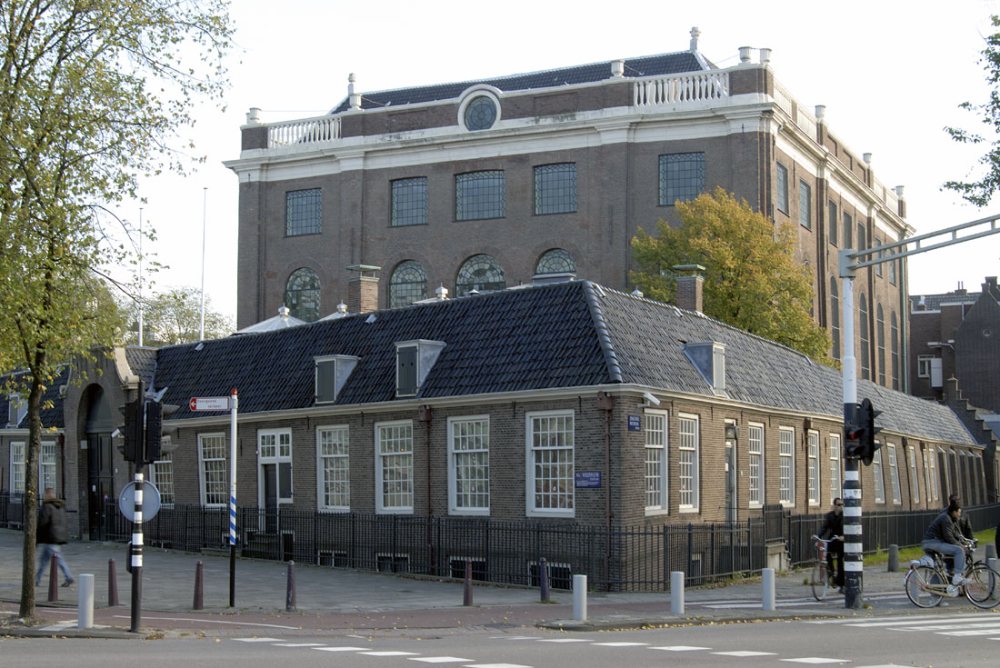
An aerial view of Naarden to give you the complete view.Just before leaving for our trip to Belgium we rode our bikes (a short preparatory ride) around the walls of Naarden a walled city in a star pattern with complete walls and moat from 1300. The church may even predate that.The Esnoga (Portuguese synagogue) built in the 17th century by Spanish and Portuguese Jews who fled Spain in the Inquisition. It has no electricity and is lit completely with candles. It was magical to be there for the evening service for Yom Kippur.Inside the lower buildings you see is a large cobblestoned courtyard. Once it got dark and you could see the glow of candlelight inside and children running around playing games outside, it was easy to imagine being there in the early 1700s.The large and imposing building that is the synagogue is in a very central location in Amsterdam. Somehow it survived World War II unscathed. Not sure why.
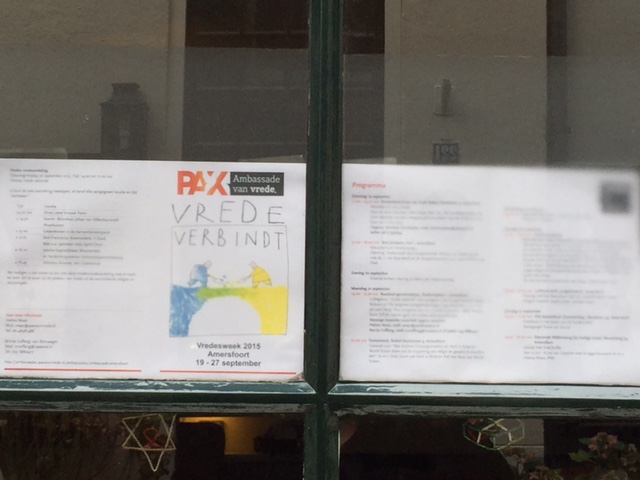
In typical Dutch fashion this household has named itself an embassy of peace. Let’s hope for that in the coming year.A pond near Bussum to start off our new year. One can see how much water is in the life of this country. They are always trying to get rid of it and we are craving it. Let’s hope we get some this year. Apparently these ponds were dug to take earth to Amsterdam for landfill. They now are slow moving bodies of water with lush vegetation all around.Sheep in the woods keep the grass mowed and wonder around at will. We biked to a lovely cafe to get out of the rain.
On the opposite end of the spectrum from the Dutch Baroque, is Piet Mondrian, the father of de Stijl a non-objective artistic style. He was born in Amersfort, about a 30 minutes train ride from Bussum. It was a lovely quiet town to stroll around and we enjoyed the visit to Mondrian’s birthplace. Mondrian moved to Paris where he was greatly influenced by Picasso, Duchamp, and Leger among others. He immigrated to the US in 1938 when he feared that things would go quite badly for artists in Europe under Nazi rule. While it doesn’t exactly fit with the subject here I’m including a photo of Rembrandt’s house that I neglected to send in the last post.
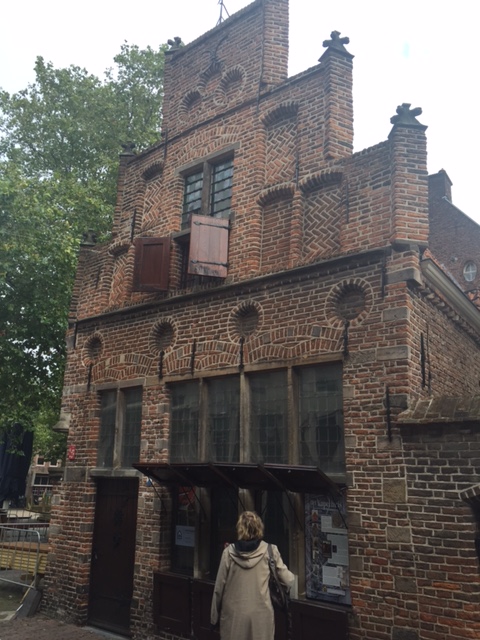
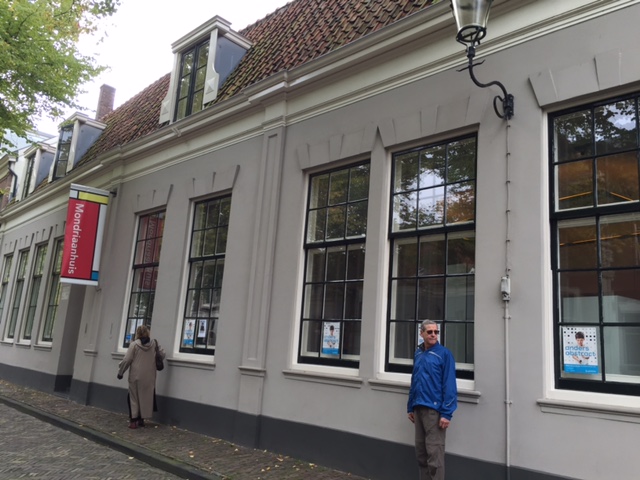
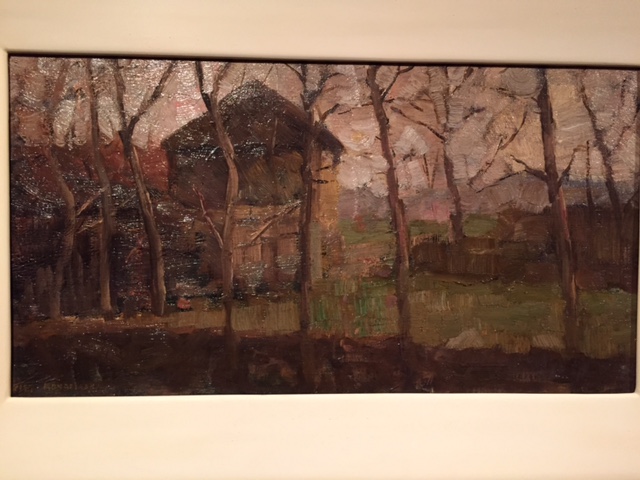
Rembrandt’s house in the center of Amsterdam. The building shows the extensive costume collection that Rembrandt used on his models and the museum next door specializes in drawings and prints.The center of Amersfort, the birthplace of Mondrian. Canals and narrow tall houses as usual.The church in Amersfort is from the Romanesque period and is well known because it is located in the exact center of Holland.The cost to the Netherlands during World War II was in loss of life rather than loss of property with the exception of Rotterdam which was leveled by bombs. This building was built in 1445.These old windows are magnificent examples of old glass that is a bit mottled.Piet Mondrian’s home, a very interesting place to learn about this artist’s life. Most of his art is in museums around the world. This building looks like a school because it was. His father was a schoolmaster and the family lived in the school.There was a small show of early drawings and paintings. You can see that Mondrian started in a very traditional manner but you can see how his early work morphed into his later constructivist works.An early Mondrian landscape painting, very much in the Impressionist mode. The museum had a video that showed early works actually morphing into later works.Mondrian’s Paris studio recreated in the museum. It was complete with the man himself (video projected on the wall). Pamela and Mondrian got into a deep conversation.
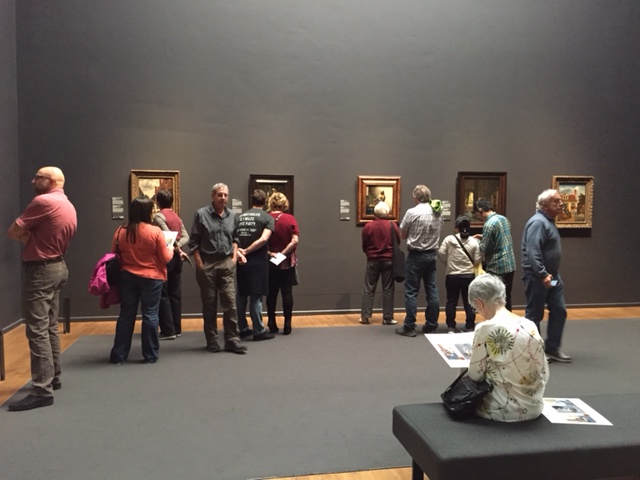
The last time I was in Amsterdam, the Rijksmuseum was closed for a long renovation. It is now reopened and it was a thrill to visit. Some of my favorite paintings live there and getting to see art “in the flesh” is always a thrill no matter how many times you do. The Rijksmusem has a collection of one million objects but they don’t try to display everything all the time. I enjoy museums like that where one is not overwhelmed. We spent most of our time in the Dutch Baroque galleries (1600-1700). For the most part I’m including photographs I took myself so forgive the lopsided funny frames.
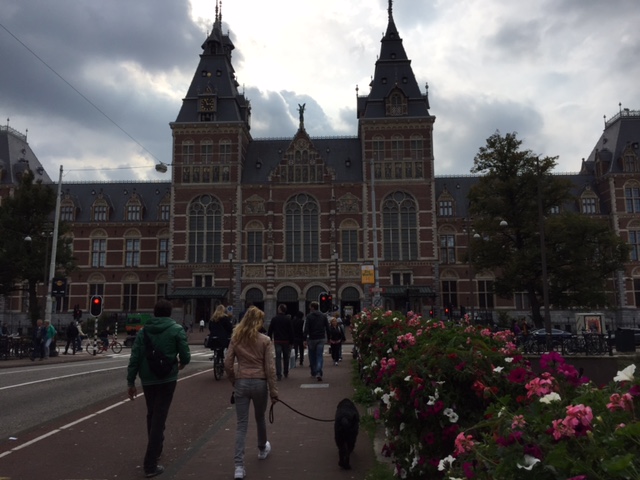
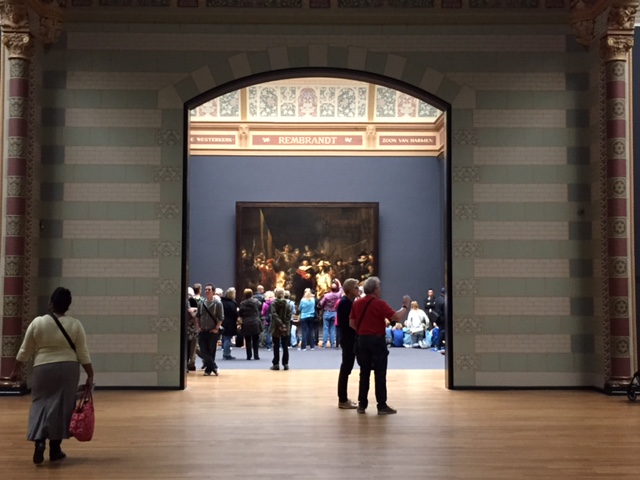
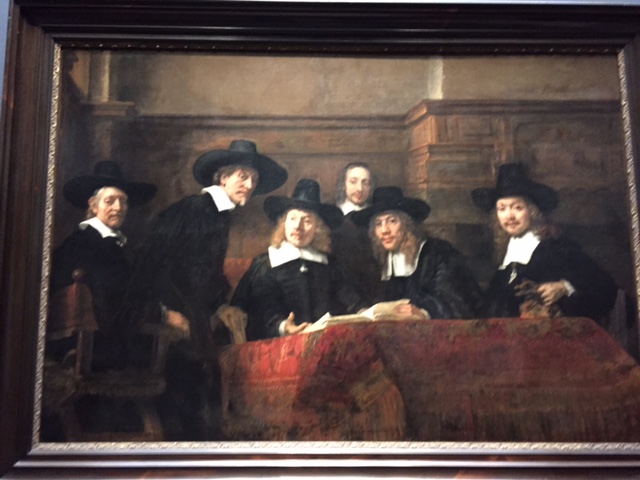
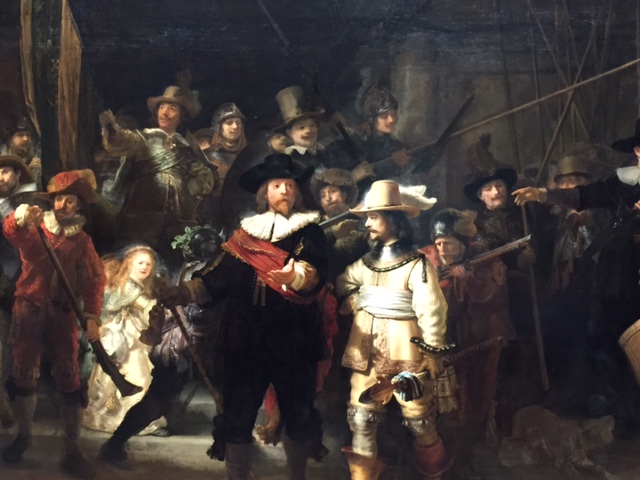
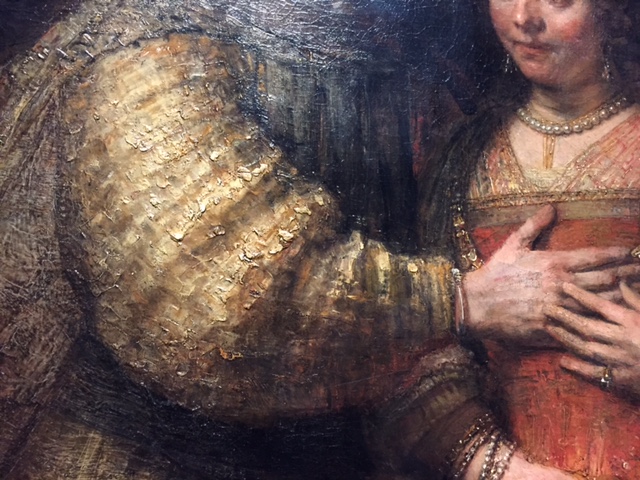
The Rikjsmuseum was built in the late 19th century to house the national collection of the Netherlands. Among the treasures are artists of the Baroque including Rembrandt, Vermeer, Ruisdael, and Steen. There are also galleries of every period of Dutch art from the Middle Ages to the 21st Century. Some galleries are devoted to Asian art particularly from Dutch colonies of the 17th and 18th centuries.Certainly the most famous painting in the museum is Rembrandt’s “Militia Company of Captain Frans Banning Cocq”, also called the Night Watch. As you can see it’s a popular destination in the museum. It was never sold and became part of the Dutch National Collection and is considered priceless. In Art 1A we are discussing the value of art so this is an interesting one to consider. Yesterday the Rijksmuseum paid $180 million for two Rembrandt paintings to keep them from going to private collections. Half the money came from the Dutch government and the other half from the museum. Can you imagine that happening in the US?Rembrandt’s “Sampling Officials” is an example of portrait painting from the 17th century where each individual paid to have their portrait included. Of course, each one had to hold an important spot in the painting to be satisfied so the challenge was how to make they all look good but make it an interesting painting compositionally. You can see a master at work here.This painting was called the “Night Watch” because it was so dark from years of dirt that some of the figures completely disappeared. One thing I never noticed before is how the foreshortened hand of the Captain that is coming out towards us casts a shadow on the yellow jacket of the figure next to him. Also notice the foreshortened spear. The blue tassle close to the point has very thick paint that really gives the feeling of ropes.Rembrandt’s “Jewish Bride” has undergone extensive restoration as has the museum and is luminous. As we’ve discussed in several different classes, hands are the hardest thing to draw or paint and check out the hands here. You don’t get much better than this.The challenge of looking at reproductions is it’s so hard to see the paint surface and Rembrandt’s impasto (thick paint) makes the fabric come alive.
This alcove gallery features three Vermeers, pretty remarkable considering he only painted about 30 in total. Right in the center is “The Milkmaid”.
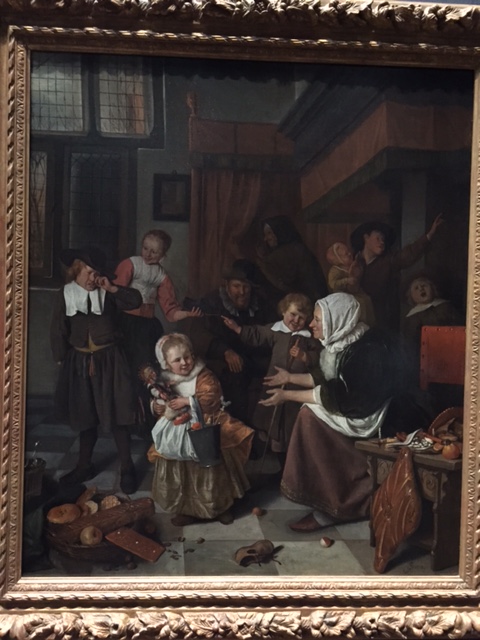
If you are Mendocino College Art 202 you have already seen this image of “St. Nikolaus” by Jan Steen. If you are in CR’s 1B you will be learning about this artist in a couple of weeks. I learned that I was wrong about it’s interpretations (allegorical). The little girl in the foreground is not being chastised for taking the doll, she’s been given the doll for being such a generous child and it’s the little boy who is dissatisfied with the treat she gave him.
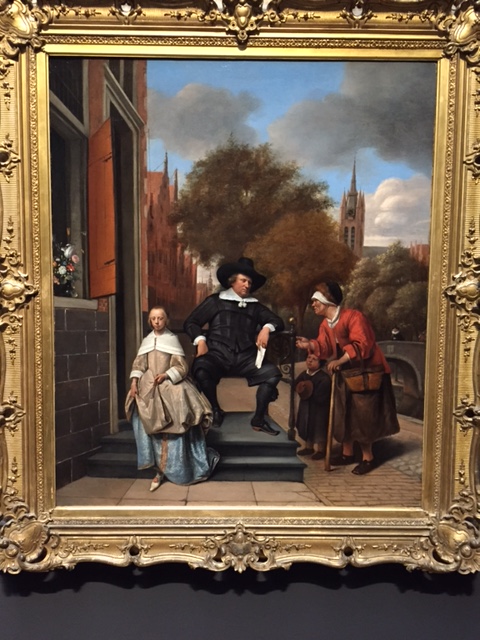
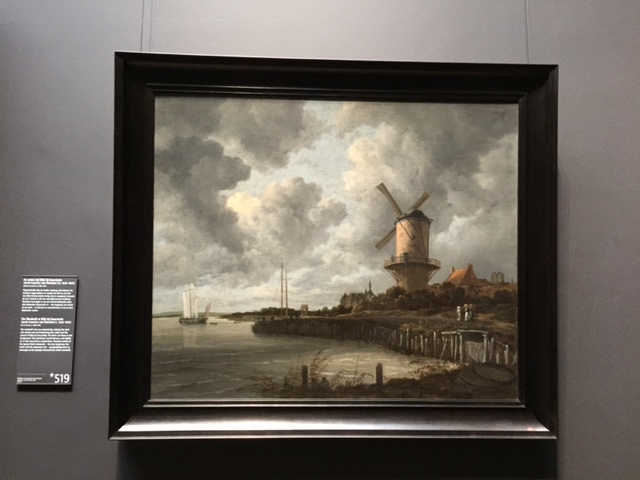
This portrait of a wealthy man and his daughter also by Jan Steen is a little odd because it shows a beggar woman and child. Why would someone want them in their portrait? Is it an allegory about generosity or stinginess? If the latter, it’s hard to imagine the sitter would want to pay for the portrait.Genre painting is a hallmark of Dutch painting of the 17th century. Genre painting depicts daily life and sometimes is an allegory of moral or religious content. In this case, always one of my favorites is a painting by Pieter de Hooch of a mother picking out lice nits from her daughter’s head, something most mothers have experienced along the way.My last post was of a real Dutch landscape though it did not have the windmill or water. If you look at any of the photo images of this country they have the same light and perspective of paintings like this one by Jakob Ruisdael. I’ll have more to share in the next few days.
The Netherlands is quite a civilized place, very quiet (even the dogs), and in addition to efficient trains and trams as in other parts of Europe bike culture is very strong. Not only for individuals to get from place to place but for transporting the children, pets, and goods. There are designated bike lanes, crossing lights especially for the bikes, and rentals at every train station. Of course, in the big cities the canals are a major source of transport as well.
Obviously the driver of this barge has a lot of experience with making turns in a canal, dragging a load behind him. Looks like he’s better than most of the RV drivers who come to Mendocino.
We picked up our bicycles that will be our primary mode of transportation this week. They say the Dutch are born on the bicycle and everyone has one. Of course, the Americans are the only ones protecting their heads with helmets.
Bicycle buddiesCrossing the heath
Holland is the most densely populated country in Europe because it is so small. People live in very crowded towns that allow for farmland and open space in between. We rented our bikes in one town and rode 3 miles back to Bussum through the open land you see. Notice how much this looks like Dutch landscape, especially the expanse of sky.
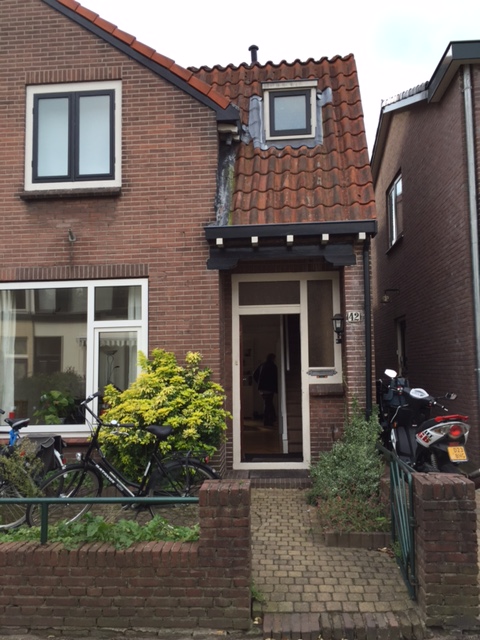
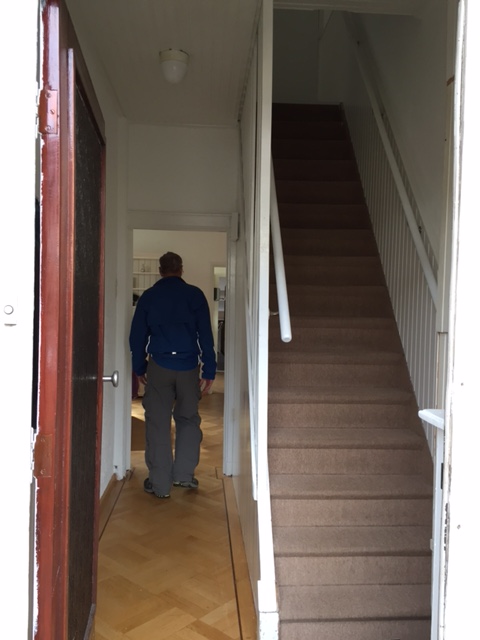
Bussum HouseStairs not for the faint hearted
This is the house of our friends Buz and Pamela Graham in a town close to Amsterdam. The town was established in the 18th century for wealthy people who wanted to escape the city. There are some large houses but in this neighborhood lived the people who “served” the wealthy like the butcher, the baker, and the candlestick maker. The houses are basically duplexes very close together, narrow, and tall to save space. In a tall narrow house the stairs are very steep. One does not go up and down quickly.
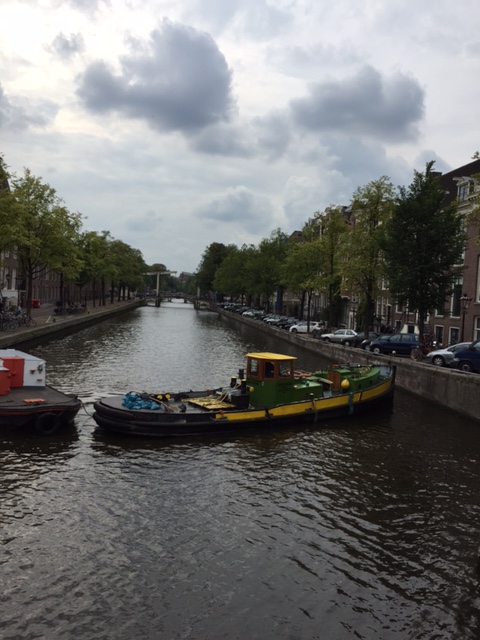
Typical CanalHouseboats
In Amsterdam one crisscrosses the canals and at this time of year many of the bridges have beautiful flower baskets. All have houseboats with some that are quite elaborate and some look like watery slums. We heard a tour guide saying that at the end of World War II houseboats were a temporary housing solution that stuck. Can’t verify that one. Needless to say they look very permanently temporary.
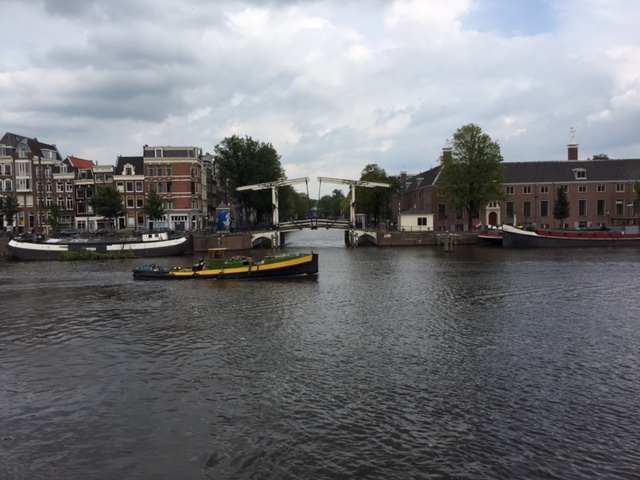
Have seen some very small cars since parking is quite a challenge in this city though bike parking can be had fairly easily. Many canals have these kinds of draw bridges. Van Gogh made one famous in a painting he completed in Arles. This one is on the main canal on the Amstel River.
































 Poetry Without Words